


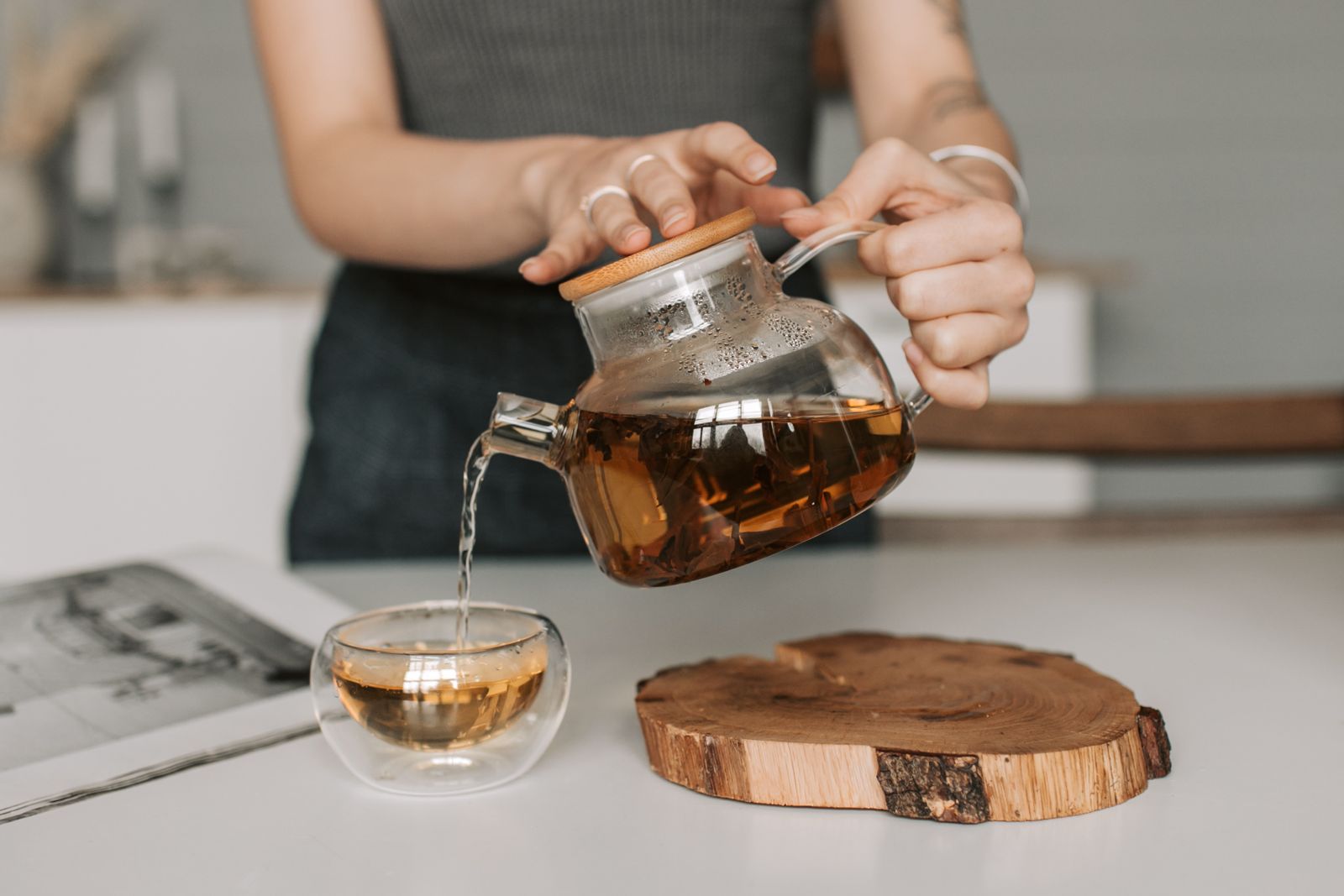
Tea: types, flavour and correct brewing
How white, green, oolong, black tea and pu-erh differ, why they all come from one plant, what water and temperature they need and how long to brew each type — with real parameters from our catalogue.
Tea
One and the same leaf gives white, green, oolong, black tea and pu-erh. The difference is not in the plant but in what was done to the leaf after picking — and in what you do with it in your kitchen.
1
plant behind every true tea
70–100 °C
working temperature range
160
products in our tea catalogue
Contents
- One leaf, six teas
- Green tea
- Matcha — a case of its own
- White tea
- Oolong
- Black tea
- Pu-erh
- Not tea, but in the teapot: tisanes
- Water: the thing there is most of in the cup
- Temperature and why it decides everything
- Dose and time: a table for every type
- Vessels and brewing methods
- Cold brewing
- Seven mistakes that ruin good tea
- Storage
- How to choose tea for the job
- Frequently asked questions
- In short
Tea is a drink almost everyone makes wrong and almost nobody suffers for it. It forgives a great deal: boiling water instead of eighty degrees, fifteen minutes instead of three, yesterday's brew. You get a brown liquid, people drink it, and nobody dies.
But the difference between »we drank it« and »that was good« comes down to exactly three decisions: which leaf, which water, how long. None of them needs equipment more expensive than a variable-temperature kettle and a kitchen scale — and usually not even that.
This text is about tea itself: how the types differ, what to do with them and what not to do. On how to build a venue's tea list and what a cup actually costs, we have a separate article; here it is about leaf and water.
One leaf, six teas
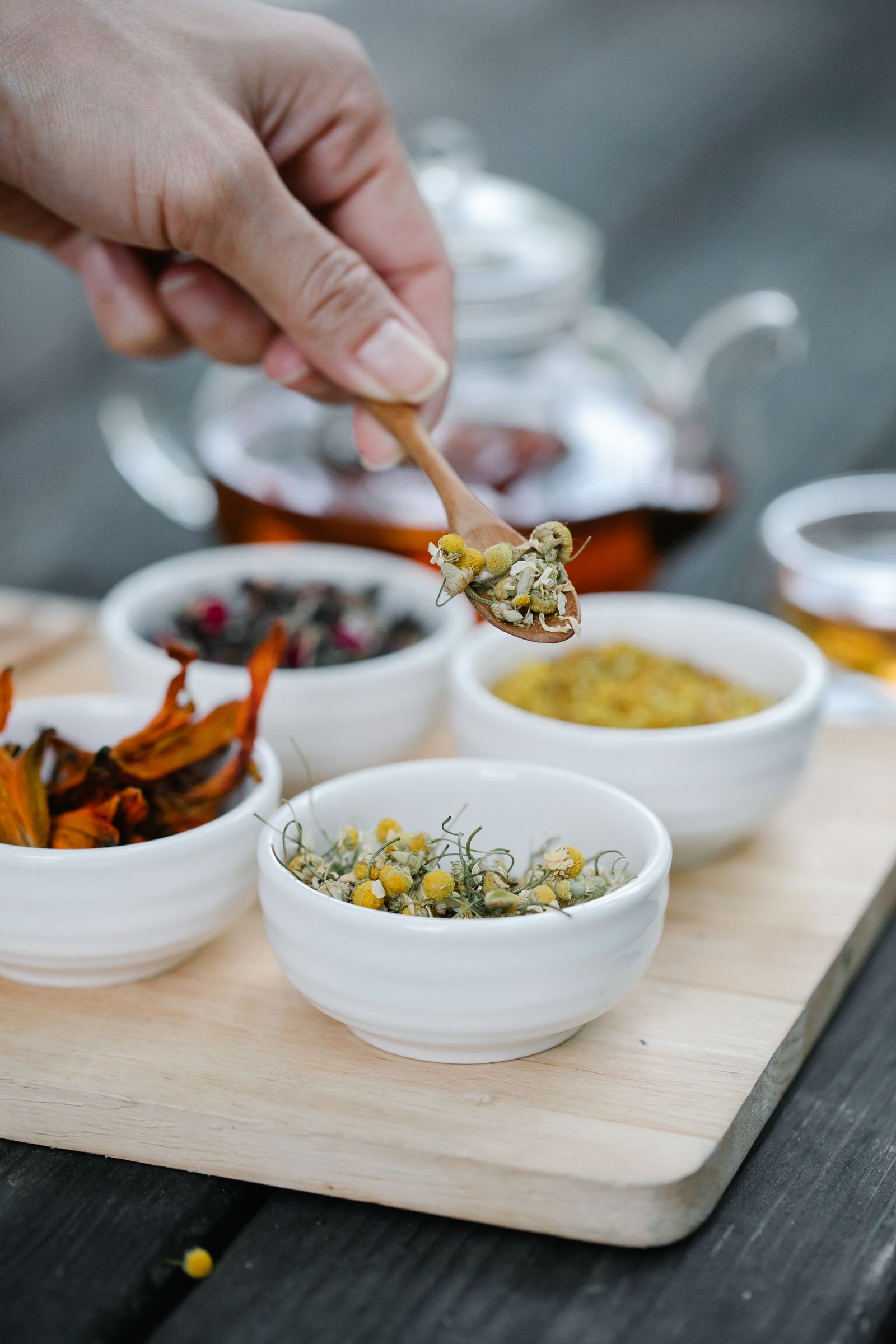
A fact that turns most people's idea of tea upside down: white, green, yellow, oolong, black tea and pu-erh are made from the leaves of one and the same plant — the Chinese camellia, Camellia sinensis. Not from different bushes, not from different families. From one.
The difference is created by processing, and its main process is oxidation. A fresh leaf contains enzymes which, once the cell walls are damaged, begin to react with the contents of the leaf. The longer that reaction runs, the darker the leaf, the denser and sweeter the flavour, and the less freshness and grassiness remain in it.
The producer controls this process with two levers: letting oxidation run or stopping it with heat. Heat kills the enzymes — from then on the leaf no longer darkens. The whole difference between types of tea comes down to at what moment the heat was applied and what was done to the leaf before that.
| Type | Degree of oxidation | What is done to the leaf | Character of the flavour |
|---|---|---|---|
| White | Minimal | Almost nothing: withered and dried | Light, sweetish, floral |
| Green | Stopped immediately | Steamed or pan-fired within the first hours | Fresh, grassy, sometimes with a marine note |
| Yellow | Slight, with a smothering stage | Like green plus a stage of »smothering« under cloth | Softer than green, without the grassy edge |
| Oolong | Partial, from 15 to 80 % | Withered, shaken, rolled, often roasted | The widest range: from floral to baked |
| Black | Complete | Rolled and left to oxidise fully | Dense, malty, with tannic astringency |
| Pu-erh | Fermentation by microorganisms | A separate process involving microflora, then ageing | Earthy, thick, with a »cellar« depth |
A common confusion: »fermentation« and »oxidation« are not the same thing. In everyday speech black tea is called »fermented«, and this has stuck so firmly that arguing is almost pointless. Strictly speaking, however, black tea production involves oxidation — a reaction of the leaf's own enzymes with atmospheric oxygen.
True fermentation, involving outside microorganisms, happens only in pu-erh production. That is exactly why pu-erh stands apart and behaves differently: it does not spoil with the years but changes, and a good aged pu-erh is valued above a young one.
Everything else brewed in a teapot — chamomile, mint, rooibos, fruit blends, hibiscus, maté — is not tea. These are tisanes, infusions of other plants. The name is colloquial and rarely causes confusion, but one practical difference matters: tisanes (apart from maté) contain no caffeine, and their brewing rules are completely different — more on that below.
Green tea
The most demanding category to handle and the most frequently ruined. Green tea is leaf whose oxidation was stopped within the first hours after picking. The leaf's original compounds are preserved to the fullest, and it is they that give the freshness it is drunk for.
Chinese and Japanese: a difference in how oxidation is stopped
Oxidation is stopped with heat, and the method of heating determines the tea's entire subsequent character.
- The Chinese school — pan-firing. The leaf is heated in a wok or drum over dry heat. The result is a flavour with a hint of nuts, toasted seeds, sometimes light smoke. The liquor is golden yellow. Classic examples are Chun Mee with its leaf rolled into an »eyebrow« and jasmine teas, where flowers are added to the finished leaf.
- The Japanese school — steaming. The leaf is treated with steam for a matter of tens of seconds. The flavour stays vividly green, grassy, with a characteristic marine, almost seaweed note and a pronounced umami sweetness. The liquor is greener and cloudier than the Chinese one. The main representative is sencha.
This is not a question of »better or worse«, these are two different drinks. To someone used to Chinese green, Japanese sencha often tastes »fishy«; to someone used to the Japanese, the Chinese tastes flat. If you have tried green tea and disliked it, you may simply have landed in the wrong school.
Parameters
In our catalogue green teas carry the parameters 70–80 °C, 2–3 minutes, 12–15 g per litre. This is also the answer to why most people's green tea is bitter: they pour boiling water over it.
At 100 °C the leaf rapidly releases catechins and tannins — the compounds responsible for bitterness and astringency. At 75 °C they pass into the liquor slowly, while the sweet amino acids pass quickly. Twenty-five degrees of difference turn an unpleasant drink into a pleasant one, and this is the cheapest of all possible improvements.
Green tea in the catalogue
Matcha — a case of its own

Matcha formally belongs to green tea but is prepared on an entirely different principle, and this is worth treating separately, because the mistake here is the most widespread of all.
Matcha is not steeped — it is whisked. This is not an infusion, it is a suspension: the leaf, ground to powder, stays in the cup in its entirety and you drink it. Hence the different dosage, the different vessel and the different behaviour in the cup.
How it works
Matcha bushes are shaded for several weeks before picking. In response the plant builds up chlorophyll and amino acids — the leaf becomes darker and sweeter. After picking it is steamed, dried, stripped of its veins and ground on stone mills to a powder. The grinding is slow: fast grinding would heat the powder and spoil the flavour.
Hence the price. Ceremonial matcha is the top leaves of a shaded bush, ground slowly and in small quantity. Culinary matcha is coarser, darker, bitter — perfectly fine for a latte with milk and sugar, but not for a plain drink.
Parameters and technique
The dosage in the catalogue is 1–1.5 g per 100 ml, water at 70–80 °C, whisking for about 20 seconds. No »three minutes of steeping«: the powder does not steep, it is suspended.
- Sift it. Matcha cakes into lumps, and a lump is not broken up by the whisk — it stays a lump and floats. A sieve removes the problem entirely.
- Warm the bowl. Cold ceramic takes enough heat out of a small volume of water for it to be noticeable.
- Add a little water and work it into a paste, then add the rest. This is more reliable than pouring the whole volume at once.
- Whisk with fast zigzag strokes, not in circles. Circular strokes chase the powder around the walls; the zigzag creates foam.
- Drink it straight away. After a couple of minutes the powder settles and the drink separates into water on top and sediment below.
Why café matcha is often bitter. Three reasons, in order of frequency: culinary grade instead of ceremonial, boiling water instead of seventy degrees, and keeping the powder too long in an open tin — matcha oxidises in air faster than any other tea and within a month in open packaging it fades in both colour and flavour. A sealed tin in the fridge solves the third problem; the first two are solved by grade selection and a thermometer.
White tea
The least processed tea of all: the leaf is picked, allowed to wither and dried. No rolling, no firing, no oxidation beyond what happened by itself.
The classics of the category are Bai Mu Dan (»White Peony«) from a bud with two leaves and Yin Zhen (»Silver Needles«) from unopened buds alone, covered in silvery down. The needles cost more: a bush carries incomparably fewer buds than leaves, and they are picked by hand within a narrow window.
What to expect from it
White tea is subtlety, not strength. The liquor is pale, almost straw-coloured. The flavour is soft, with honeyed sweetness, a melon or floral note, sometimes a light downy feel in the mouth from that very fuzz on the buds. It does not hit the palate, and that is not the point of it.
That is exactly why white tea most often disappoints on first acquaintance: someone used to strong black tries it and says »water«. And it is almost water — that is the design. It is drunk in the morning before food or during the day when density is not wanted, and it is the only true tea that takes the heat well and drinks cold without losing its character.
Parameters
In the catalogue — 70–80 °C, 1.5–2 minutes, 12–15 g per litre. The short time should not surprise: the leaf is not rolled, the compounds come out fast, and over-steeping gives not strength but a papery dryness in the mouth.
Separately: white tea stands up very well to repeat infusions — the second and third are often more interesting than the first. If you brew in a pot for one person, it is worth pouring over the same leaf again rather than discarding it after the first cup.
White tea in the catalogue
Oolong
The most varied category and the most interesting for anyone who wants to understand what tea is actually capable of. Oolong is partial oxidation, and »partial« here means anything from fifteen to eighty per cent. The spread is such that two oolongs may have nothing in common.
Two poles
- Lightly oxidised, »green« oolongs. Rolled into tight pellets that unfurl in hot water into whole leaves. The flavour is floral, creamy, with a lilac or orchid note. In feel closer to green tea, but denser and softer.
- Heavily oxidised and roasted oolongs. Dark rolled leaf, a baked flavour with notes of dried fruit, caramel, sometimes wood resin. In feel closer to black, but without its tannic edge.
Between these poles lies the whole range. If green seems too grassy and black too sharp, an oolong is almost certainly what you want: it occupies exactly that middle ground.
Parameters and multiple infusions
In the catalogue oolongs run at 80 °C, 2–4 minutes, 12–15 g per litre. But the main thing about oolong is not in those numbers — it is that it is made for several infusions.
A leaf rolled into a pellet unfurls gradually. The first infusion takes the surface layer, the second the opened middle, the third and fourth what was in the tightest core. The flavour changes from infusion to infusion, and this is not degradation but development: the third is often the most interesting.
In practice: take a smaller vessel and more leaf, pour for a short time and repeat. The same oolong brewed »in a mug for three minutes« and brewed in a small pot in successive infusions are two different experiences, and the first is much the poorer.
Oolong in the catalogue
Black tea
What Europe calls black tea, China calls red — after the colour of the liquor, not the leaf. This is fully oxidised leaf, the most straightforward and most universal category.
What determines the flavour
Origin. Assam gives malty density and holds milk well. Ceylon is brighter, citrusy, with noticeable acidity. Darjeeling is light, muscatel, the »champagne among teas«, and will not tolerate milk. Kenya is strong and even, the backbone of most bagged blends. Lapsang Souchong stands apart: it is dried over pine-wood smoke and the flavour comes out frankly smoky — a tea people either love or cannot stand, with almost no opinions in between.
Leaf size. The marking on the packet is not quality but size and method of processing:
| Marking | What it is | How it behaves |
|---|---|---|
| OP (Orange Pekoe) | Whole rolled leaf | Brews slowly, the flavour is finer, it forgives over-steeping better |
| BOP (Broken OP) | Broken leaf | Gives up strength and colour faster, easier to over-steep |
| Fannings | Fine grade | Very fast extraction, the typical filling of tea bags |
| Dust | Tea dust | Maximum strength in minimum time, minimum subtlety |
The »Orange« in Orange Pekoe has nothing to do with the fruit — by the common account it is a reference to the Dutch House of Orange. There are no citrus notes in OP, and buyers expecting an orange flavour are regularly surprised.
Parameters
The catalogue values for black tea are 100 °C, 3–5 minutes, 12–15 g per litre. This is the only category of true tea that genuinely needs boiling water: the leaf is fully oxidised and there is almost nothing left to extract beyond what high temperature takes.
On milk: it makes sense for dense Assams and strong blends, where it softens the tannins. For Darjeeling, Lapsang and fine Ceylons, milk simply destroys what they were bought for. The British debate over »milk first or tea first« has a technical explanation: pour hot tea into milk and the protein heats gradually; do it the other way round and the first drops of milk take a thermal shock and curdle in spots. There is a difference in taste, though a small one.
Black tea in the catalogue
Pu-erh
The only tea that is genuinely fermented — with the involvement of microorganisms, not just the leaf's own enzymes. And the only one produced with years of ageing in mind.
Sheng and shou
- Sheng, »raw« pu-erh. The leaf is processed minimally and left to mature naturally — for years, sometimes decades. Young sheng is astringent, sharp, almost green in character. With age it softens and gains depth. This is the pu-erh around which a collectors' market exists.
- Shou, »ripe« pu-erh. Invented in the 1970s to achieve the effect of ageing in months rather than decades: the leaf is piled into damp heaps and fermented under control. The result is darker, softer, earthier and more affordable. Most pu-erh on the market is shou.
Its form is its own too: pu-erh is often pressed into cakes, bricks and small tuocha nests for a single brew. Pressing appeared for the sake of transport along mountain routes, but proved useful for ageing as well — a dense cake ages more slowly and more evenly than loose leaf.
How to brew it
The catalogue values are 100 °C, 3–5 minutes, 12–15 g per litre, but pu-erh has an obligatory extra step.
The rinse. Pressed leaf is covered with boiling water for five to ten seconds and that water is poured away. This is done for two reasons: to wash off the dust that is inevitable in storage and pressing, and to »wake« the leaf — to let a dense lump begin to open. The flavour of the first real infusion after a rinse is noticeably cleaner.
Pu-erh, like oolong, is built for many infusions — a good shou will take six to eight, and the last come out soft and sweetish.
Pu Erh in the catalogue
Not tea, but in the teapot: tisanes

Everything brewed from something other than the camellia is grouped under the word »tisane«. The category is vast and mixed, but from the brewing point of view it has one shared rule, the opposite of the tea rule: tisanes need boiling water and a long time.
The logic is simple. In a tea leaf the compounds sit near the surface and come out within minutes; over-steeping drags out bitterness. In a root, bark, fruit or thick dried petal the compounds are locked into a dense structure, and three minutes at eighty degrees will extract nothing but coloured water. Hence 7–12 minutes at 100 °C — and a tisane is practically impossible to over-steep.
Rooibos and honeybush
South African shrubs with no relation to tea. Rooibos gives a reddish-tawny liquor with a woody-honeyed sweetness; honeybush is softer and noticeably sweeter, with a floral-honey character. There is also green rooibos — unoxidised, grassier and lighter.
Its key practical property: rooibos never turns bitter. It contains almost no tannins, so it cannot be over-steeped — it can stand in the pot for half an hour and remain drinkable. That makes it the ideal choice wherever nobody is watching the brewing time: in a thermos, in a household with children, in a venue with busy staff.
Rooibos contains no caffeine at all. Catalogue parameters: 100 °C, 7–10 minutes, 15–20 g per litre.
Rooibos and honeybush in the catalogue
Herbal blends
The largest of our caffeine-free categories — 31 products, 23 of them organically certified. It covers both single-ingredient infusions (mint, chamomile, ginger) and composed blends for a particular time of day or state.
When choosing a herbal blend it is worth looking at the composition rather than the name. »Evening« and »calming« are marketing words, whereas the specific ingredients on the list tell you what the drink will actually taste like: lemon balm and lavender give softness, chamomile a characteristic honey-apple note, fennel and anise a sweetish spice that is far from universally liked.
Parameters: 100 °C, 7–10 minutes, 12–15 g per litre.
Herbal blends in the catalogue
Fruit blends
The base of most fruit blends is apple pieces and rosehip; they give body and acidity, while everything else works on the aroma. The liquor comes out bright red and tart, and this is the only category that drinks equally well hot and iced.
Fruit blends are precisely the working base for iced tea and for the children's table: no caffeine, natural acidity, and sugar can be left out altogether or kept to a minimum.
The parameters are the longest in the whole catalogue: 100 °C, 10–12 minutes, 15–20 g per litre. Large dried fruit pieces genuinely need that time: after three minutes you will get pale pink water.
Fruit blends in the catalogue
Maté
The exception among tisanes: maté contains caffeine, and a fair amount of it. This South American holly is traditionally drunk from a gourd through a metal bombilla straw, but brews perfectly well by ordinary means.
The flavour is specific — herbaceous, with a distinct bitterness and smokiness in the roasted grades. For those who want something stimulating but are tired of coffee and do not get on with black tea, maté often turns out to be the answer.
Parameters: 70–80 °C, 5–10 minutes, 14–17 g per litre. Note: the temperature here is a tea temperature, not a tisane one. Boiling water makes maté sharply bitter, and the tradition of brewing it with hot but not boiling water has a sound basis.
Mate in the catalogue
Water: the thing there is most of in the cup
A cup of tea is 99 % water and 1 % everything else. It would be logical to begin any conversation about tea with water, yet water is usually not discussed at all.
Hardness
Calcium and magnesium salts interact with the compounds in tea, and the result is visible to the eye: a rainbow film appears on the surface of strong tea made with hard water, and scale settles on the walls of the pot. The flavour meanwhile turns flat and the liquor cloudy.
Water that is too soft is the other extreme: in distilled water tea comes out empty and harsh, because minerals take part in forming the flavour and do not merely get in its way.
The practical guide is water of medium hardness. At home that usually means a jug filter; in a venue, a water treatment system chosen for the local supply.
Oxygen
Water boiled a second time loses its dissolved oxygen, and tea made with it is noticeably duller. This is not a myth and can be checked in one evening: brew the same tea with fresh water and with water boiling in the kettle for the third time that day. The difference is audible.
The conclusion is simple: boil as much as you intend to use, and do not bring the remainder back to the boil.
Smell
Chlorine from the mains is clearly perceptible in tea, especially in green and white teas, where there is no dense flavour to mask it. A carbon filter solves the question completely; letting water stand for a few hours solves it partly.
Temperature and why it decides everything

If you remember one point from this entire text, let it be temperature. It gives the greatest difference for the least effort.
Different compounds in the tea leaf pass into water at different temperatures and at different speeds:
| What is extracted | Behaviour | What it gives in the cup |
|---|---|---|
| Amino acids | Come out even at low temperature | Sweetness, softness, umami |
| Caffeine | Rises with temperature | Alertness, slight bitterness |
| Catechins and tannins | Accelerate sharply above 85 °C | Astringency, a drying feel, bitterness |
| Aromatic compounds | Volatile, leave with the steam | Aroma — and its loss under boiling water |
Hence the rule: the less oxidised the leaf, the lower the temperature. White and green 70–80 °C, oolong 80 °C, black and pu-erh 100 °C, tisanes 100 °C.
How to reach the right temperature without a thermometer
- A kettle with temperature control. The simplest solution, it costs little and settles the question for good.
- Let it stand. Boil and leave it open: roughly 5 minutes gives about 80 °C in an ordinary room, 2–3 minutes about 90 °C. The guide is rough and depends on volume and vessel, but it works.
- Dilute it. Roughly four parts boiling water to one part cold gives about 80 °C. The method has some error, but for green tea it is still better than plain boiling water.
- Pour it across. Every pour from one vessel to another takes off about 5–7 degrees. Chinese tea practice uses this deliberately.
Dose and time: a table for every type

The values below are working parameters from the cards in our catalogue, not averaged recommendations from the internet. For a specific product the exact figures are given on its own page.
| Category | Water | Time | Dose per litre | Products |
|---|---|---|---|---|
| White tea | 70–80 °C | 1.5–2 min | 12–15 g | 11 |
| Green tea | 70–80 °C | 2–3 min | 12–15 g | 31 |
| Matcha | 70–80 °C | 20 sec of whisking | 1–1.5 g per 100 ml | within the green teas |
| Oolong | 80 °C | 2–4 min | 12–15 g | 12 |
| Black tea | 100 °C | 3–5 min | 12–15 g | 28 |
| Pu-erh | 100 °C | 3–5 min + rinse | 12–15 g | 6 |
| Maté | 70–80 °C | 5–10 min | 14–17 g | 5 |
| Herbal blends | 100 °C | 7–10 min | 12–15 g | 31 |
| Rooibos and honeybush | 100 °C | 7–10 min | 15–20 g | 16 |
| Fruit blends | 100 °C | 10–12 min | 15–20 g | 20 |
Converted into household measures. 12–15 g per litre is roughly 2.5–3 g for a standard 200 ml mug, that is a heaped teaspoon for rolled leaf and one and a half to two for a bulkier one. For fruit blends and rooibos, closer to three or four grams per mug.
The spread between grades by volume is enormous: three grams of tightly rolled oolong fill a teaspoon, three grams of fluffy white tea a heaped tablespoon. A scale is therefore more accurate than a spoon, and if tea is not an occasional drink for you, a simple kitchen scale pays for itself within a week.
Vessels and brewing methods

There is one key requirement for any brewing vessel: the leaf needs room. Dry leaf expands several times over as it brews, and if it is squeezed into a tight strainer the water passes around it rather than through it.
What works and what does not
| Method | Assessment |
|---|---|
| Teapot with a wide basket strainer | The best domestic option. The leaf is free and the basket comes out on time. |
| Gaiwan | Ideal for successive infusions of oolong and pu-erh. Takes getting used to, but gives complete control. |
| Teapot with a filter and a valve | Convenient for one or two servings and for work behind the counter: the liquor is drained exactly on time. |
| French press | It works, but the liquor keeps brewing after the plunge. Fine for tisanes, worse for green tea. |
| Tea »ball« on a chain | The worst of the common options: the leaf does not unfurl and extraction is incomplete. |
| Disposable filter bags | An acceptable compromise, provided you take large ones and do not pack them tightly. |
Material
Porcelain and glass are neutral — they add nothing to the flavour and take nothing away, which is exactly why they suit any tea. Clay, especially unglazed Yixing, absorbs aromas over time: such a pot »tunes itself« to one grade and should not be used for different ones. Metal in direct contact with the liquor is better avoided for green and white teas, where a foreign note is noticeable.
One more thing that is underrated: warming the vessel. A cold ceramic pot takes 5–10 degrees out of the water in the first seconds. For black tea this is immaterial; for oolong and green it is already noticeable. Rinsing the pot with boiling water before adding the leaf takes five seconds.
Cold brewing
A method that takes almost no effort and gives a result unattainable by hot brewing.
The method: the leaf is covered with cold water and left in the fridge for 6–12 hours. No boiling water, no temperature control, no risk of over-steeping.
It works because at low temperature catechins and tannins are barely extracted, while amino acids are — slowly, but they are. The result is a liquor that is sweet, soft, without a single bitter note and with a pronounced aroma. Green tea opens up in a cold brew as it never opens up hot.
- The dose — roughly the same as for hot brewing, or slightly more.
- Best suited are green, white and lightly oxidised oolongs; among tisanes, fruit blends and rooibos.
- Least suited — dense black teas and pu-erh: they need the temperature.
- Keeping — two days in the fridge, after which the flavour fades. Better to make a day's volume at a time.
For a venue this also solves the iced tea problem on the menu: a cold-brewed liquor needs neither sugar to mask bitterness nor dilution with ice that waters it down. One jug made the evening before covers the day's demand.
Seven mistakes that ruin good tea
- Boiling water on green and white. The most widespread mistake and the easiest to fix. Twenty degrees down and the same tea becomes a different drink.
- »Let it steep good and strong«. Strength is controlled by the amount of leaf, not by time. Time beyond the mark adds only bitterness and astringency — it no longer adds strength.
- The leaf stays in the pot. The liquor goes on extracting, and the second cup from the same pot is always worse than the first. The strainer or basket comes out by the timer, not from memory.
- A tight strainer. Leaf squeezed into a ball does not unfurl. You pay for loose leaf and get worse extraction than from a bag.
- Water boiled many times over. The loss of oxygen makes the liquor flat. Boil it fresh.
- Storing next to spices and coffee. Tea takes on smells as readily as it gives off its own. A tin of tea next to ground coffee smells of coffee within a month.
- Three minutes for a fruit blend. The reverse mistake: tisanes need 7–12 minutes, and treating them like tea gives pale coloured water.
Storage
Tea is a dry product, and it does not spoil through mould but through loss: the aroma evaporates, the leaf oxidises in the air, foreign smells are absorbed.
Four enemies, in order of importance: air, light, moisture, foreign smells. All of them together are handled by an opaque tin with a tight lid, kept in a cupboard rather than on an open shelf above the stove.
| Type | How long it keeps its character | Notes |
|---|---|---|
| Green and white | 6–12 months | Freshness is their main virtue, and it is the first thing to go |
| Matcha | 1–2 months after opening | The powder oxidises fastest of all; a sealed tin in the fridge |
| Oolong | 1–2 years | Roasted ones keep longer than lightly oxidised ones |
| Black | 2–3 years | Already oxidised, with little left to lose |
| Pu-erh | Years and decades | The only one that benefits from storage; needs air access and stable humidity |
| Tisanes | 1–2 years | Fruit blends with large pieces are sensitive to moisture |
The fridge is a bad idea for tea, with one exception. The temperature swing produces condensation, and dry leaf greedily absorbs both moisture and the smells of whatever is in the fridge. The exception is matcha in a hermetically sealed tin: there the gain from low temperature outweighs the risk.
How to choose tea for the job
Practical navigation instead of a list of grades.
| The job | What to take | Why |
|---|---|---|
| Waking up | Dense black: Assam, strong Ceylon | Maximum caffeine and body, goes well with milk and food |
| Working with focus | Green, matcha, lightly oxidised oolong | The lift is softer and more even, without the coffee spike |
| After a heavy meal | Pu-erh, roasted oolong | A dense character is fitting after a dense table |
| An evening without caffeine | Herbal blends, rooibos, honeybush | No caffeine at all, impossible to over-steep |
| For children | Fruit blends, rooibos | No caffeine, natural sweetness, sugar optional |
| Iced tea | Fruit blends, cold-brewed green | They do not turn bitter on cooling and need no sugar |
| A first encounter with »real« tea | A lightly oxidised oolong | The middle of the range: comprehensible to the black drinker and the green drinker alike |
| For a thermos or the whole day | Rooibos | The only one still drinkable after two hours in a thermos |
Frequently asked questions
Is there more caffeine in tea than in coffee?
In the dry leaf, yes, more than in the dry bean. In the cup, no: a serving of tea takes 2–3 grams of leaf, a serving of espresso 7–9 grams of bean, and the extraction is entirely different. A cup of tea therefore contains noticeably less caffeine than a cup of coffee, while it is felt more gently and lasts longer — largely because of the amino acids that smooth out its action.
Can the same leaf be brewed several times?
Oolongs and pu-erhs should be, that is what they are made for. White tea, yes — the second infusion is often better than the first. Green, once, at most twice with a longer time. Broken black and tisanes, practically pointless: they give up almost everything on the first infusion.
Is a tea bag always bad?
Not bad, but different. Bags usually contain a fine grade that gives up strength and colour quickly but offers no subtlety. For strong tea with milk in the morning that is exactly right. For green or oolong it is not, because the whole point there is precisely what a fine grade cannot give.
What does »organic« on the packaging mean?
Certified production without synthetic pesticides and fertilisers, with a verified chain of custody. It is a statement about how the tea was grown, not about flavour: organic tea is under no obligation to taste better than non-organic. In our catalogue more than half of the herbal blends and about half of the green teas are organic.
Why does tea turn cloudy as it cools?
This is »cream down« — on cooling, tannins and caffeine form compounds that precipitate into suspension. It is a sign of a strong liquor, not a fault. For iced tea it is avoided by cold brewing or by softer water.
How much tea does a venue need per month?
It is calculated from the serving: 2.5–3 g per cup of tea, 3–4 g for fruit blends and rooibos. A hundred servings a day comes to roughly 8–10 kg a month across all products together. We worked through the exact calculation, allowing for the range and the cost per cup, in the article on the tea list.
In short
Temperature matters more than grade. An inexpensive green tea at 75 °C will taste better than an expensive one drowned in boiling water. If you change one habit, change this one.
Strength is dose, not time. If you want it stronger, take more leaf rather than holding it longer. Time beyond the mark adds only bitterness.
With tisanes the rules are reversed. Boiling water and 7–12 minutes. A fruit blend brewed »like tea« does not brew at all.
The leaf needs room. A wide basket instead of a tight ball changes the result more than moving to a more expensive grade.
Everything else is detail, which becomes interesting once these four points are already observed.
Alveus tea in the Verdamare catalogue
We supply Alveus tea to venues and at retail: 160 products across nine categories, from ceremonial matcha to herbal and fruit blends, a substantial share of them organically certified. Each product page states the composition, dosage, temperature and brewing time — the very parameters this article is built on.
Latest articles
 Table Setting for Hotel Breakfast: Guest Place, Service and Table ResettingThe guest table at hotel breakfast: what is set in advance, what the server brings, how to reset a table quickly and how many pieces you need for a room…Read more →
 Pu-erh in hospitality: sheng and shu, brewing, cost per cup and working with the Alveus rangeWe follow pu-erh from Yunnan raw leaf to the cup in a hotel room: sheng and shu production, two brewing methods, rinsing, teaware and the exact cost per serving based…Read more →
 Porcel Porcelain for Restaurants and Hotels: How It Is Made, Why It Lasts and How to Choose a SeriesHow Porcel hard-paste porcelain is produced, what the collection ratings mean and how to put together a set for a restaurant or banquet hall from the HoReCa Collections catalogue.Read more →