


Christmas Tea and Coffee Menu: Three Formats, Cost per Serving and Seasonal Purchasing
A seasonal menu for 6–8 weeks: a separate tea menu, a separate coffee menu or a mixed one with "bridges" such as dirty chai. Items, cost calculations and purchase volumes.
From mid-November to Epiphany, guest traffic in venues across Slovenia and neighbouring countries changes: Christmas markets open, company parties begin, hotels fill up for the holiday dates, and people linger longer in the warmth over a hot cup. A seasonal hot-drinks menu is the cheapest way to show that your venue is living in the rhythm of the holidays: it needs no new equipment, runs on the same espresso machine and the same teapots, and, if costed correctly, delivers a higher margin than the main menu. Below you will find how to choose a format (a separate tea menu, a separate coffee menu or a mixed menu), which items to include, how to calculate the cost per serving and how much to buy for the season.
Why you need a seasonal menu and how long it lasts
A short run is the main advantage
A Christmas menu lasts roughly 6–8 weeks. That is a short cycle, and it brings several practical benefits.
First, guests perceive a seasonal item as available for a limited time and order it more readily than "yet another tea from the list". Second, the short run lets you buy exactly for the season instead of carrying stock until next winter: blends with cinnamon, cloves and orange peel are at their most aromatic in the first months after the pack is opened. Third, a seasonal menu is an opportunity to raise the average ticket: a teapot for two or a signature milk drink costs more than a standard americano, while the cost per serving, as you will see below, is comparable.
There is an operational benefit, too: a seasonal menu is a test. Within six weeks you will see which items sell and can move one or two of them onto the permanent menu.
When to launch and when to withdraw
Guideline dates for the region:
- end of October — choose the items, hold a tasting with staff, place the first order; Alveus blends in the catalogue are made to order, so allow time for delivery;
- mid-November (target date: 15 November) — launch. Many Christmas markets and city lights open on the last weekend of November, and by then your baristas should already be preparing every item with confidence;
- Advent (the four Sundays before Christmas) — demand rises at weekends; second order at the beginning of December;
- 24–31 December — peak: festive dinners, tourists, company parties, New Year's Eve;
- 6 January — withdraw the menu. After Epiphany, demand for festive drinks drops sharply; leftover caffeine-free rooibos blends and spiced teas can move to the regular winter menu until the end of February.
There is no point launching before early November: guests are not yet in a festive mood, and the menu will feel "stale" by the peak. Keeping it after mid-January means selling a Christmas that has already passed.
How many items
The number of items is set by the throughput of your bar, not by the range in the catalogue.
| Format | Items | Where it fits |
|---|---|---|
| Mini menu | 4–6 | café with one barista, bar, Christmas market stall, hotel lobby bar |
| Extended | 8–12 | restaurant with a separate tea station, hotel with breakfast service and an evening bar, tea room |
More than 12 seasonal items on one menu is almost always a mistake: guests do not read to the end, baristas mix up recipes, and purchasing splinters into small lots that do not sell in time.
Three menu formats
The choice of format depends on what you already sell. If you have a tea menu that guests know, a separate Christmas tea insert is the logical step. If most of your revenue comes from espresso drinks, go for a winter coffee menu. If you want to show that your venue can do more than "coffee and tea separately", choose a mixed menu with bridge drinks.
Format 1. A separate Christmas tea menu
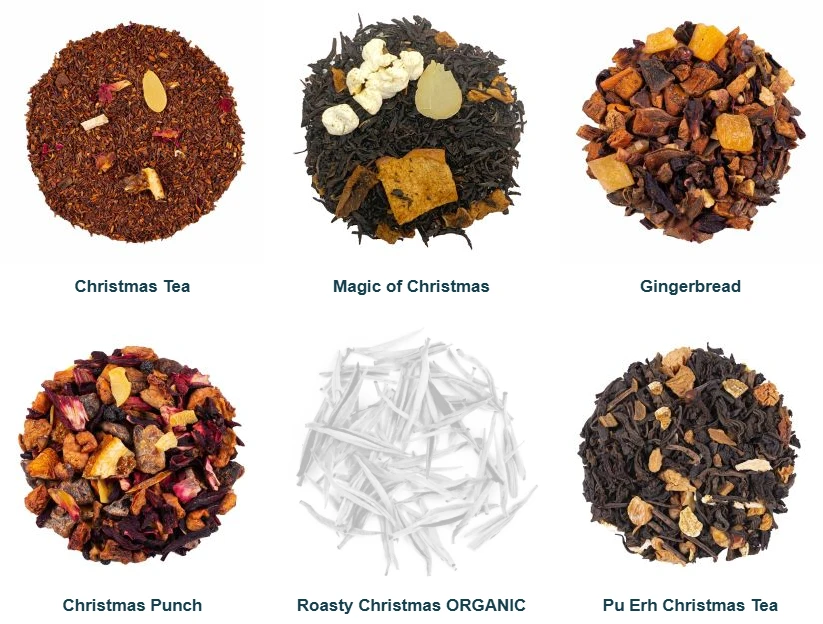
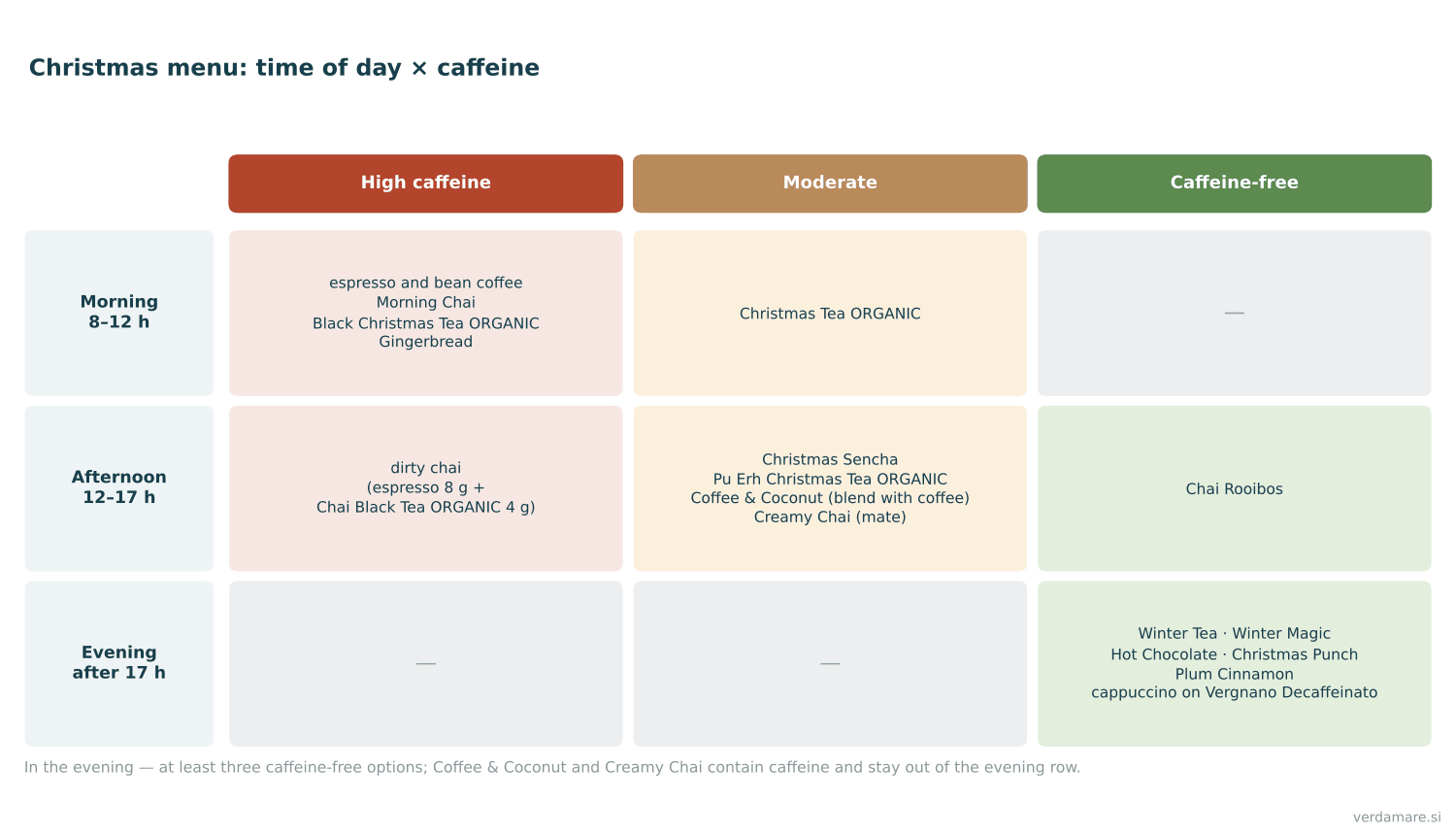
A tea menu is easiest to build by base: black, green and white, pu-erh, rooibos and fruit. Within it there are two rows: daytime (with caffeine) and evening (caffeine-free). This is not a formality: in December a large share of tea orders comes in the evening, after dinner, and a guest who wants to avoid caffeine should find at least three items to choose from.
Below are items with a confirmed composition that make a convenient core for the menu. Prices are per 100 g including VAT; parameters are taken from the catalogue.
| Blend | Base | Price, €/100 g | Brewing | Profile |
|---|---|---|---|---|
| Christmas Tea ORGANIC | white Pai Mu Tan + green Chun Mee | 9.43 | 12–15 g/l, 1–2 min, 70–80 °C | orange and cinnamon, cardamom, walnut |
| Christmas Sencha | green Sencha 76% | 9.02 | 12–15 g/l, 2–3 min, 70–80 °C | orange and cinnamon, rose, vanilla, almond |
| Black Christmas Tea ORGANIC | black Assam and South India 72% | on request | 12–15 g/l, 3–5 min, 100 °C | apple, orange peel, cinnamon, rose, cardamom |
| Morning Chai | black Assam CTC | 9.11 | 12–15 g/l, 7–10 min, 100 °C | spiced tea: cinnamon, ginger, pepper, nutmeg |
| Pu Erh Christmas Tea ORGANIC | pu-erh 68% | 11.15 | 12–15 g/l, 3–5 min, 100 °C | cinnamon, apple, orange, hazelnut, walnut |
| Winter Tea | rooibos, caffeine-free | 8.70 | 15–20 g/l, 7–10 min, 100 °C | cinnamon and orange, rose, cardamom |
| Winter Magic | rooibos | 6.64 | 15–20 g/l, 7–10 min, 100 °C | cinnamon, orange, caramel |
| Hot Chocolate | rooibos | 6.64 | 15–20 g/l, 7–10 min, 100 °C | spiced chocolate: cocoa nibs, pepper, ginger |
| Chai Rooibos | rooibos 54% | 8.22 | 15–20 g/l, 7–10 min, 100 °C | cinnamon, ginger, fennel, anise, cloves, cardamom |
You can extend the range with blends for which the catalogue lists only the type, price and brewing parameters. We do not give their composition here — request the specification before adding them to the menu.
| Blend | Type | Price, €/100 g |
|---|---|---|
| Gingerbread | black (ginger pieces) | 8.38 |
| Magic of Christmas | black | 8.38 |
| Spicy Cookies | black | 8.80 |
| Winter Sky | green | 10.76 |
| Cinnamon | white | 9.81 |
| Pu Erh Christmas Cake | pu-erh | 9.81 |
| Plum Cinnamon | rooibos, caffeine-free (plum and cinnamon) | 7.59 |
| Cranberry - Ginger | rooibos, caffeine-free | 9.02 |
| Christmas Punch | fruit, caffeine-free | 8.38 |
| Baked Apple | fruit, caffeine-free (apple pieces) | 7.59 |
For the black teas on this list the catalogue gives 12–15 g/l, 3–5 min, 100 °C; for the rooibos blends 15–20 g/l, 5–8 min, 100 °C; for the fruit blends 15–20 g/l, 5–10 min, 100 °C.
Example of a 6-item mini menu. Daytime row: Christmas Tea ORGANIC (light, for guests who dislike astringency), Morning Chai (strong and spicy, pairs well with milk), Pu Erh Christmas Tea ORGANIC (deep, for the connoisseur). Evening row: Winter Tea (the classic "cinnamon-orange" without caffeine), Hot Chocolate (chocolate profile), Christmas Punch (fruity and vivid, served as a punch).
An extended menu with 10–12 items adds Christmas Sencha, Gingerbread, Winter Magic, Chai Rooibos, Plum Cinnamon and Cranberry - Ginger. Note that even in the extended version there are only five bases, and the profiles are kept distinct: orange-cinnamon, ginger, chocolate, caramel, plum, cranberry.
A word on two blends that are easy to place in the evening row by mistake. Creamy Chai is a maté (9.97 €/100 g; 15 g/l, 5 min, 80 °C) and contains caffeine. Coffee & Coconut is a herbal blend, but it contains coffee, so it is not caffeine-free either. Both belong in the daytime row only.
Format 2. A separate winter coffee menu
If espresso drinks make up most of your traffic, a winter coffee menu is built not on new coffees but on new recipes around one or two blends your baristas already know. Switching the house blend for the season is risky: dialling in the grind and dose takes several days, and in December there is no time for that. It is wiser to keep the base beans and add one seasonal coffee — for filter coffee or for a "winter" espresso with a fuller body.
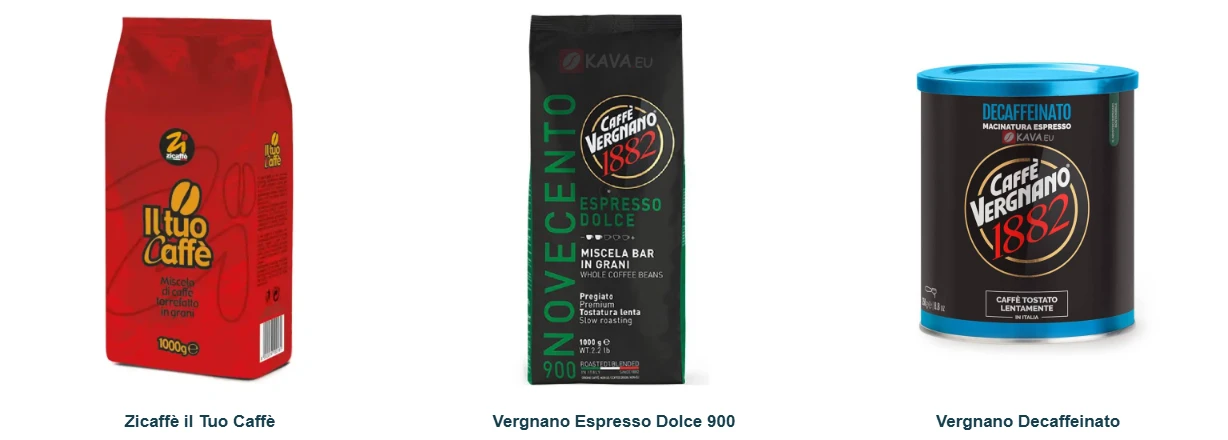
Bean guidelines from the "Coffee" section (1 kg packs, prices including VAT):
| Beans | Price per 1 kg | Cost of 8 g | Cost of 16 g (double) | 8 g servings per 1 kg |
|---|---|---|---|---|
| Zicaffè il Tuo Caffè | 23.80 € | 0.19 € | 0.38 € | 125 |
| Kimbo Caffè Crema Dolce 100% Arabica | 26.88 € | 0.22 € | 0.43 € | 125 |
| Vergnano Espresso Bio Organic | 30.80 € | 0.25 € | 0.49 € | 125 |
| Lavazza Super Crema | 32.34 € | 0.26 € | 0.52 € | 125 |
| Vergnano Decaffeinato, ground 250 g | 12.04 € per 250 g (48.16 €/kg) | 0.39 € | 0.77 € | 31 per pack |
The difference between the most affordable and the most expensive beans in the table is 7 cents per 8 g serving. For a drink that sells for 3–4 €, that is less than 2% of the price, so for the season choose your beans by how they taste in milk, not by the price per kilogram. Spiced milk drinks usually work better with medium and dark roasts, which do not get lost behind spices and citrus; a light roast with pronounced acidity can taste harsh when combined with orange.
Decaf is a must. In winter the share of evening coffee orders grows, and a guest who avoids caffeine after dinner needs a proper alternative, not "we only have tea". Vergnano Decaffeinato comes ground, in 250 g packs: once the pack is opened, ground coffee loses aroma faster than beans, so open one pack at a time and keep it tightly closed. One pack yields about 31 servings of 8 g. For venues with very little evening traffic there is the option of Tonino Lamborghini Deca capsules (Nespresso, 10 pcs — 9.24 €), if you have a capsule machine on the bar.
Seasonal espresso drinks rest on three flavour lines that guests read as "wintery":
- orange — fresh orange zest infused in the milk before steaming (peel the zest without the white pith, warm it with the milk and strain), or a thin strip of peel twisted over the finished drink so the essential oils settle on the foam;
- cinnamon and spices — your own spiced syrup: sugar and water 1:1, a cinnamon stick, a few cloves, a strip of orange peel; simmer for 10 minutes, let it infuse, strain. A syrup like this is cheaper than a bought one, and you know its full composition for allergen labelling;
- chocolate and caramel — with milk, using the cocoa or chocolate you normally buy.
Working ideas: an "orange latte" (double espresso, orange-infused milk, a pinch of cinnamon on top), a "spiced cappuccino" (espresso, 10–15 ml spiced syrup, milk foam), a "winter flat white" on decaf for the evening. Keep no more than 3–4 seasonal coffee drinks on the menu: they all use the same preparations, which keeps your mise en place from ballooning.
Format 3. A mixed "coffee + tea" menu
A mixed menu is the most interesting format for venues where coffee and tea sell in roughly equal measure. The point is not to put coffee and tea on the same sheet but to offer bridge drinks that connect the two categories. A bridge like this makes the menu memorable and helps you lead a coffee guest towards tea and back again.
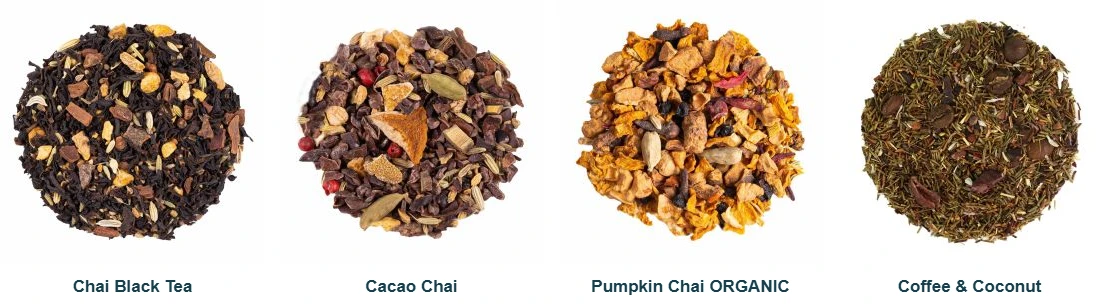
Dirty chai. Spiced tea with milk and a shot of espresso. A working recipe for a 250–300 ml cup: steep 4 g of Chai Black Tea ORGANIC in 100 ml of boiling water for 7–10 minutes (the concentrate is stronger than regular tea so it does not get lost in the milk), strain, add 150 ml of steamed milk and one 8 g espresso. Kimbo Caffè Crema Dolce 100% Arabica suits this well — a soft arabica does not fight the spices. For a fuller spiced flavour, use Morning Chai on an Assam CTC base: the fine CTC granules release colour and strength faster.
Coffee with spiced tea, no milk. An option for guests who do not drink milk: an americano in which part of the water is replaced with a strong infusion of Chai Rooibos (rooibos is caffeine-free, so there is no extra caffeine, only spice). A starting ratio is 1 espresso, 80 ml of infusion and 70 ml of hot water; adjust at the tasting.
Coffee & Coconut. A ready-made bridge in blend form: a herbal base with coconut and coffee, brewed like tea — 15–20 g/l, 5–10 minutes, 100 °C. This is convenient for the bar: the espresso machine does no work, the drink is made in a teapot, and the guest still gets a coffee note. Remember the caffeine — this item belongs in the daytime row only.
Hot Chocolate and Cacao Chai as an alternative to cocoa. Hot Chocolate is a rooibos with cocoa nibs, chocolate, ginger, cinnamon and black pepper. Brewed as a concentrate and topped up with hot milk, it makes a drink with a chocolate profile that is lighter than classic hot cocoa. Cacao Chai is a herbal blend (its composition is not disclosed in the catalogue; request the specification before adding it to the menu). The rooibos-based Hot Chocolate fits the evening row and works as a family item for guests with children; state honestly in the description that it contains cocoa nibs and chocolate, so guests do not expect "real" hot cocoa. Put Cacao Chai in the evening row only once the specification has confirmed its composition.
Non-alcoholic punch. Christmas Punch and Mulled Wine Spice ORGANIC are caffeine-free fruit blends (15–20 g/l, 5–10 minutes, 100 °C). They make a hot non-alcoholic punch that sells well at a Christmas market stall and in a hotel lobby. Base recipe for 2 litres: 40 g of blend to 2 l of boiling water, steep for 8–10 minutes, strain, add orange slices and, if you like, 300–500 ml of apple or red grape juice, reducing the water accordingly; sweeten with honey or syrup to taste. For venues that serve mulled wine, the catalogue also has the Glühweingewürz BIO spice mix (50 g — 3.80 €), but in this article we stick to non-alcoholic recipes.
How to write a menu line
A seasonal item is sold by its description, not by the name of the blend. The German producer's names, such as Winter Magic or Christmas Punch, tell guests little, so it helps to keep four elements in each menu line: a clear drink name, one line on flavour, caffeine and allergen notes, and the size and price. For example:
- "Christmas white and green tea — orange, cinnamon, cardamom. Mellow and light. 400 ml teapot. Contains nuts";
- "Spiced chocolate rooibos with milk — cocoa, ginger, black pepper. Caffeine-free. 250 ml. Contains milk";
- "Dirty chai — spiced black tea, milk and espresso. 300 ml. Contains milk";
- "Winter punch — hot fruit infusion with orange. Caffeine-free, alcohol-free. 250 ml".
The "caffeine-free" mark is best highlighted with a pictogram or a colour used consistently across the whole menu: in the evening, that is exactly what guests look for. If your menu is bilingual or trilingual (Slovenian, English, and German or Italian for tourists), keep the flavour line short — three or four words — otherwise you will not fit more than six items on one sheet.
Cost per serving: calculations at real prices
All calculations below use catalogue prices including VAT. For tea, the dose is taken at the upper end of the recommended range: where the data say 12–15 g/l, the calculation uses 15 g/l; where 15–20 g/l, it uses 20 g/l. This builds a safety margin into the cost, and with an actual dose in the middle of the range it will be lower.
Tea: 400 ml teapot and 250 ml cup
| Blend | €/100 g | Dose, g/l | Leaf per 400 ml teapot | Cost per teapot | Leaf per 250 ml cup | Cost per cup |
|---|---|---|---|---|---|---|
| Christmas Tea ORGANIC | 9.43 | 15 | 6.0 g | 0.57 € | 3.75 g | 0.35 € |
| Christmas Sencha | 9.02 | 15 | 6.0 g | 0.54 € | 3.75 g | 0.34 € |
| Pu Erh Christmas Tea ORGANIC | 11.15 | 15 | 6.0 g | 0.67 € | 3.75 g | 0.42 € |
| Morning Chai | 9.11 | 15 | 6.0 g | 0.55 € | 3.75 g | 0.34 € |
| Winter Tea | 8.70 | 20 | 8.0 g | 0.70 € | 5.0 g | 0.44 € |
| Winter Magic | 6.64 | 20 | 8.0 g | 0.53 € | 5.0 g | 0.33 € |
| Hot Chocolate | 6.64 | 20 | 8.0 g | 0.53 € | 5.0 g | 0.33 € |
| Christmas Punch | 8.38 | 20 | 8.0 g | 0.67 € | 5.0 g | 0.42 € |
Note an interesting effect: the most expensive blend per kilogram in the table (the pu-erh) and one of the mid-priced ones (Winter Tea) give almost the same cost per teapot — 0.67 and 0.70 €. The reason is the dose: rooibos and fruit blends are dosed more generously than black or green tea. That is why comparing blends by price per 100 g makes no sense — compare them by cost per serving.
A second practical detail: rooibos and fruit blends need 7–12 minutes of steeping. If your bar has no separate tea station, this becomes a bottleneck at peak hour. The solution is to prepare concentrate in advance in batches for 1–2 hours or to pour from a thermal flask (more on this below), and to serve the guest a ready-made drink in the teapot.
Coffee: the espresso base
The cost of an 8 g base for the four bean types and decaf is shown in the coffee-format table above: from 0.19 € (Zicaffè il Tuo Caffè) to 0.26 € (Lavazza Super Crema), and 0.39 € for Vergnano Decaffeinato. Per serving, decaf is roughly twice as expensive as the house beans — normal for a small pack size and no reason to drop the item: at a drink price of 3 €, a 20-cent difference barely shows in the margin.
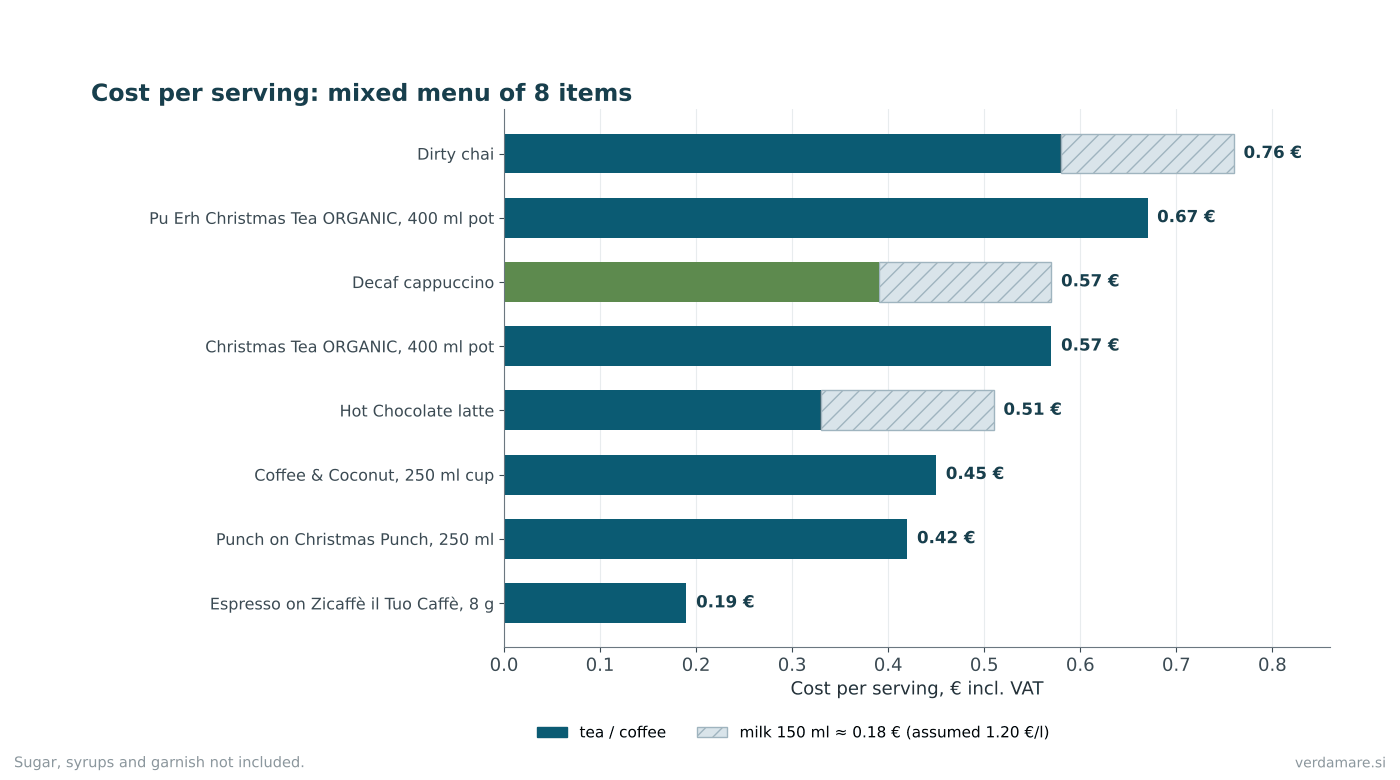
Example of an 8-item mixed menu
This example includes not only the catalogue ingredients but also milk where it is used. The milk price is an assumption: 1.20 €/l including VAT (substitute your own purchase price). Sugar, syrups, garnish fruit and disposables are not included — add them at your own prices. Selling prices are an example for the calculation, not a recommendation: they will differ in Ljubljana, on the coast and in a ski hotel.
| No. | Item | Catalogue ingredient | Ingredient, € | Milk | Cost, € | Example price, € | Cost share |
|---|---|---|---|---|---|---|---|
| 1 | Espresso | Zicaffè il Tuo Caffè, 8 g | 0.19 | — | 0.19 | 1.80 | 10.6% |
| 2 | Decaf cappuccino | Vergnano Decaffeinato, 8 g | 0.39 | 150 ml, 0.18 € | 0.57 | 3.00 | 18.8% |
| 3 | Dirty chai | Chai Black Tea ORGANIC 4 g + Kimbo Crema Dolce 8 g | 0.58 | 150 ml, 0.18 € | 0.76 | 4.20 | 18.0% |
| 4 | Coffee & Coconut, 250 ml cup | Coffee & Coconut, 5 g | 0.45 | — | 0.45 | 3.20 | 14.1% |
| 5 | Hot Chocolate latte | Hot Chocolate, 5 g | 0.33 | 150 ml, 0.18 € | 0.51 | 3.80 | 13.5% |
| 6 | Non-alcoholic punch, 250 ml | Christmas Punch, 5 g | 0.42 | — | 0.42 | 3.50 | 12.0% |
| 7 | Christmas Tea ORGANIC, 400 ml teapot | 6 g | 0.57 | — | 0.57 | 4.50 | 12.6% |
| 8 | Pu Erh Christmas Tea ORGANIC, 400 ml teapot | 6 g | 0.67 | — | 0.67 | 5.20 | 12.9% |
In this example the "price / cost" ratio ranges from 5.3 (decaf cappuccino) to 9.5 (espresso). These multipliers illustrate how the menu behaves; they are not a markup standard. What matters more is this: items with milk and with two ingredients (dirty chai) have the highest cost in absolute terms but also sell for more, while 400 ml teapots for 1–2 guests, at a cost of 0.57–0.67 €, generate high absolute income per order.
If barista time is limited at peak, it is also worth looking at labour intensity. Espresso and a teapot take minimal work. Dirty chai and the Hot Chocolate latte require concentrate and steamed milk. Punch served from a thermal flask is one of the fastest items on the menu.
How much to buy for the season
Assumptions
The calculation is for a café selling an average of 70 hot drinks a day (the middle of a 60–80 range). The season runs 53 days, from 15 November to 6 January inclusive. The allowance for spillage, grinder adjustment and peak days is 10%. The split of sales by item is an assumption and should be replaced with your own data from last winter:
| Item | Servings per day | Ingredient per serving |
|---|---|---|
| Coffee on house beans (espresso, americano, cappuccino, seasonal lattes) | 30 | 8 g Zicaffè il Tuo Caffè |
| Decaf | 4 | 8 g Vergnano Decaffeinato |
| Dirty chai | 6 | 4 g Chai Black Tea ORGANIC + 8 g Kimbo Crema Dolce |
| Coffee & Coconut | 4 | 5 g |
| Hot Chocolate latte | 7 | 5 g |
| Punch (Christmas Punch) | 8 | 5 g |
| Christmas Tea ORGANIC, teapot | 6 | 6 g |
| Pu Erh Christmas Tea ORGANIC, teapot | 5 | 6 g |
| Total | 70 |
Result
Formula for each item: servings per day × grams per serving × 53 days × 1.1.
| Item | Calculated, kg | Purchase | Amount, € incl. VAT |
|---|---|---|---|
| Zicaffè il Tuo Caffè | 13.99 | 14 × 1 kg | 333.20 |
| Kimbo Caffè Crema Dolce 100% Arabica | 2.80 | 3 × 1 kg | 80.64 |
| Vergnano Decaffeinato | 1.87 | 8 × 250 g | 96.32 |
| Chai Black Tea ORGANIC | 1.40 | 1.4 kg | 126.28 |
| Coffee & Coconut | 1.17 | 1.2 kg | 108.24 |
| Hot Chocolate | 2.04 | 2.1 kg | 139.44 |
| Christmas Punch | 2.33 | 2.4 kg | 201.12 |
| Christmas Tea ORGANIC | 2.10 | 2.1 kg | 198.03 |
| Pu Erh Christmas Tea ORGANIC | 1.75 | 1.8 kg | 200.70 |
| Total | coffee 17 kg + 2 kg decaf, tea 11.0 kg | 1,483.97 |
Of this amount, 510.16 € goes on coffee and 973.81 € on tea. That is about 28 € per day of the season, or about 0.40 € per serving on average, excluding milk.
Two orders instead of one
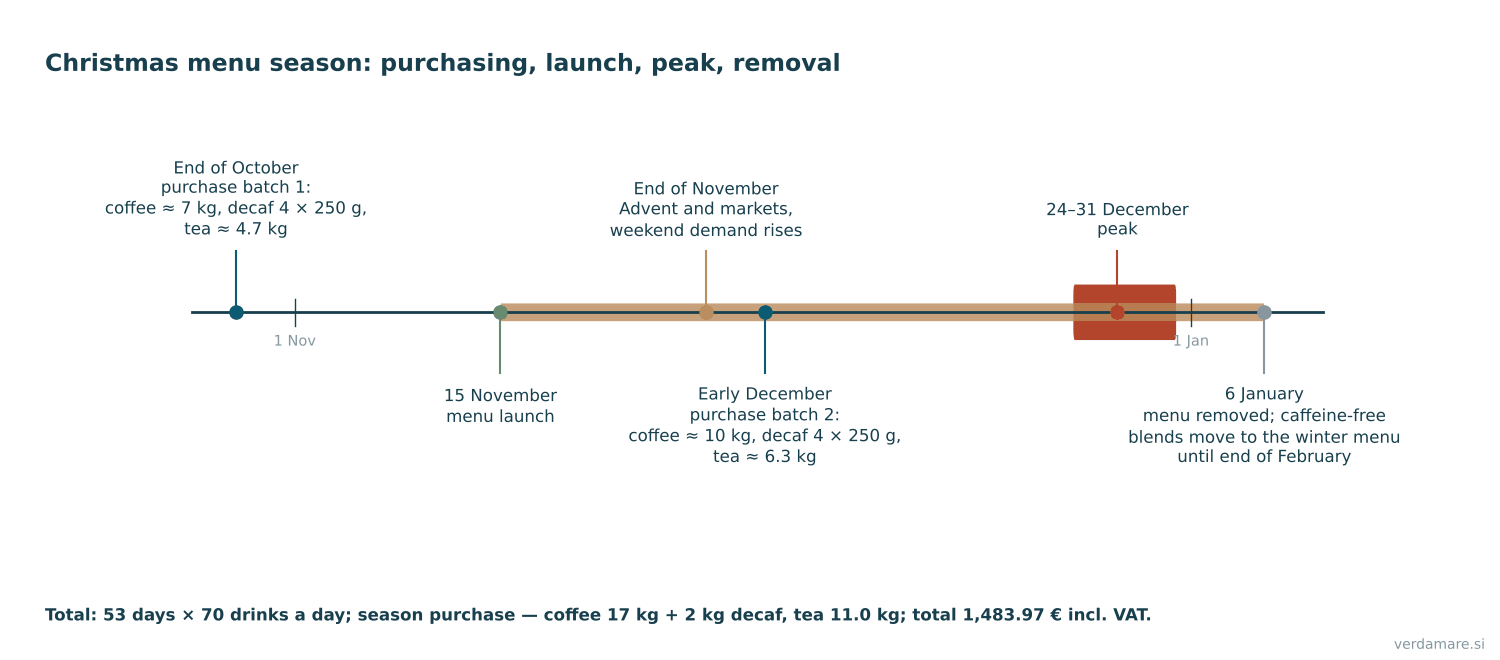
Buying the full volume at the end of October is not a good idea. First, it ties up about 1,500 € of working capital for two months. Second, the split of sales by item is an assumption, and it will almost certainly change after the first two weeks. A practical scheme:
- order 1 (end of October) — for 15 November to 7 December (23 days): about 7 kg of house beans and beans for dirty chai, 4 packs of decaf (1 kg), about 4.7 kg of tea;
- order 2 (beginning of December) — for 8 December to 6 January (30 days, including the 24–31 December peak): about 10 kg of beans, 4 packs of decaf, about 6.3 kg of tea — already adjusted to actual sales in the first weeks.
If an item in the first order did not take off, you can replace it in the second order with another blend on the same base without reprinting the whole menu: for example, Winter Tea instead of Hot Chocolate in the evening row.
Allergens: how to mark them on the menu
Christmas blends are one of the most allergen-heavy tea categories: nuts, almonds and dairy ingredients are common in them because they create the "pastry and festive table" profile. Regulation (EU) No 1169/2011 requires guests to be given information on 14 allergen groups for non-prepacked food served in a venue as well; these groups include nuts and milk. How the information is provided (on the menu, on a separate sheet, orally backed by written documentation) is governed by national rules, but the most reliable approach for a seasonal menu is to mark allergens directly in the drink's line.
For items with a confirmed composition, the picture is as follows:
| Blend | Allergens according to the catalogue |
|---|---|
| Christmas Tea ORGANIC | walnut |
| Christmas Sencha | almond |
| Pu Erh Christmas Tea ORGANIC | hazelnut, walnut |
| Winter Magic | almond, walnut, butter, cream (in the caramel) |
| Sweet Almond Chocolate | almond, walnut, hazelnut |
| Orange Cinnamon | almond |
| Fruity Christmas Tea (86151) | almond |
| Hot Chocolate | no nuts or milk listed in the composition; the chocolate contains lecithin — check its source in the specification |
Practical rules for the menu:
- Mark the allergen in the drink's line, not only in a general footnote at the bottom of the page. A short note is enough: "nuts", "milk" — or numeric codes if your main menu already numbers allergens.
- Mark Winter Magic twice: nuts and milk. A guest with a milk intolerance does not expect dairy in a rooibos served without milk. This is the most common trap on a winter tea menu.
- Milk drinks (dirty chai, latte, cappuccino) get a "milk" mark regardless of the blend. If you offer plant-based milk, check that too: almond milk adds a "nuts" mark, and oat milk may contain gluten.
- For blends from section B (composition not disclosed in the catalogue), request the specification before printing the menu. Until you have it, either leave the item off the menu or state "ingredients and allergens — ask staff" and keep the document at the bar.
- Your own syrups are an advantage: you know their full composition. Write down the recipe and keep it next to the allergen sheet.
- Cross-contact: rinse the teapot after Winter Magic or Pu Erh Christmas Tea ORGANIC before brewing the next tea, and if possible set aside separate strainers for blends containing nuts.
Service and tableware
Teapots and cups
White porcelain works best for a seasonal menu: it shows off the colour of the infusion (from the pale gold of Christmas Tea ORGANIC to the ruby red of a hibiscus-based punch) and the pieces of fruit in the leaf, while the festive mood comes from a napkin, a fir sprig or a cinnamon stick on the saucer rather than from coloured tableware. The catalogue includes the white porcelain Diamond teapot in two sizes: 990 ml (BA1040, 35.80 €) for a group of 3–4 guests, and 500 ml (BA1040-1, 25.80 €) for a serving for 1–2 people, which matches our 400 ml teapot calculation with headroom for the leaf.
A few rules of service:
- Leaf in the pot or not. For green and white blends (Christmas Tea ORGANIC — 1–2 minutes, Christmas Sencha — 2–3 minutes) the leaf must not be left in the teapot: after 10 minutes on the table the infusion will turn bitter. Brew in a removable infuser and take it out before serving, or strain into a pre-warmed teapot. Rooibos and fruit blends tolerate longer contact with water.
- Pre-warm the tableware. Cold porcelain takes several degrees from the infusion. For teas brewed at 100 °C (rooibos, pu-erh, fruit), warm the teapot with boiling water.
- Pu-erh. Deep white cups or bouillon cups bring out the colour of the infusion and suit a guest who drinks slowly, especially in a hotel where tea is served with a late breakfast.
- A timer on the tray. A small 3- or 5-minute sand timer is part of the presentation and at the same time tells the guest when to pour.

Punch and portioning from a thermal flask
Non-alcoholic punch sells faster when it is ready to pour. A scheme for the bar or a Christmas market stall:
- make 2-litre batches (40 g Christmas Punch, 8–10 minutes of steeping, strain) — that is 8 servings of 250 ml;
- pour into a pre-warmed thermal flask or a dispenser with a tap; add orange pieces to the cup when serving, not to the flask — in a hot drink the peel turns bitter over time;
- keep a batch for no longer than 1.5–2 hours, after which the flavour goes flat; in quieter hours, make 1 litre at a time;
- serve in thick-walled glass mugs with a handle or in porcelain cups, with a spoonful of honey or syrup on the side — guests adjust the sweetness themselves.
The same approach works for Hot Chocolate concentrate and the spiced tea for dirty chai: brew the concentrate in advance, keep it hot in a separate thermal flask and top it up with milk when ordered. This way, items based on a blend with a 7–10-minute steep are ready in the time it takes to steam the milk.
Storing the blends
Christmas blends are harder to store than plain leaf. Apple pieces, orange segments, caramel and sugared ginger absorb moisture. In a damp room, caramel (as in Winter Magic) starts clumping, and dried fruit softens and can develop an unpleasant smell. Spices, for their part, are strongly aromatic themselves and pass their aroma on to their neighbours.
The rules are simple:
- airtight, opaque containers, one per blend, labelled (name, opening date, allergens);
- a dry, cool place, away from the coffee grinder, dishwasher, cooker and steam from the espresso machine;
- do not store Christmas blends next to "pure" teas (white or green without additives): cinnamon and cloves easily transfer to neutral leaf;
- the working jar on the bar holds 1–3 days' worth; the main stock stays in the storeroom in sealed packaging;
- use what was opened first; with purchasing in two orders, this happens naturally.
Typical mistakes on a seasonal menu
Too many items
A menu with 15–20 Christmas drinks looks generous, but in practice guests get lost, baristas cannot remember the recipes, and purchasing scatters into a dozen packs of 100–200 g. Half the items sell 1–2 servings a day and turn into leftovers by January. Limiting the mini menu to 4–6 items and the extended one to 8–12 is a matter of service speed on a peak evening, not of saving money.
The same "cinnamon-orange" in every line
If you look at the ingredients of Christmas blends, you will see that orange peel and cinnamon are almost everywhere: in Christmas Tea ORGANIC, Christmas Sencha, Black Christmas Tea ORGANIC, Pu Erh Christmas Tea ORGANIC, Winter Tea and Winter Magic. Put them all on one menu and you get six lines of the same flavour on different bases. Guests will notice by the second cup. The solution is to choose one "cinnamon-orange" blend per base and keep the other profiles distinct: ginger (Gingerbread, Morning Chai), chocolate (Hot Chocolate), caramel (Winter Magic), plum (Plum Cinnamon), cranberry (Cranberry - Ginger), coconut with coffee (Coffee & Coconut).
No caffeine-free items
The evening is when a Christmas menu sells best, and it is precisely in the evening that guests are most likely to avoid caffeine. If the evening row contains only pu-erh and black tea, guests will order water or nothing at all. The minimum is three caffeine-free items (rooibos, fruit, punch) plus decaf in the coffee section.
No allergen marks
Guests do not expect nut ingredients in tea, yet they are common in Christmas blends. Missing marks are both a legal risk and a risk to the guest's health. "Nuts" and "milk" marks in the drink's line solve the problem with a few minutes of work when laying out the menu.
Boiling water for green and white blends
Christmas Tea ORGANIC and Christmas Sencha are brewed at 70–80 °C for 1–3 minutes. Poured with boiling water from the espresso machine's boiler and left in the teapot on the table, they give a bitter, astringent infusion, and the spices "shout over" the leaf. If your bar has no water heater with temperature control, dilute boiling water with cold filtered water (roughly 1 part cold to 4 parts boiling brings the temperature down to 80 °C) and check it with a thermometer during staff training.
A menu without staff training
A seasonal menu that baristas see for the first time on launch day sells poorly. Hold a tasting of all items a week before launch: every staff member should taste every drink, know the brewing times and be able to describe the flavour and name the allergens in one sentence.
A short pre-launch checklist
- format chosen: tea, coffee or mixed menu;
- 4–6 or 8–12 items, no more;
- at least three caffeine-free items in the evening row, and decaf in the coffee section;
- no flavour profile repeated more than once per base;
- the cost of each item calculated per serving, not per 100 g;
- allergens marked in the line of every drink, and specifications obtained for blends with an undisclosed composition;
- purchasing split into two orders, the second after two weeks of sales;
- concentrates and punch portioned from thermal flasks, and water temperature set for green and white blends;
- staff tasting completed.
If you are putting together a Christmas menu this year, we will help you choose Alveus blends for the format you need, calculate a two-order purchase and select coffee, decaf and porcelain for service — write to us and together we will build a winter menu that fits your guest traffic.
Latest articles
 Equipping a kitchen by zone: from goods-in to the wash-upWhich zones a professional kitchen needs and what equipment goes into each — from receiving and storage to the hot kitchen, pass and wash-up — plus how much space to…Read more →Christmas Tea and Coffee Menu: Three Formats, Cost per Serving and Seasonal PurchasingA seasonal menu for 6–8 weeks: a separate tea menu, a separate coffee menu or a mixed one with "bridges" such as dirty chai. Items, cost calculations and purchase volumes.Read more →
 A Coastal Hotel: What to Order from Verdamare for the Season – from Umbrellas to DishwashingA complete purchasing map for a seaside hotel – by zone, by month and with a budget calculation for a 40-room hotel with a 60-seat terrace.Read more →