


Which porcelain to choose for a restaurant: white, bone, decorated or reactive glaze
How professional porcelain differs from household ware, how to choose between white hotel porcelain, bone porcelain, decorated lines and reactive glazes, which shapes and sizes you need and how to test a sample before ordering.
Tableware outlives the menu — so choose it just as carefully
In a restaurant a plate is washed several times a day, stacked while still hot, warmed under the salamander and carried across the room on a tray. After a year you can see which porcelain was the right choice: one shows no chips and no knife marks, the other has to be reordered every quarter. Here is how the four lines of professional porcelain differ and how to choose yours.
This article is about choosing porcelain for a restaurant, café, hotel or catering business: how professional tableware differs from household ware, how white porcelain, bone porcelain, decorated lines and reactive glazes work, which shapes and sizes you need for your plating, what the dishwasher and the salamander can take, and how to test a sample before you order. The examples come from our Porselen section — 2,455 items in 82 collections.
01Why household porcelain does not survive a restaurant
A household dinner set goes through the dishwasher two or three hundred times a year. A restaurant plate does the same in a couple of months. A commercial dishwasher washes at 55–65 °C and rinses at 80–85 °C, the cycle lasts one to two minutes, and the plates are stacked straight away while still hot. Add trolleys, trays and rims knocking against each other when tables are cleared, and the load on each piece is many times higher than at home.
Household porcelain is not built for this, for three reasons. Its rim is thin and unreinforced, so the first chips appear within weeks. Its glaze is designed for gentle washing and turns dull under aggressive detergents. Most importantly, household ranges change every season: a year later you can no longer buy the same plate to replace a broken one, and the table turns into a mix of different series.
Professional porcelain solves all three problems. It costs more per piece, but the figure that matters is the cost per serving: a plate that lasts three years instead of one ends up cheaper.
02What makes porcelain professional
Hotel porcelain is fired at around 1,380 °C. At this temperature the body vitrifies completely: it becomes dense and almost glass-like, and water absorption drops below 0.5 %. In practice this means that fat, coffee, sauce and the smell of fish are not absorbed and do not show up a month later as grey stains around the foot.
- Reinforced rim. The edge is rounded and thickened — it is the part that takes the knocks during clearing and washing. Look at the plate in profile: on a professional model the rim is visibly thicker than the centre.
- Hard glaze. A glossy glaze withstands knives and forks without grey marks and does not turn dull with detergents.
- Unglazed foot ring. The ring on the underside is left unglazed so the plate stands firmly and does not slide in the stack.
- Stackability. Shapes are designed so that a stack of 10–15 plates stands straight without pressing on the rim of the plate below.
- Long-term range. Collections stay in production for years, so two or three years later you can reorder exactly the same plate.
- Food safety. In the EU, ceramics in contact with food fall under Regulation 1935/2004 and Directive 84/500/EEC, which limits the release of lead and cadmium from glazes and decoration.
03The four lines at a glance
Professional porcelain today is not just white plates. In the Porselen section it is divided into four lines, and each does a different job.
| Line | Look | Where it works best | What to watch |
|---|---|---|---|
| White hotel porcelain | Pure white, glossy glaze, classic and contemporary shapes | The backbone of any venue, from cafés to banquets and hotels | The widest choice of shapes and sizes; easiest to reorder |
| Bone porcelain | Warm ivory tone, thinner walls, lower weight | Chef-driven restaurants, hotels, receptions | Next to pure white the tone difference is visible — mix it with white deliberately |
| Decorated porcelain | Digital prints and decors on bone porcelain: speckled, graphic, coloured rims | Accent pieces, cafés with character, breakfasts | Ask how the decor is applied; metallic rims are not for the microwave |
| Reactive glazes | Coloured glazes with flowing tones; every piece is slightly different | Bistros, gastro bars, contemporary plating | Shades can vary between batches; matt glazes show cutlery marks more easily |
04White hotel porcelain
White porcelain is the workhorse of every venue. It does not compete with the food: the colour of a sauce, fresh herbs and the texture of meat read best on white, which is why chefs choose it for the core range even where coloured tableware is used for signature dishes.
The second argument is predictability. The white is the same from batch to batch, collections live for years, and one collection usually covers everything: flat and deep plates in several diameters, bowls, platters, cups, sauce dishes and accessories. You can set the whole table from one series and reorder it piece by piece.
When choosing a collection, look at the whole series, not one plate: does it have the sizes you need, a deep plate for pasta, cups for your espresso and cappuccino volumes and platters for sharing?
 VD0018487Flat plate 14 cm X-TanbulWhite porcelain
 VD0018598Flat plate 16 cm SaturnWhite porcelain
 VD0018388Flat plate 15 cm BilbaoWhite porcelain
 VD0018361Tea cup and saucer 180 ml AnkaraWhite porcelain
05Bone porcelain: a warm ivory tone
Bone porcelain in this line is not bone china: there is no bone ash in the body. It is hard professional porcelain given a warm ivory tone and a slight translucency: hold a plate up to the light and you will see the shadow of your fingers. Wall thickness and weight are comparable to white professional porcelain.
On the table bone porcelain looks more upmarket than white, which is why it is chosen by chef-driven restaurants, hotels and venues where the table setting is part of the experience. Follow the maker's washing instructions: the bone line calls for a gentler cycle up to 60 °C.
One practical note: next to pure white tableware the ivory tone of bone porcelain stands out. If you plan to combine the lines, do it on purpose — for example bone porcelain for mains and white porcelain for side plates and the buffet — and not by accident when reordering.
 VD0019564Flat plate 15 cm Enternasyonal Bone PS01546Bone porcelain
 VD0019426Flat plate 17 cm Barcelona BoneBone porcelain
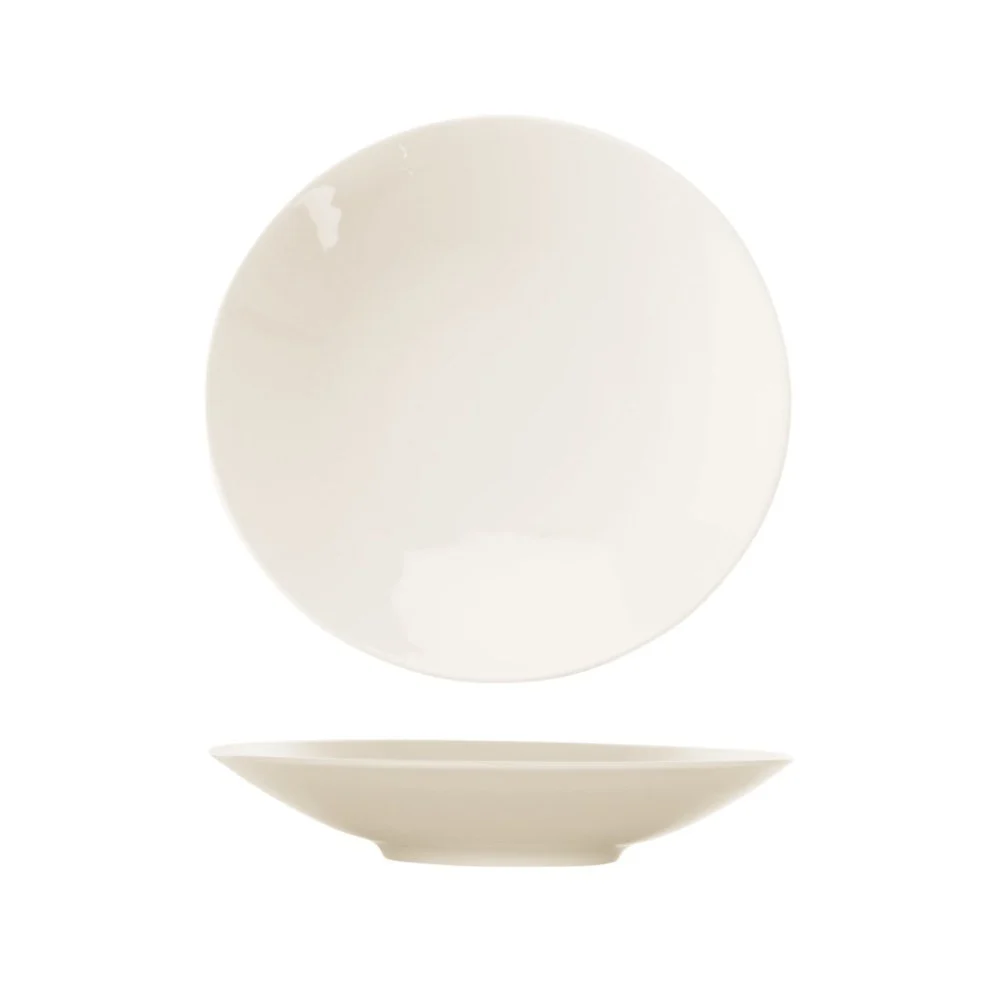 VD0019371Deep plate 23 cm Atina BoneBone porcelain
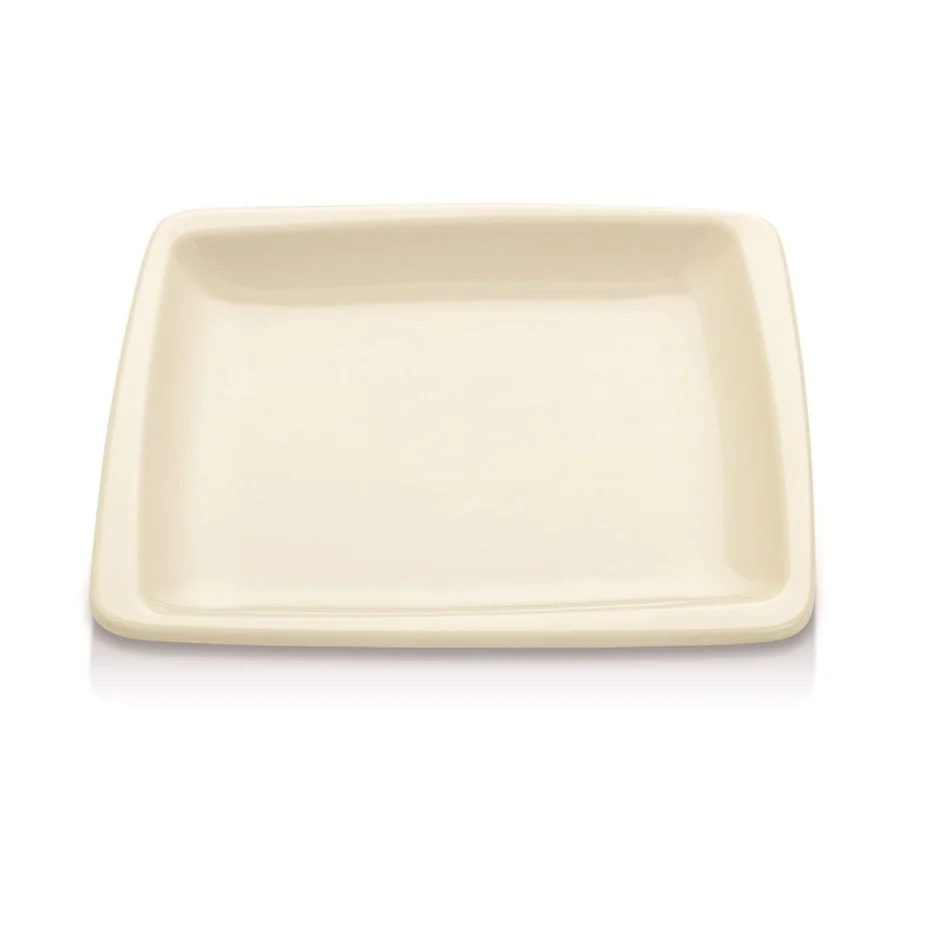 VD0019323Flat plate 17×17 cm Orlando Bone PS01305Bone porcelain
06Decorated porcelain
The decorated lines are based on bone porcelain: a pattern is applied to the plate — speckles, a stone effect, a graphic ornament, a coloured or 'raw' rim. Modern digital printing makes complex decors possible that used to be available only as hand painting.
Decor works well at breakfast, in cafés and on signature dishes: one or two patterned pieces bring life to a table set in calm white porcelain. When choosing a decor, ask how it is applied and fired, because this determines how the pattern copes with commercial washing. Gold and platinum rims are a separate case: such tableware does not go into the microwave.
 VD0019976Flat plate 19 cm AntaresDecorated porcelain
 VD0020046Flat plate 19 cm ArnimDecorated porcelain
 VD0020024Bowl 19 cm SideDecorated porcelain
 VD0020075Coffee cup and saucer 90 ml EnigmaDecorated porcelain
07Reactive glazes
A reactive glaze contains metal oxides that flow and react with each other during firing. The result is flowing tones, drips, spots and colour transitions that cannot be reproduced exactly. Two plates from the same box will look alike but not identical — this is not a defect but a property of the material.
This tableware makes plating recognisable and photographs well, which is why bistros, gastro bars and restaurants with contemporary cuisine love it. It is usually paired with simple, clean plating: a complex glaze pattern should not compete with a layered presentation.
- Reorders. The shade can vary slightly between production batches. If you need the tableware for years, order a reserve straight away or reorder in larger batches.
- Matt glazes. A matt surface looks refined but shows grey knife and fork marks more than gloss. For steaks and dishes that are cut, gloss is the safer choice.
- Colour and food. Dark and blue glazes set off light-coloured dishes; warm terracotta and beige tones set off greens and vegetables. Before ordering, plate one or two real dishes on a sample.
 VD0018019Flat plate 19 cm Seal ParisReactive glaze
 VD0018087Flat plate 19 cm Terra ParisReactive glaze
 VD0018208Flat plate 21 cm Ombra BilbaoReactive glaze
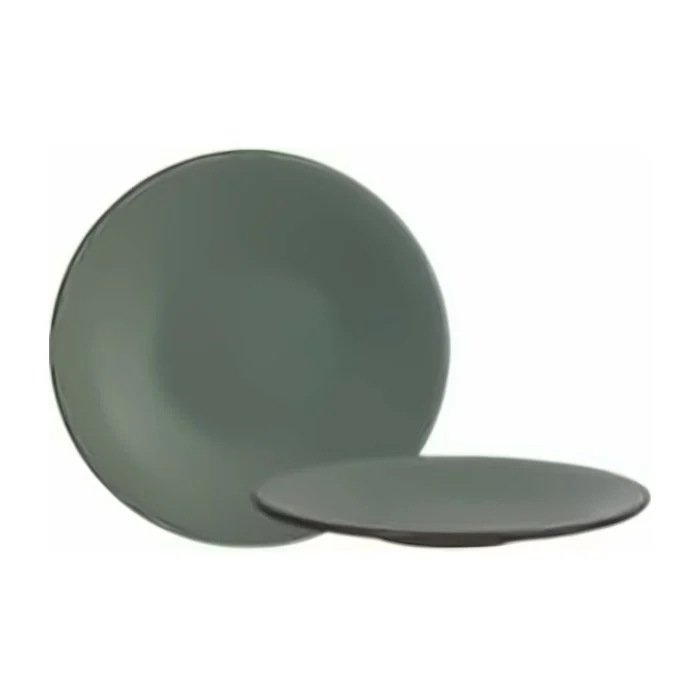 VD0018248Flat plate 19 cm Matte Verde ParisReactive glaze
08Shapes: coupe, rim, gourmet and the rest
The shape of a plate affects the presentation as much as its colour. On a rimmed plate the working area is smaller than the diameter: a 27 cm plate with a wide rim frames the portion like a picture frame. A coupe plate, without a rim, gives almost the full diameter to the food and looks more contemporary.
| Shape | What it gives | Typical use |
|---|---|---|
| Coupe (no rim) | Maximum working area, modern look, stacks easily | Mains in bistros, breakfasts, pizza and pasta |
| Rimmed | A frame around the dish, sauce stays on the plate, classic look | Banquets, hotels, classic cuisine |
| Gourmet plate | Wide rim and a small well in the centre: a small portion looks like chef-style plating | Tasting menus, starters, signature desserts |
| Deep plate and gourmet bowl | Holds liquid and sauce, keeps food warm | Pasta, risotto, soups, bowls |
| Oval and boat-shaped | Long presentation, sharing plates | Fish, sides, starters for the centre of the table |
| Square and rectangular | Graphic plating, starters in a row | Sets, starters, sushi; need suitable dishwasher racks |
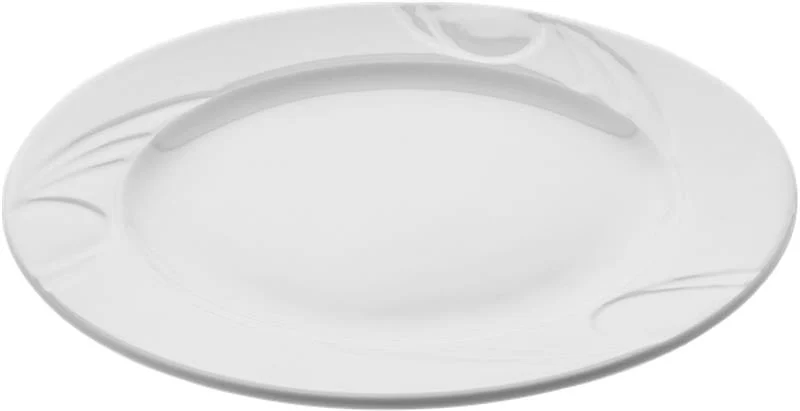


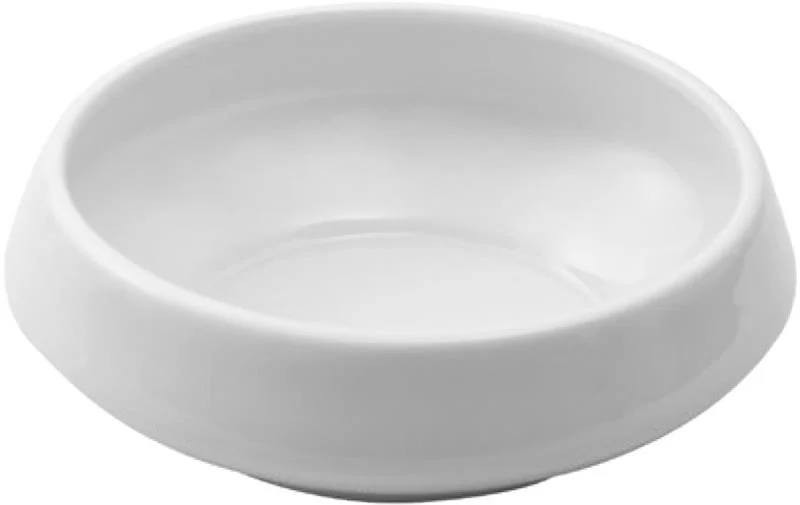
A practical rule: build the core of the table from round shapes, which are cheaper to run, and add square, oval and gourmet shapes selectively for specific menu items.
09Sizes: which plate for which dish
Diameters in professional porcelain go up in steps of two to three centimetres, and choosing one size wrong is obvious at once: a steak on a 25 cm plate looks cramped, a starter on a 31 cm plate looks lost.
| Use | Size guide |
|---|---|
| Bread, butter, sauces | 15–17 cm |
| Starters, desserts, individual salads | 19–21 cm |
| Main courses | 25–28 cm |
| Presentation, gourmet, charger plate | 29–32 cm |
| Pasta, risotto, soups (deep) | 22–26 cm, 300–500 ml |
| Espresso / cappuccino / tea | 80–100 ml / 180–250 ml / 180–250 ml |
Exact dimensions of every item are given on the product page. How many pieces of each size you need per seat is covered separately in “Restaurant tableware: how to calculate a starter set” and in “Tableware for hospitality: how much you need”.
10Dishwasher, microwave, oven
Professional porcelain is designed for commercial washing, which is its main advantage over household ware. Still, it is worth discussing the operating conditions with your supplier before ordering.
- Dishwasher. White porcelain is designed for daily commercial washing. For the bone line the maker recommends a gentler cycle up to 60 °C, and for reactive glazes (Bilbao) hand washing. For decorated lines, check how the pattern is applied.
- Microwave. Porcelain without metallic decoration is fine for reheating. Gold, platinum and silver rims are not.
- Oven and salamander. Porcelain handles plate warming and service from under the salamander, but not an open flame or a sudden temperature change — for example a cold plate placed directly on a hot hob.
- Thermal shock. Do not put a hot plate from the salamander into cold water, and do not pour boiling water into a cup straight from the fridge.
- Storage. Keep stacks to 15–20 plates at most, on a level shelf: a leaning stack presses on the rims of the plates at the bottom.
11How to test a sample before ordering
A catalogue and photos cannot replace a plate in your hands. Before a large order, take two or three samples and run a simple test: it takes ten minutes and saves years.
- Look at the plate in profile: the rim should be rounded and visibly thicker than the centre.
- Turn it over: the foot ring is even, with no sharp glaze runs, and the plate does not rock on the table.
- Stack 8–10 pieces: the stack stands straight and does not rest on the rim of the plate below.
- Draw a knife across the glaze, especially a matt one: does it leave a grey mark?
- Plate one or two dishes from your menu and look at them in the light of your dining room, not the office.
- Ask how many years the collection has been in the range and how quickly reorders are delivered.
12How to combine lines on one table
The most robust scheme is a calm base with one or two accents. The core range — side, starter and main plates, deep plates, cups — comes from white or bone porcelain of one collection. A reactive glaze or a decor becomes the accent on two or three menu items, for example a signature dish, desserts or breakfast.
This way the table looks considered rather than busy, and the venue does not depend on reordering coloured tableware for the whole room. If the accent series changes over time, the base stays the same.
13Common mistakes
- Choosing by a single plate. You like the collection, but it has no deep plate or no cup of the right size — and the table ends up assembled from different series.
- A household range “for now”. A year later it is no longer available, and breakages have to be replaced with something else.
- The whole table in colour. Reactive glazes on every item tire the eye and complicate reorders: the shades of a new batch will differ.
- Main plates that are too big. 31–32 cm looks great in photos but does not fit small tables or standard dishwasher racks.
- Forgetting stacks and shelves. Square and oval shapes take up more storage space than the catalogue suggests.
- Metallic decor without a warning. The kitchen reheats a dish in the microwave, and the gold rim darkens or sparks.
14Checklist before you order
- The menu is mapped to shapes and sizes: which plate for which dish.
- A core collection is chosen, and it contains every item you need.
- Accent items and the line for them are defined.
- Quantities per seat and a reserve for breakage and rotation are calculated.
- A sample has been tested: rim, foot, stack, knife marks, look with real food.
- Dishwasher, microwave and salamander use is confirmed for the chosen lines.
- Shapes have been checked against dishwasher racks and shelves.
- Delivery times and the option to reorder the same collection are confirmed.
15Frequently asked questions
How does bone porcelain differ from ordinary white porcelain?
Bone porcelain has no bone ash in the body. What sets it apart from plain white is the warm ivory tone and the slight translucency, and it looks more upmarket on the table. White porcelain is cooler in tone and offers the widest choice of shapes.
Why are plates with a reactive glaze different from each other?
The glaze contains metal oxides that flow and react differently during firing. Every piece is therefore unique — this is a property of the material, not a defect.
Can decorated porcelain go in the dishwasher?
For most professional decors, yes, but check how the pattern is applied before ordering. Tableware with gold or platinum does not go into the microwave.
How long can I keep reordering the same collection?
Professional collections stay in production for years. With reactive glazes, bear in mind that the shade of a new batch may differ slightly, so order key items with a reserve.
Can I get samples?
Yes. Tell us which items you are interested in, and we will prepare an offer and arrange samples to test in your venue.
16In short
Reduced to a few points, the article comes down to this.
Verdamare — porcelain and table settings for hospitality
The Porselen section brings together 2,455 items of professional porcelain in four lines: white hotel porcelain, bone porcelain, decorated porcelain and reactive glazes. Prices on request, based on quantity and delivery time. We will help you choose a collection for your menu and prepare samples.
Latest articles
 Table Setting for Hotel Breakfast: Guest Place, Service and Table ResettingThe guest table at hotel breakfast: what is set in advance, what the server brings, how to reset a table quickly and how many pieces you need for a room…Read more →
 Pu-erh in hospitality: sheng and shu, brewing, cost per cup and working with the Alveus rangeWe follow pu-erh from Yunnan raw leaf to the cup in a hotel room: sheng and shu production, two brewing methods, rinsing, teaware and the exact cost per serving based…Read more →
 Porcel Porcelain for Restaurants and Hotels: How It Is Made, Why It Lasts and How to Choose a SeriesHow Porcel hard-paste porcelain is produced, what the collection ratings mean and how to put together a set for a restaurant or banquet hall from the HoReCa Collections catalogue.Read more →