


Restaurant Tableware: How to Calculate Your Starter Set
A method for calculating plated-service tableware for an à la carte restaurant: from menu and table turns to quantities, three budgets with real item codes, and rules of use.
A starter set of tableware is usually calculated from the number of seats: sixty seats means sixty dinner plates plus a few extra. On the very first busy Saturday, that calculation falls apart. A server stands at the pass with a finished main course, waiting for a stack to come back from the dish station; the cook plates a side dish on a dessert plate; and a hot dish cools on cold porcelain because the plate warmer is empty. In a restaurant, tableware works like a revolving stock: at any moment part of it is on the tables, part is on its way to the dish station, part is cooling on the rack, and only what remains is ready for service. Below is a method that turns the menu and dining-room load into piece counts, three full budget calculations using SANTAI porcelain from the Verdamare catalogue, and the rules that determine how long the set will last.

Why the set is not calculated by seat count
This article covers plated service in an à la carte restaurant: guests order from the menu, and each dish leaves the kitchen on its own plate. Buffets, breakfasts, oven-to-table dishes and tea and coffee service work differently, and we cover them in a separate article.
The plate as a queue
Every plate goes through the same cycle: shelf or plate warmer → pass → table → clearing and waiting for the wash → washing → cooling and drying → back to the shelf. Let W denote the time of a full cycle. If at peak hour the kitchen sends out λ plates of a given type per hour, then on average L = λ · W pieces are in circulation at the same time. This is Little's law from queueing theory, and it describes the tableware cycle well: the faster a plate comes back, the fewer you need.
Take a 40-seat bistro as an example. The evening shift lasts four hours and a table turns 2.5 times on average, so the venue serves about 100 guests. Roughly a third of them – 35 guests – arrive in the peak hour, and 95% of those order a main course: λ ≈ 33 dinner plates per hour. A plate stays on the table for 25–30 minutes, then waits 20–30 minutes in the dirty-dish area, is washed in one or two machine cycles and cools for 10 minutes. In total W ≈ 1.25 hours, and L = 33 × 1.25 ≈ 41 plates are in circulation at the same time.

Forty-one plates are only the ones in motion. Add a buffer at the pass: the plate warmer or the stack by the pass must not run empty just as eight orders come in from the floor at once – that is another 15–20 pieces. On top of that comes "invisible" consumption: the kitchen keeps prepped ingredients on plates, staff eat their meals, and some tableware is always sitting in a dishwasher rack or on a trolley. Altogether that makes 65–75 pieces, or 1.6–1.9 per seat.
Why the standard quantities are still higher
Practical standards – 2.5–3 dinner plates per seat – are noticeably higher, for three reasons.
First, cycle time is not stable. If on a Friday there is only one dishwasher on shift and glasses and sauté pans arrive at the dish station at the same time, W rises from 1.25 to 2 hours, and there are now 66 plates in circulation instead of 41. A reserve of 1.7 per seat will not be enough at that moment.
Second, it is the worst case, not the average, that matters. In a classic restaurant with banquets, the calculation is driven by a full house, when 60 main courses go out within ten minutes while the plates from the previous course have not yet come back from the dish station. If the dinner plate is used for both the hot starter and the main course, a banquet needs at least 120 pieces just on the tables and in the wash.
Third, breakage and reorders. Made-to-order tableware does not arrive the next day, so the set has to survive several months of losses without running short.
Little's formula is useful as a check: if the per-seat standard gives a quantity lower than L plus the pass buffer, there is a mistake somewhere in the calculation. If it is three times higher, you are overpaying or your dishwashing is slow – and it is the dishwashing that needs fixing.
Step 1. From the menu to the range of shapes
Start not with the catalogue but with the menu. List all the dishes and define a serving shape for each: flat plate, deep plate, pasta plate, oval plate, bowl. You get a "dish × shape" matrix. Its purpose is to reduce the number of shapes to a minimum without compromising presentation.
Example for a bistro with a 22-item menu:
| Menu group | Items | Serving shape | Note |
|---|---|---|---|
| Cold starters, salads | 5 | dessert plate 20 cm | the same plate is used for dessert |
| Soup of the day | 1 | deep plate 22–23 cm | also covers warm salads |
| Pasta, risotto | 4 | pasta plate 25 cm | 5 cm depth holds the sauce |
| Hot meat and fish mains | 6 | dinner plate 26 cm | the key item of the set |
| Sides served separately | 3 | bowl 14 cm | |
| Sharing dishes | 1 | oval deep plate 30 cm | |
| Desserts | 2 | dessert plate 20 cm | |
| Sauces, olives, butter | — | bowl 9 cm |
Twenty-two menu items fit into seven shapes and one sauce dish. Each new shape adds a stack on the shelf, a line in the inventory and an item code you will have to reorder, so introduce one only if the dish genuinely does not work on an existing plate.
Then, for each shape, estimate the share of guests who use it per seating. Almost everyone orders a main course; pasta depends on the menu, soup on the season. That share multiplied by the number of guests in the peak hour is λ for that particular shape.
Step 2. Quantities per seat
The standards below are reference points that make a convenient starting point for the calculation. They already include the table, the wash, the pass buffer and a moderate reserve; adjust them for the number of turns, dishwashing speed and whether you run banquets.
| Shape | Bistro, 2–3 turns | Classic restaurant, banquets | Fine dining, 1–1.5 turns | What drives it |
|---|---|---|---|---|
| Charger 30 cm | — | 1.1 | 1.1 | not washed every turn, +10% for breakage |
| Dinner 26–27 cm | 2.5 | 3 | 2.5 | the main course is the busiest item |
| Dessert 20–21 cm | 2 | 2.5 | 2 | starters + desserts |
| Bread & butter 16 cm | 1.5 | 2 | 1.2 | in fine dining, bread often stays on one plate all evening |
| Pasta / deep | 1.25 | 1.5 | 1.5 | share of pasta and risotto on the menu |
| Soup | 1 | 1.5 | 1.5 | closer to the upper limit in winter |
| Oval plates and sharing dishes | 0.3 | 0.5 + 0.2 | — | fish, sharing, banquet service |
| Small bowls and sauce dishes | 1.5 | 1 | 2 | butter, sauces, amuse-bouches |
Why the per-seat standard in fine dining, with a single turn, is no lower than in a bistro: there are more courses, and each course goes out on its own shape. The plate from the starter does not make it back in time for the next table's service, and there are more shapes in the set, so every stack has its own job.
The annual reserve for breakage and chips is roughly 10–15% of the core set, depending on how intensively you operate and how the dish station is organised. It pays to order part of it right away, together with the initial delivery.
Plate size, portion and presentation
Nominal size in inches vs actual diameter
Sizes in plate names are given in inches and rounded, so two "identical" 10.5″ plates from different collections can differ by half a centimetre. For plate warmers, pass shelves and dishwasher racks, what matters is the actual diameter, which the catalogue gives in centimetres.
| Item | Nominal | Nominal in cm | Actual | Difference |
|---|---|---|---|---|
| Alice BA2982 | 10.5″ | 26.67 | Ø 27.2 | +0.53 |
| Windflow BA3531 | 10.5″ | 26.67 | Ø 26.6 | −0.07 |
| Drizzle BA2928-1 | 10.25″ | 26.04 | Ø 25.9 | −0.14 |
| Prague BA3187 | 10.25″ | 26.04 | Ø 26.4 | +0.36 |
| Dora BA3674 | 12″ | 30.48 | Ø 30 | −0.48 |
| Windflow BA3534 | 11.75″ | 29.85 | Ø 29.6 | −0.24 |
When choosing a stack for a heated dispenser or the shelf spacing at the pass, go by the actual size.
The well and the rim
The area of a round plate grows with the square of its diameter: a Ø 30 cm plate (707 cm²) has 36% more area than a Ø 25.9 cm plate (527 cm²), even though the difference in diameter is only 4 cm. But for presentation, what matters is not the total area but the well – the flat part inside the rim. That is where the chef works; the rim remains a frame.
Take a Ø 27.2 cm plate, such as the Alice BA2982 dinner plate. With a 2.5 cm rim, the well is 22.2 cm across and takes up 67% of the plate's area; with a 3.5 cm rim, 20.2 cm and 55%; with a 4.5 cm rim, 18.2 cm and just 45%. A wide rim makes the presentation more formal and more upscale-looking, but it "eats" nearly half the area. A portion that looks restrained on a narrow-rimmed plate looks large and cramped on a wide-rimmed one.
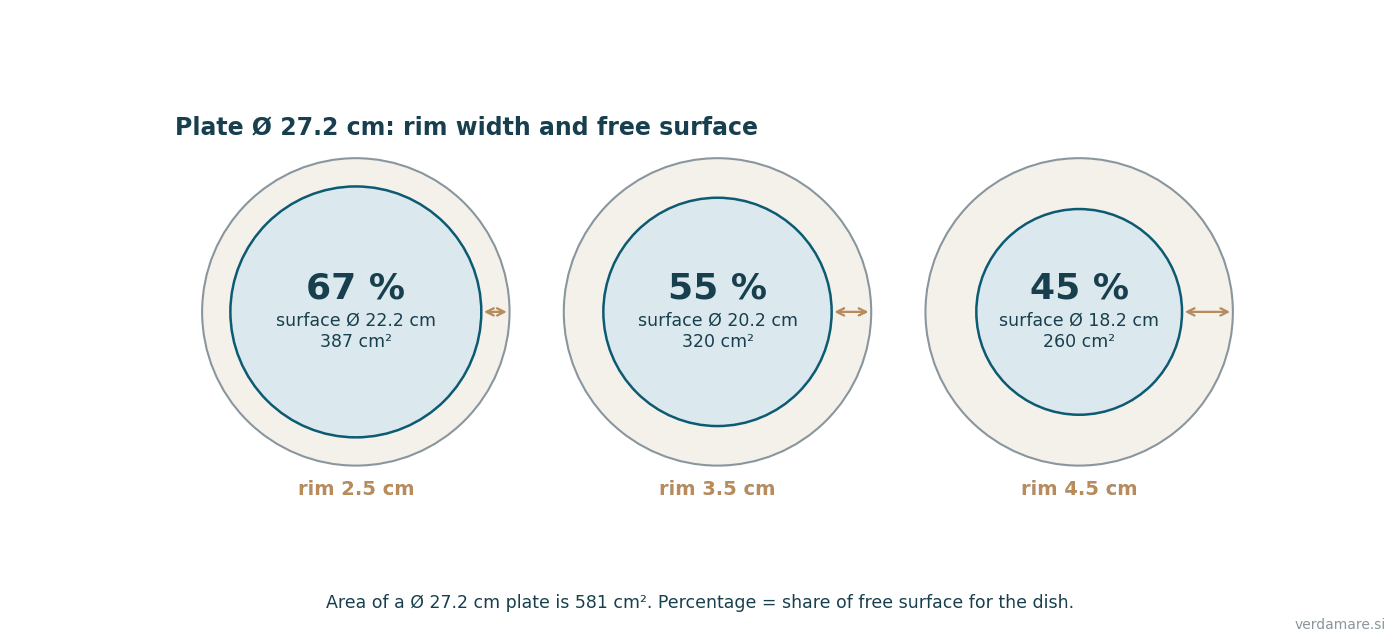
A practical rule for plated service: the main part of the dish takes up roughly half to two-thirds of the well, and the rest is air that makes the composition legible. This has consequences for purchasing. If your chef works with minimalist portions, choose a wide-rimmed plate or a large deep shape – for example a Ø 29.6 cm pasta plate, where a small portion sits in the centre as if framed. If portions are generous and the side is plated next to the meat, you need a narrow-rimmed plate or a rimless coupe, otherwise the sauce ends up on the rim and the server carries the plate with a thumb on the food.
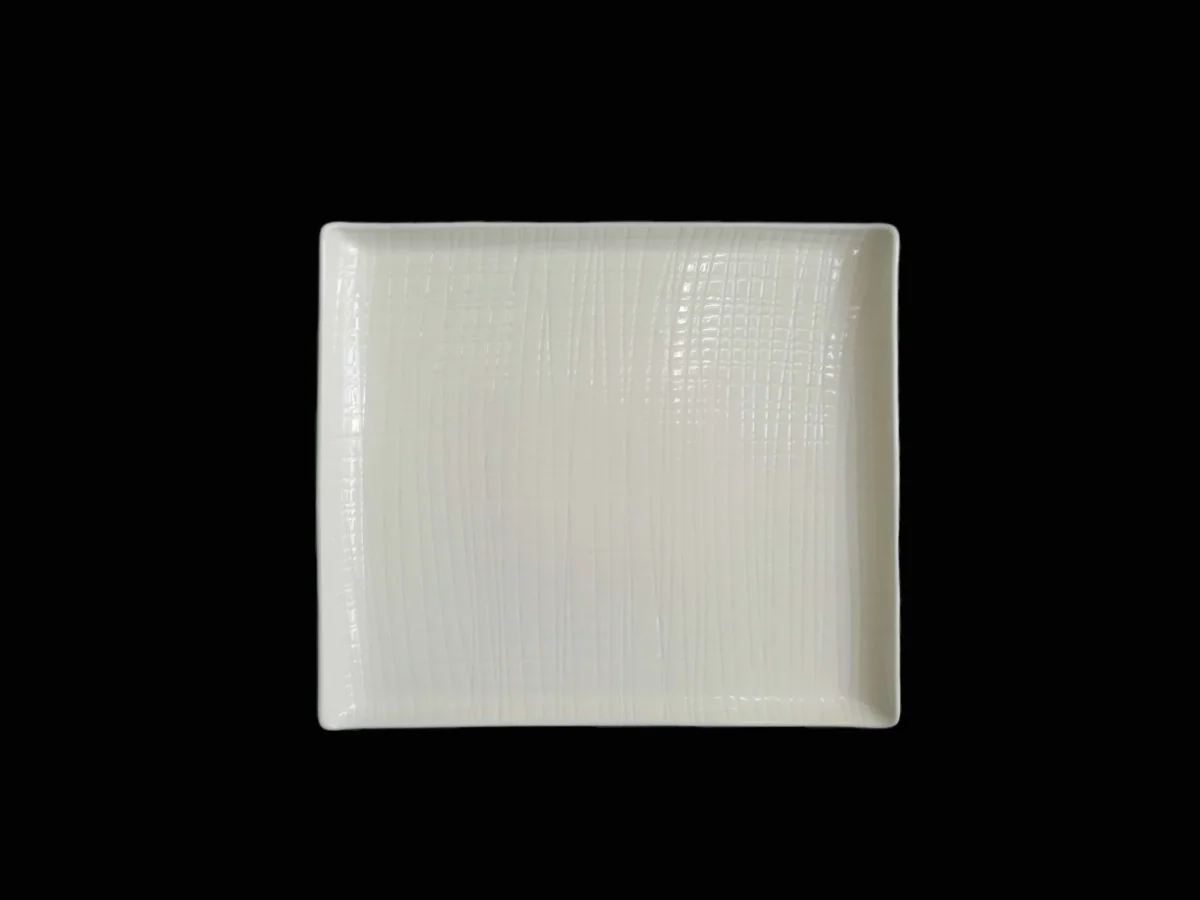
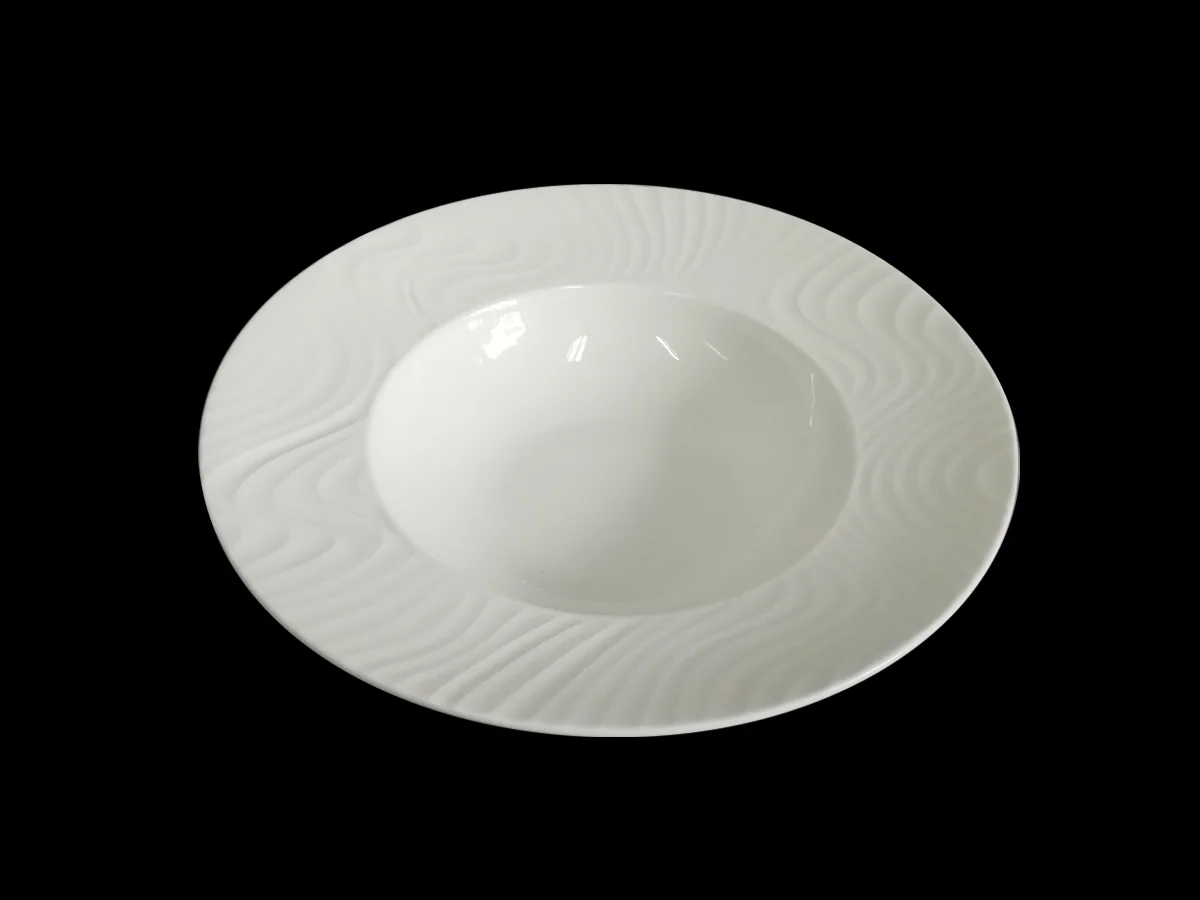
Relief also affects presentation. On Alice, the pattern runs along the rim and the centre stays smooth. On Windflow, the wave-like relief runs across the surface, so sauces are better placed as dots on the smooth areas than dragged in a swoosh across the relief. On Drizzle, the vertical ribs visually elongate the shape.
Depth
Depth determines how the sauce behaves. A flat dinner plate 2.2–2.8 cm high holds sauce under meat, but not broth. Pasta plates in the catalogue range in height from 4.2 cm (Drizzle BA3219) to 6.3 cm (Prague BA3185), and Dora deep plates go up to 6.1 cm. The higher the rim, the more steadily the server can carry pasta with sauce, but the more space the shape takes up in the stack and in the dishwasher rack. For risotto, which should spread out, a wide, shallow shape is better; for pasta in broth and mussels, a deep one.
Collections for plated service
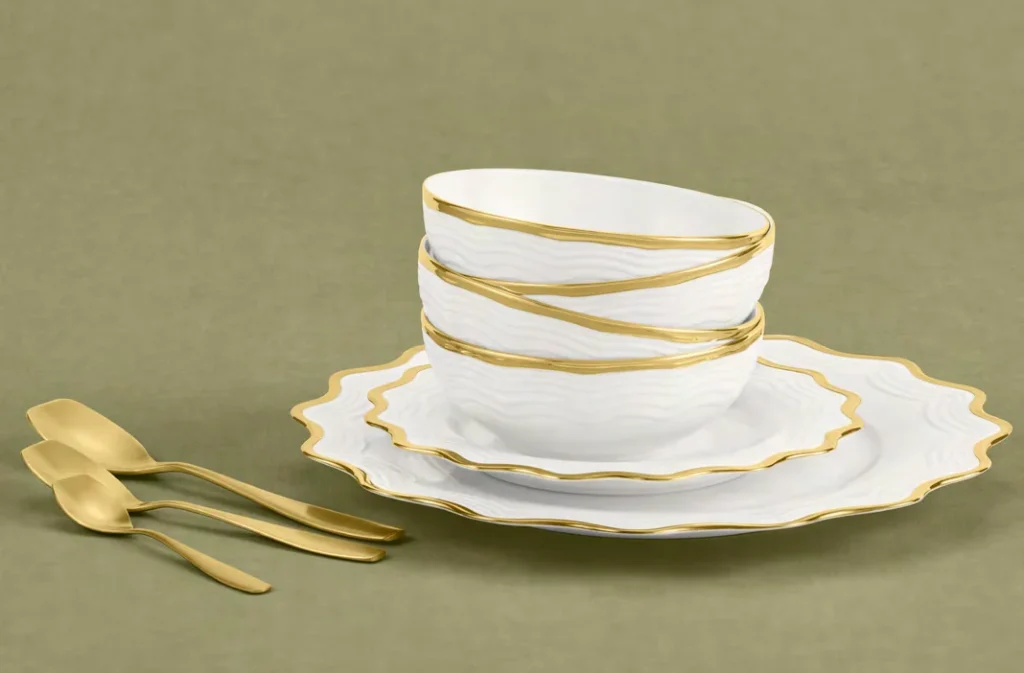
The Tableware section of the catalogue features 11 collections of white professional SANTAI porcelain – 770 items. Seven of them are suited to plated service in an à la carte restaurant.
| Collection | Items | Character | Dinner plate | Charger ~30 cm | Pasta plates |
|---|---|---|---|---|---|
| Alice | 102 | shaped rim, embossed floral pattern | BA2982, Ø 27.2 cm, 19.80 €; BA3158, Ø 25.9 cm, 15.80 € | BA2982-3, 25.80 € | 9″ 17.80 €; 10″ 21.80 €; 11.75″ 31.80 € |
| Windflow | 38 | wave-like relief across the surface | BA3531, Ø 26.6 cm, 15.80 € | not listed | 9.75″ 21.80 €; 11.75″ 29.80 € |
| Dora | 40 | petal-like fluting along the edge | BA3674-1, Ø 25.6 cm, 17.80 €; BA3270-1, Ø 25.9 cm, 19.80 € | BA3674 and BA3270, 27.80 € | 9.75″ 23.80 €; 10.75″ 29.80 €; 11.75″ 39.80 € |
| Barco | 25 | triangular and teardrop silhouettes | no round one; triangular BA3374, 27.2 × 22.7 cm, 15.80 € | none | 9″ 17.80 € |
| Prague | 73 | square and rectangular shapes, fine grid | BA3187, Ø 26.4 cm, 15.80 € | BA3187-3, 23.80 € | 10″ 21.80 €; 11.75″ 33.80 €; wide-rimmed 9.25″ 17.80 € and 11.75″ 39.80 € |
| Drizzle | 35 | fine vertical ribs | BA2928-1, Ø 25.9 cm, 15.80 € | BA2928-3, 23.80 € | 8.75″ 13.80 €; 10″ 19.80 € |
| Coupe | 44 | open rimless shapes | BA1481, Ø 26 cm, 15.80 € | BA1179, 21.80 € | deep 9–12″ from 15.80 € |
Prices are as listed on the website, including VAT, per piece.
Alice is the broadest range of the seven. It includes two series of flat plates (BA2982 and BA3158) with different diameters and prices, three sizes of pasta plates, a dedicated soup plate, deep plates from 7″ to 12″, and oval platters from 20 to 36 cm. For a classic restaurant with banquets this matters: there is a shape in the same style for every kind of service, and reordering does not turn into a search for "something similar".
Windflow is designed for course-by-course service. Its strength lies in the large pasta plates (Ø 29.6 × 5.8 cm) and deep plates up to Ø 26.3 cm, in which a small portion looks like a work of art in its own right. The dinner plate costs the same as in the simpler collections – 15.80 €. We did not find a 30 cm charger in the range, so it is taken from a neutral collection.
Dora is a classic with a softer, "lacy" edge than Alice. Two series of round plates with 30 cm chargers, oval plates in four sizes, three pasta plates. The largest deep shapes here are more expensive than in other collections (the 11.75″ pasta plate is 39.80 €), which is worth bearing in mind if pasta makes up a large part of the menu.
Barco is an accent collection. It has no round dinner plate: instead there are 8.25″ and 10.75″ triangular plates, long plates of 30.4 × 11.9 and 35.5 × 12.6 cm, and teardrop-shaped deep forms. Barco rarely becomes a restaurant's only collection, but it complements a calm base well with one or two courses of expressive geometry.
Prague builds presentation around rectangles: plates from 15.5 × 14 to 28 × 25 cm, long narrow plates up to 41 × 15.1 cm for starter sets, while the collection also includes round plates and wide-rimmed pasta plates. The corners are rounded – on square shapes these are the most vulnerable points on impact.
Drizzle is a practical collection for a bistro or all-day restaurant: a full set of round plates, two pasta plates, oval deep plates for sharing, and some of the most affordable prices in the catalogue.
Coupe consists of open rimless shapes where the entire surface of the plate is usable. A detailed review of the collection is available in a separate article on our blog; here it is of interest as a neutral base that can be combined with the embossed collections.
Three budget calculations
All three calculations use the catalogue's retail prices at the time of writing, including 22% VAT. Quantities are based on the standards from Step 2, adjusted for the specific menu.
40-seat bistro: Drizzle
Format: a 22-item menu as in the matrix above, 2.5 table turns per evening, about 100 guests. No charger is needed; bread is served on a bread & butter plate.
| Item | Item code | Size, cm | Price, € | Qty | Total, € |
|---|---|---|---|---|---|
| Dinner plate 10.25″ | BA2928-1 | Ø 25.9 × 2.2 | 15.80 | 100 | 1,580.00 |
| Dessert plate 8″ | BA2928 | Ø 20 × 1.8 | 9.80 | 80 | 784.00 |
| Bread & butter plate 6.25″ | BA2928-2 | Ø 15.8 × 1.5 | 5.80 | 60 | 348.00 |
| Pasta plate 10″ | BA3218 | Ø 25.5 × 5.3 | 19.80 | 50 | 990.00 |
| Deep plate 9″ | BA2979 | Ø 22.8 × 4.1 | 13.80 | 40 | 552.00 |
| Bowl 5.5″ | BA2978 | Ø 13.9 × 6.5 | 9.80 | 30 | 294.00 |
| Oval deep plate 12″ | BA3226-1 | 30.5 × 22.5 × 3.1 | 21.80 | 12 | 261.60 |
| Bowl 3.5″ | BA1689 | Ø 9 × 4.5 | 3.58 | 60 | 214.80 |
| Total | 432 | 5,024.40 |
About 126 € per seat including VAT, or 4,118 € excluding VAT. One hundred dinner plates is 2.5 per seat: more than Little's formula gives (65–75), but less than the classic standard, because a bistro has no banquets with main courses served to the whole room at once.
If geometry suits the concept better, the same set can be assembled from Prague: dinner plate BA3187 (15.80 €), dessert plate BA3187-1 (9.80 €), bread & butter plate BA3187-2 (5.80 €), 10″ pasta plate BA3185-1 (21.80 €), soup plate BA3184 (13.80 €), 6″ bowl BA3373-1 (9.80 €), 12.25″ oval plate BA3186-1 (19.80 €) and 3.5″ bowl BA3318 (3.18 €). With the same quantities the total is 5,076.40 €, just 52 € more. Choosing between Drizzle and Prague is a question of style, not budget.

60-seat classic restaurant: Alice
Format: settings with chargers, 1.5–2 turns per evening, full-room banquets several times a month. That is why dinner plates are calculated at the upper standard – 3 per seat.
| Item | Item code | Size, cm | Price, € | Qty | Total, € |
|---|---|---|---|---|---|
| Charger plate 12″ | BA2982-3 | Ø 30 × 2.8 | 25.80 | 66 | 1,702.80 |
| Dinner plate 10.5″ | BA2982 | Ø 27.2 × 2.6 | 19.80 | 180 | 3,564.00 |
| Dessert plate 8.25″ | BA2982-1 | Ø 21 × 2 | 11.80 | 150 | 1,770.00 |
| Bread & butter plate 6.5″ | BA2982-2 | Ø 16.4 × 1.8 | 7.80 | 120 | 936.00 |
| Soup plate 8.75″ | BA3093 | Ø 22.2 × 4.6 | 17.80 | 90 | 1,602.00 |
| Pasta plate 9″ | BA3162-2 | Ø 22.9 × 4.7 | 17.80 | 90 | 1,602.00 |
| Oval plate 12″ (fish) | BA3094-1 | 30.1 × 22.3 × 2.9 | 19.80 | 30 | 594.00 |
| Oval plate 14″ (sharing) | BA3094 | 35.2 × 26.1 × 3 | 27.80 | 12 | 333.60 |
| Bowl 3.5″ (butter, sauces) | BA2983-2 | Ø 9 × 4.5 | 3.78 | 60 | 226.80 |
| Total | 798 | 12,331.20 |
About 206 € per seat including VAT, or 10,108 € excluding VAT. In absolute terms this is the most expensive of the three options: more seats, a higher standard, chargers and two groups of oval platters.
Where you can save without sacrificing style:
- The second series of Alice flat plates. The BA3158 series in the same collection is cheaper: 10.25″ plate (Ø 25.9 cm) – 15.80 € instead of 19.80 €, 8″ (Ø 20.4 cm) – 9.80 € instead of 11.80 €, 6.25″ – 5.80 € instead of 7.80 €, 12″ (Ø 30.5 cm) – 23.80 € instead of 25.80 €. With the same quantities the saving is 1,392 €. Compare samples before you decide: the diameters differ, and the dinner plate becomes 1.3 cm smaller.
- One deep shape instead of two. If there is only one soup on the menu, and not every day, a separate soup plate is unnecessary: the 9″ pasta plate takes over its role. By dropping 90 soup plates and adding 30 pasta plates, you cut the estimate by 1,068 € and remove an entire stack from the shelf.
- A softer option is to replace the BA3093 soup plate with the BA3160-2 deep plate (Ø 23.1 × 4.2 cm, 15.80 €): the shape stays, and the saving is 180 €.
What you should cut is the range of shapes, not the number of dinner plates: running out of plates for mains on a banquet night costs more than any saving on the purchase.
30-seat fine dining: Windflow and Barco
Format: a four- to five-course à la carte menu, about one table turn, an amuse-bouche from the kitchen. Windflow is the base, two courses are served on Barco, and the charger is the smooth Coupe so as not to compete with the relief.
| Item | Item code | Size, cm | Price, € | Qty | Total, € |
|---|---|---|---|---|---|
| Coupe, charger 12″ | BA1179 | Ø 30.5 × 3 | 21.80 | 33 | 719.40 |
| Windflow, dinner 10.5″ | BA3531 | Ø 26.6 × 2.4 | 15.80 | 75 | 1,185.00 |
| Windflow, pasta plate 11.75″ | BA3534 | Ø 29.6 × 5.8 | 29.80 | 45 | 1,341.00 |
| Windflow, deep 8.25″ | BA3664-2 | Ø 20.8 × 4.6 | 13.80 | 45 | 621.00 |
| Windflow, dessert 8.25″ | BA3531-1 | Ø 20.9 × 2.2 | 11.80 | 60 | 708.00 |
| Windflow, bread & butter 6.5″ | BA3531-2 | Ø 16.5 × 1.7 | 5.80 | 36 | 208.80 |
| Barco, triangular 10.75″ | BA3374 | 27.2 × 22.7 × 2.1 | 15.80 | 45 | 711.00 |
| Barco, long plate 14″ | BA3338 | 35.5 × 12.6 × 2.8 | 13.80 | 45 | 621.00 |
| Windflow, 4″ dish (butter, amuse-bouche) | BA3665 | Ø 10.1 × 2.1 | 2.98 | 60 | 178.80 |
| Total | 444 | 6,294.00 |
About 210 € per seat including VAT, 5,159 € excluding VAT. The piece count is almost the same as for the 40-seat bistro, but there are almost 15 items per seat versus 11 in the bistro. What makes it expensive is not individual plates – the Windflow dinner plate costs the same 15.80 € – but the number of shapes: each course goes out on its own, and each needs its own reserve to cover the wash.
The Ø 29.6 cm pasta plate is not only for pasta: it is also used for risotto, a warm starter and fish in broth – a small portion in the centre of a deep, wide shape. The long Barco 35.5 × 12.6 cm plate works for a three-element cold starter, the triangular one for the fish course.
The three formats side by side
| Format | Seats | Pieces | Pieces per seat | Total incl. VAT, € | Per seat, € |
|---|---|---|---|---|---|
| Bistro, Drizzle | 40 | 432 | 10.8 | 5,024.40 | 126 |
| Classic, Alice | 60 | 798 | 13.3 | 12,331.20 | 206 |
| Fine dining, Windflow + Barco | 30 | 444 | 14.8 | 6,294.00 | 210 |
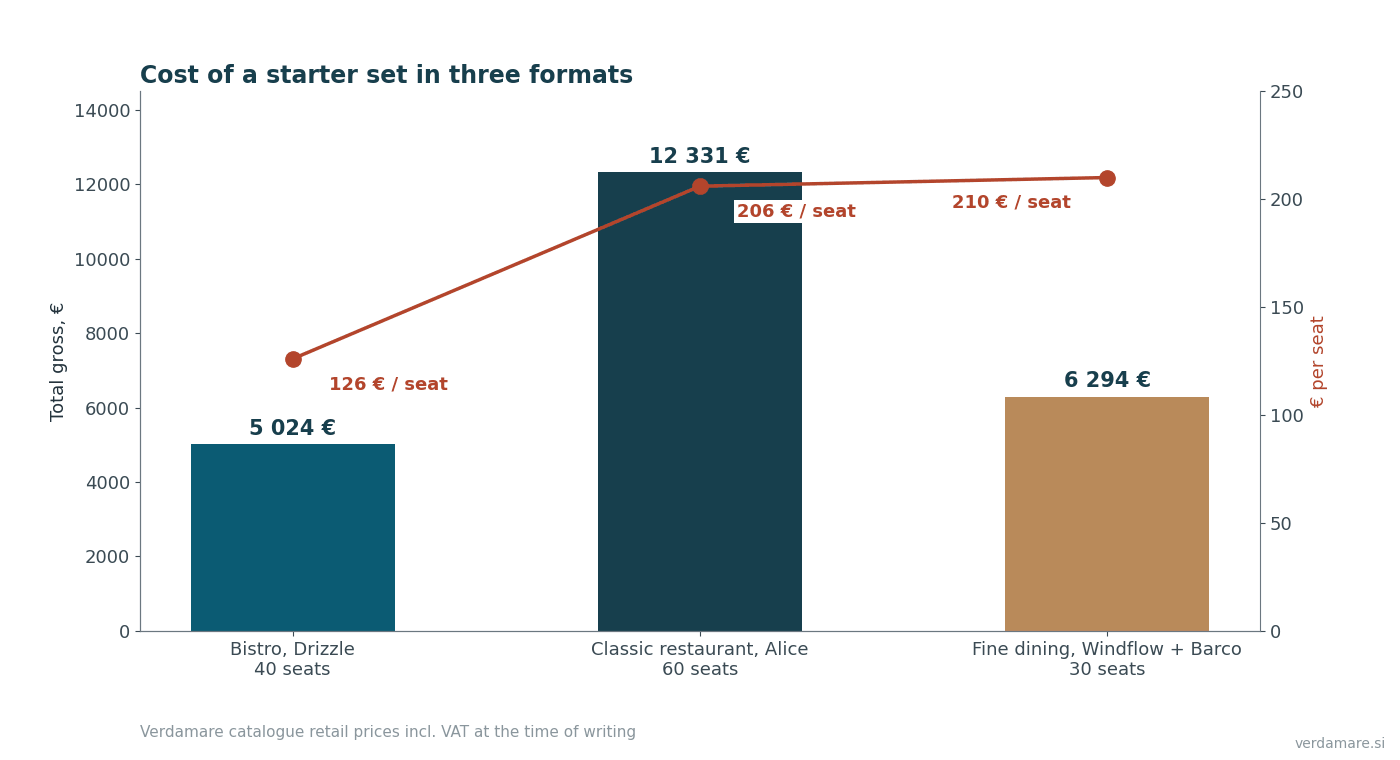
The per-seat budget is determined primarily not by the price of an individual plate but by the number of shapes and the reserve standard: the dinner plate costs 15.80 € in three of the four collections used, yet the per-seat difference between the bistro and fine dining is 84 €.
What professional porcelain is
For the SANTAI professional line, the manufacturer states a fully vitrified body, a durable glaze, chip-resistant edges, stackability and suitability for microwave ovens, ovens and dishwashers. Below we explain what these terms mean physically and how to check them in practice. We do not quote specific test figures for this manufacturer: if you need them for a tender or for sanitary documentation, request them together with the quotation.
Vitrified body and water absorption
Porcelain is fired at temperatures of around 1300 °C and above, at which part of the body turns into a glassy phase and fills the pores. The body becomes dense, and water absorption is a fraction of a percent. For earthenware and other porous ceramics it runs to several percent. For a restaurant this means three things. Grease and water do not soak into the body of the piece, so a chip does not turn into a "sponge" for bacteria. The piece does not swell with repeated washing and does not crack from moisture freezing in its pores when stored in an unheated warehouse. The sound when lightly tapped is clear and high: a rattling sound often indicates a hidden crack.
Heat resistance and thermal shock
Porcelain withstands high temperatures in itself; what is dangerous is a sudden change in temperature. When the surface heats or cools quickly, stress builds up in it, which for a fully constrained layer is estimated by the formula σ ≈ E · α · ΔT / (1 − ν). For porcelain in general, the literature gives a modulus of elasticity E of around 60–100 GPa, a coefficient of linear expansion α of about 4–6 · 10⁻⁶ K⁻¹ and a Poisson's ratio ν of about 0.2. Substituting E = 70 GPa, α = 5 · 10⁻⁶ K⁻¹ and ΔT = 100 K gives about 44 MPa – of the same order as the tensile strength of ceramics. Real stresses are lower because heating is not instantaneous, but the conclusion holds: a difference of a hundred degrees at a thin edge is a risk zone.
In practice it looks like this. A plate from the plate warmer for a cold dessert – fine, the difference is small. A dish from the oven onto a wet, cold worktop or into a sink of cold water – dangerous. A plate from the fridge under a red-hot salamander – dangerous. If the kitchen wants to use a specific item in a non-standard way, it is better to confirm its suitability in advance.
On a quality piece, the glaze is formulated so that its coefficient of expansion is slightly lower than that of the body: after cooling it is under compression and increases the strength of the surface. If the coefficients are not matched, crazing – a network of fine cracks in the glaze – appears over time.
Glaze hardness and grey marks
The glaze is harder than the stainless steel of knives and forks. That is why grey lines on a plate after a steak are usually not scratches but traces of metal worn off the cutlery. They can be removed with special porcelain cleaners and mild abrasives. Real scratches are caused by ceramic knives, grit in the dish station, and plates whose foot rubs against the well of the plate below when stacked.
Edges and chips
A chip almost always starts at the edge: the plate is knocked against a tap, a dishwasher rack or the next plate during hasty unloading. A thickened, rounded edge distributes the energy of the impact and chips noticeably less often than a thin one. There is one rule for the dining room and the kitchen: a chipped plate is taken out of circulation immediately. A sharp edge and a broken-off fragment of glaze are a direct risk to the guest.
Stackability
A plate that stacks well sits with its foot in the recess of the plate below; the stack stands upright and does not "wobble". This saves space on the rack and in the plate warmer and reduces breakage when carrying. You cannot calculate stack height by multiplying plate height by the number of pieces – plates nest inside one another. Ask for samples and measure a stack of ten: that gives you an exact figure for planning shelves. Keep stacks at a height that can be safely lifted with both hands, and do not stack plates from different series on top of each other.
Microwave and oven
White porcelain without metallic decoration can be used in a microwave – there is nothing in it to spark. In the oven, what matters is not the heating itself but its evenness: it is safer to heat the piece together with the oven than to put a cold piece into a preheated oven.
EU requirements for food contact materials
The core document is Regulation (EC) No 1935/2004 on materials and articles intended to come into contact with food. It requires that, under normal use, a material must not transfer its constituents to food in quantities that could endanger human health, bring about an unacceptable change in the composition of the food or a deterioration in its taste and odour. The Regulation also introduces traceability at all stages except the final consumer. For a restaurant, the practical point of traceability is that the supplier must be able to name the manufacturer and the batch.
Ceramics are covered by a specific directive, Council Directive 84/500/EEC, as amended by Commission Directive 2005/31/EC. It limits the migration of lead and cadmium from ceramic articles into food; the test is carried out with a 4% acetic acid solution for 24 hours at 22 °C. The limits depend on the category of article:
| Category | Lead | Cadmium |
|---|---|---|
| 1. Flat articles and articles up to 25 mm deep | 0.8 mg/dm² | 0.07 mg/dm² |
| 2. Other articles that can be filled | 4.0 mg/l | 0.3 mg/l |
| 3. Cooking ware, packaging and storage vessels over 3 l | 1.5 mg/l | 0.1 mg/l |
The 2005 amendments introduced a mandatory written declaration of compliance that accompanies the articles at all marketing stages up to retail. The source of lead and cadmium in ceramics is glazes and decoration, so for white porcelain without coloured decoration the risk is minimal – but it is confirmed by a document, not by the colour. EU rules for ceramics are being revised towards stricter limits, so ask for a declaration with up-to-date regulatory references and keep it in your HACCP documentation together with the delivery notes.
Compatibility with furniture and equipment
The table
The width of one place setting is roughly 60–70 cm. On a 70 × 70 cm square table, each of two guests gets a strip of 70 × 35 cm. A Ø 30 cm charger takes up 30 of those 35 cm of depth, leaving almost no room for a Ø 16 cm bread & butter plate, glasses and bread. For settings with chargers, it makes sense to plan for a table of at least 80 cm. A bistro without chargers using Drizzle (25.9 cm dinner plate) works comfortably on 70 cm.
A long Barco plate of 35.5 × 12.6 cm is placed along the edge of the table and takes up half the width of a place setting; an Alice oval platter of 35.2 × 26.1 cm in the middle of a table for four needs free space of its own. Work out the maximum table configuration – for example, a sharing starter, four bread & butter plates, a bottle and glasses – before ordering sharing platters.
The dishwasher
A standard 500 × 500 mm plate rack usually holds 16–18 pieces. 180 dinner plates means 10–12 racks, and if half of them come back in the peak hour, the machine has to process 5–6 racks of dinner plates alone, not counting glasses and cutlery. With a cycle of a couple of minutes the theoretical capacity is high, but the real limit is set by loading, pre-rinsing and the fact that one machine handles all the tableware. This is exactly where W in Little's formula grows.
Check two dimensions. First, the rack's prong spacing against the rim height of deep shapes: pasta plates 5.7–6.3 cm high do not fit into every other slot, so the rack holds fewer. Second, the height of the loading opening: an oval plate 35–36 cm long, standing upright, may not fit into an undercounter front-loading machine.
After washing with a final rinse at 80–85 °C, plates are hot and damp. Do not stack them tightly right away: moisture will remain between the plates, and hot porcelain placed on a cold metal table will suffer an unnecessary thermal shock.
The pass, plate warmers and racks
Plate warmers and heated dispensers are designed for a specific range of diameters. If you have Ø 30–30.5 cm chargers and Ø 29.6–30 cm pasta plates, check that they fit into the columns or onto the shelves. Deep and triangular shapes need a separate place – a stack of Barco will not fit into a round dispenser.
For racking, it makes sense to calculate shelf depth based on the largest item: an oval plate of 35–36 × 26 cm needs a shelf at least 40 cm deep, with room for your hand. Keep heavy stacks of dinner plates between knee and shoulder height, and light, rarely used items at the top.
Washing, storage and record-keeping
Washing
Most breakage happens not in the dining room but at the dish station. A few rules that reduce it more than any change of supplier:
- racks of tableware are set down, not dropped; the bus tub in the dining room should have a soft bottom;
- sort plates by shape before loading them into the rack: dinner plates with dinner plates, deep with deep;
- wash cutlery separately – metal rattling against plates in the rack chips edges and leaves grey marks;
- set the dosage of detergent and rinse aid according to water hardness: limescale dulls the glaze faster than any abrasive.
Storage
Store tableware by shape in closed cabinets or on racks, in stacks of the same series. It is handy to label each shelf with a target quantity – the minimum level below which that stack must not fall at the start of a shift. Keep the reserve that is not used every day separately in its original packaging: that way it does not wear and does not drift in shade relative to the working set.
Tracking breakage
Breakage is counted not "by feel" but over a period. The formula is simple: losses = opening stock + purchases − closing stock. Divide the losses by the average stock and annualise the figure to get the annual breakage rate. Example: a classic restaurant has 180 dinner plates, and two went missing in a month. That is 24 plates a year, or 13% of the set. A handy additional metric is breakage per 1,000 guests: it does not depend on the season and allows months to be compared.
What breakage costs: at 10% a year a restaurant loses 18 Alice dinner plates worth 356 €; at 25%, 45 plates worth 891 €. The difference of 535 € a year is the price of careless washing for a single item alone. Per dish, tableware costs are negligible: a bistro that loses 13% of 100 dinner plates at 15.80 € spends about 205 € a year, and with 95 mains a day and 300 working days that is less than one cent per main-course plate. Saving on tableware quality is therefore pointless, while investing in how the dish station is organised pays off.
Keep a breakage log with the cause: washing, dining room, kitchen, storage. After two or three months you will see exactly where tableware is being lost.
Stocktaking and reordering
It is convenient to take stock of the working set monthly and of the reserve once a quarter. The reorder point for each item: minimum level + expected losses during the delivery lead time. An illustrative example: the minimum level for dinner plates is 150 pieces, breakage is 2 per month, and the lead time for a made-to-order delivery is two months. It is time to reorder when 154 pieces remain in stock.
All SANTAI items in the catalogue are supplied to order, so it pays to order the breakage reserve right away with the initial delivery – from the same production batch. White porcelain from different firings can differ in shade: one slightly warmer, "creamy", another cooler, with a bluish tint. On the shelf this goes unnoticed, but side by side on the same table it shows. If you do need to reorder, send us the item code and, if possible, the marking from the base – we will find the closest batch.
Common purchasing mistakes
Calculating by seat count. Sixty plates for sixty seats is a set for the first service only. Calculate using Little's formula and the standards, allowing for the worst-case scenario of the evening.
Too many shapes. Each additional shape splits your stock: 90 soup plates and 90 deep plates are not 180 all-purpose plates but two stacks, each of which can run out on its own.
Choosing from a photo rather than a sample. A 1.3 cm difference in diameter, relief on the rim or across the well, a height of 4.2 or 6.3 cm on a pasta plate – all of this only becomes apparent in your hands and with the chef's dish on it. Order samples of the main shapes and do a test plating.
Nominal inches instead of actual diameter. Plate warmers, dispensers and racks are selected using the centimetres in the specification.
No reserve from the same batch. A set in mismatched shades after six months of use is the most common complaint when reordering.
Tableware without checking furniture and dishwashing. A charger on a 70 cm table, an oval platter that will not fit into the machine, deep plates that take up two rack slots – all of this comes to light in the first week of operation.
Saving on the number of dinner plates. You can almost always cut the range of shapes without loss; you cannot cut the stock of plates for mains.
Mixing collections without a system. Combining is possible and even advisable – for example, a calm base and an accent collection for one or two courses. But each shape must have its own role on the menu, not appear simply because you "liked it in the catalogue".
How we work with the calculation
Send us your menu, number of seats, expected number of guests per evening and the type of dishwasher. Based on this, we will draw up a specification in your chosen collection from the Tableware section, check the dimensions against your equipment, suggest where to reduce the range of shapes without compromising presentation, and include a reserve from the same batch in our quotation. Samples of the main shapes are available before you order, so your chef can try out their dishes on them.
Latest articles
 Table Setting for Hotel Breakfast: Guest Place, Service and Table ResettingThe guest table at hotel breakfast: what is set in advance, what the server brings, how to reset a table quickly and how many pieces you need for a room…Read more →
 Pu-erh in hospitality: sheng and shu, brewing, cost per cup and working with the Alveus rangeWe follow pu-erh from Yunnan raw leaf to the cup in a hotel room: sheng and shu production, two brewing methods, rinsing, teaware and the exact cost per serving based…Read more →
 Porcel Porcelain for Restaurants and Hotels: How It Is Made, Why It Lasts and How to Choose a SeriesHow Porcel hard-paste porcelain is produced, what the collection ratings mean and how to put together a set for a restaurant or banquet hall from the HoReCa Collections catalogue.Read more →