


Cost per Cup of Coffee: Calculating by Format — Beans, Ground, E.S.E. Pods, Pads, Capsules
We calculate the coffee share of the cost of espresso, cappuccino and filter coffee using real catalogue prices and compare beans, ground coffee, E.S.E. pods, pads and capsules by sales volume.
In a coffee programme, the question "what does one cup actually cost us?" is almost always asked too late — when the espresso machine is already on the bar, the supplier has been chosen and the menu has been printed. Yet the answer is built from a few simple values: the price per kilogram, the dose per drink, real-world waste, cleaning consumption, and the cost of equipment spread over the number of cups sold. Each of them can be got wrong, and over a year's volume the difference between "roughly" and "exactly" can easily exceed the price of a new grinder.
This article does not cover varieties, origins or brewing methods — there is a separate piece on the blog for that. Here we focus on the economics: how to convert the price of a bag into the price of a portion, what waste to allow for, at what sales volume a bean programme overtakes capsules and pods, and which format makes sense for a café, a restaurant, a hotel breakfast, an office and a guest room. All prices are taken from the "Coffee beans" section of our catalogue and include VAT; equipment and labour are illustrative assumptions, clearly marked as such, and you can replace them with your own.
What makes up the coffee share of the cost
First, let us agree on the boundaries. The cost of a drink at the bar includes coffee, milk, sugar and syrups, the cup or glass (if disposable), lid, napkin, water, electricity, depreciation, cleaning agents and labour. In this article we consistently calculate only the coffee share and what is inseparably linked to it: bean waste, group head cleaning and — in the section on volumes — depreciation of the coffee equipment. Milk for cappuccino and latte is a separate line and must not be forgotten: in a 300 ml drink it is often more expensive than the coffee itself.
The formula for the coffee share looks like this:
Coffee cost in the drink = (pack price ÷ pack weight in grams) × dose × (1 + waste factor) + cleaning cost per cup
The order matters. First, bring all packs to a common base — price per kilogram and per gram. Packs of 250 g, 500 g and 1 kg look comparable on the shelf, but once converted they can differ by a factor of two. Then fix the dose according to the recipe card, not "by eye". Enter waste as a separate line rather than as a hidden margin in the dose: that way it is visible and can be managed.
If you are VAT-registered and deduct input VAT, calculate costs using prices excluding VAT — take the rate from the invoice. In the tables below, catalogue prices are shown including VAT, as on the website; to calculate without tax, simply divide them by the corresponding factor.
Step 1. Price per kilogram and per gram
Let us take bean products from different price levels. Two of them are not sold in kilogram packs, which nicely illustrates why conversion is needed: Illy Espresso Classico 500 g at 20.44 € costs 40.88 €/kg — exactly twice as much as Pellini La Crema del Caffè Gusto ORO in a 1 kg pack for the same 20.44 €.
| Product (beans) | Pack size | Price, € | €/kg | cents per 1 g |
|---|---|---|---|---|
| Schwarz & Budil Espresso Blend | 500 g | 7.56 | 15.12 | 1.51 |
| Tchibo Exclusive Light | 1 kg | 18.06 | 18.06 | 1.81 |
| Pellini La Crema del Caffè Gusto ORO | 1 kg | 20.44 | 20.44 | 2.04 |
| Segafredo Intermezzo | 1 kg | 21.00 | 21.00 | 2.10 |
| Barbera I Generazione Dark Roast | 1 kg | 21.84 | 21.84 | 2.18 |
| Kimbo Caffe Crema Dolce 100% Arabica | 1 kg | 26.88 | 26.88 | 2.69 |
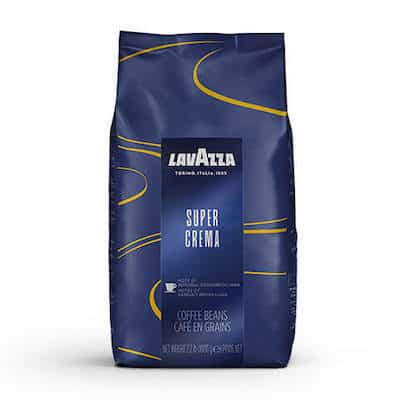
| Lavazza Super Crema | 1 kg | 32.34 | 32.34 | 3.23 |
| Kimbo Aroma Gold | 250 g | 8.26 | 33.04 | 3.30 |
| Illy Espresso Classico | 500 g | 20.44 | 40.88 | 4.09 |
| Cellini Prestigio | 1 kg | 50.68 | 50.68 | 5.07 |
The spread in price per gram is more than threefold: from 1.51 cents for Schwarz & Budil Espresso Blend to 5.07 cents for Cellini Prestigio. At the same time, the pack price on its own is misleading: Kimbo Aroma Gold at 8.26 € looks like a cheap purchase, but per kilogram it comes to 33.04 € — more than Lavazza Super Crema in a kilogram pack.
Step 2. Dose and cost per portion
In professional practice, espresso doses range from 7 to 9 g for a single shot and from 14 to 20 g for a double. The lower end of the double dose is closer to the classic Italian bar tradition, the upper end to modern specialty cafés with larger-capacity baskets. Within one venue there should be a single dose, written into the recipe card: the difference between 16 and 18 g for a double is 12.5 % of bean consumption — nobody will notice it in the cup, but everyone will notice it on the annual bill.
| Product | 7 g | 9 g | 14 g | 20 g |
|---|---|---|---|---|
| Schwarz & Budil Espresso Blend | 0.106 € | 0.136 € | 0.212 € | 0.302 € |
| Tchibo Exclusive Light | 0.126 € | 0.163 € | 0.253 € | 0.361 € |
| Segafredo Intermezzo | 0.147 € | 0.189 € | 0.294 € | 0.420 € |
| Lavazza Super Crema | 0.226 € | 0.291 € | 0.453 € | 0.647 € |
| Illy Espresso Classico | 0.286 € | 0.368 € | 0.572 € | 0.818 € |
| Cellini Prestigio | 0.355 € | 0.456 € | 0.710 € | 1.014 € |
This is the "net" cost of the dose — before waste. Note that for expensive products, the choice of dose affects cost more than the choice between neighbouring brands. Moving Cellini Prestigio from 14 to 20 g adds 0.30 € to every double — more than an entire double portion of Schwarz & Budil Espresso Blend costs.
Espresso-based drinks and filter coffee
In terms of coffee, an americano, cappuccino, flat white and latte are the same espresso, single or double; what differs is water, milk and volume. It is therefore more accurate to calculate not "the cost of a cappuccino" but "the cost of a shot", and then state in the recipe card which shot the drink is built on. For filter coffee (pour-over, batch brew, coffee in airpots at breakfast), the guideline is 55–65 g of ground coffee per litre of water; in the calculations below we use 60 g/l, i.e. 15 g per 250 ml cup.
In the next table the dose has already been multiplied by a factor of 1.08 — waste of about 8 %, which, as shown below, is typical for a bar selling around 100 portions a day.
| Drink (coffee share) | Dose, g | Tchibo Exclusive Light | Segafredo Intermezzo | Lavazza Super Crema | Illy Espresso Classico | Cellini Prestigio |
|---|---|---|---|---|---|---|
| Espresso; cappuccino or latte on a single shot | 8 | 0.156 € | 0.181 € | 0.279 € | 0.353 € | 0.438 € |
| Doppio; 300 ml americano, cappuccino or flat white on a double | 16 | 0.312 € | 0.363 € | 0.559 € | 0.706 € | 0.876 € |
| Filter, 250 ml cup (60 g/l) | 15 | 0.293 € | 0.340 € | 0.524 € | 0.662 € | 0.821 € |
| Filter, 1 l airpot for breakfast | 60 | 1.17 € | 1.36 € | 2.10 € | 2.65 € | 3.28 € |
To put it in perspective: at an illustrative espresso selling price of 1.80 €, the coffee share is about 10 % of the price with Segafredo Intermezzo, 15.5 % with Lavazza Super Crema, 19.6 % with Illy Espresso Classico and 24.3 % with Cellini Prestigio. This figure excludes milk, cup, labour and rent — but it is precisely what determines how much headroom remains for everything else.

Step 3. Waste: flushing, calibration, spillage
Waste is the most underestimated line. In a bean programme there are several kinds, and they behave differently.
Fixed daily waste hardly depends on sales. In the morning the barista dials in the grind: two or three test shots go down the sink. After each grind adjustment, some of the ground coffee left in the grinder's chute has to be purged — otherwise the next portion will be a mix of old and new grind. When a new bag is opened, or when humidity or room temperature changes, the dial-in is repeated. In our model we allow 40 g a day for this — an assumption, but a realistic one for a single grinder.
Variable waste grows with volume: spillage when dosing, coffee left in the grinder and on the counter, remade drinks (short pour, wrong order, a failed shot). For a carefully run bar it is reasonable to allow about 3 % of consumption.
Flushing the group head before inserting the portafilter uses water, not coffee; it does not affect coffee cost, but a habit of not flushing the group leads to an overheated first portion and extra remakes — in other words, back to variable waste.
Let us combine both components for an 8 g single portion:
| Sales, portions/day | Actual consumption per portion, g | Overconsumption vs. standard | Segafredo Intermezzo, € | Lavazza Super Crema, € | Cellini Prestigio, € |
|---|---|---|---|---|---|
| 20 | 10.24 | +28.0 % | 0.215 | 0.331 | 0.519 |
| 50 | 9.04 | +13.0 % | 0.190 | 0.292 | 0.458 |
| 100 | 8.64 | +8.0 % | 0.181 | 0.279 | 0.438 |
| 200 | 8.44 | +5.5 % | 0.177 | 0.273 | 0.428 |
The conclusion is simple: the fewer sales per grinder, the more expensive each cup — not because of the bean price, but because of calibration. A venue that sells 20 espressos a day is effectively paying for 10.24 g per cup, even though the recipe card says 8 g. Hence the practical measures: dial in the grind on two test shots rather than three; do not keep a second grinder for a second blend if its sales are low; log calibration shots so you can see the real figure rather than a guess.
Step 4. Cleaning and water in the cost
Cleaning agents for the group head and machine
Daily backflushing of the groups with detergent (using a blind filter) and regular cleaning of portafilters, shower screens and the grinder are not optional but a precondition for consistent flavour: coffee oils oxidise and add bitterness to the very next portions. For this the catalogue offers Coffee Clean, a cleaning agent for espresso machines, 900 g for 17.92 € — that is 1.99 cents per gram.
Take the exact dosage from the product label and your espresso machine's manual. For the calculation we will assume 4 g per group per day. One tub then covers 225 cleanings, i.e. 0.080 € per group per day; for a two-group machine about 0.16 € per day. At 100 cups a day this is 0.0016 € per cup.
The figure is tiny, which is exactly why it is often left out altogether. The right approach is the opposite: enter it in the recipe card as a separate line so that nobody "saves" on cleaning. Saving 0.16 € a day turns into a loss of quality that neither expensive beans nor a precise dose can make up for. Descaling tablets or powder (if the machine is not on softened water), group gaskets and shower screens, and service visits go into the maintenance budget separately — we account for them below in the annual maintenance sum.

Water: general principles
Water makes up more than 90 % of a cup of espresso and almost the entire cup of americano or filter coffee, so its quality is part of the cost, even though it does not show on the coffee invoice. The principles are general:
- hard water causes scale in the boiler and heat exchanger; scale reduces heat transfer, disrupts temperature stability and ultimately leads to repairs that cost many times more than filtration;
- water that is too soft or fully demineralised extracts coffee poorly — the taste becomes flat and sour — and can promote corrosion;
- a professional machine is fitted with a filtration or softening system selected on the basis of a local water analysis; cartridge capacity is counted in litres and converted into cost per cup in the same way as the cleaning agent;
- in capsule and pod machines, which often have no filter, regular descaling according to the manufacturer's schedule is sufficient.
The cost of filtration per cup is a few tenths of a cent with a correctly chosen cartridge; the cost of not filtering is a boiler repair and spoiled flavour.
Step 5. Comparing formats: beans, ground, pods, pads, capsules, instant
Now let us compare the cost per portion across the different formats in the catalogue. It is important to understand that these are not identical drinks: a SENSEO pad produces a filter-style cup, not an espresso; instant coffee is a category of its own. But these are exactly the options a venue chooses between, so it is worth comparing them.
| Format and product | Pack, € | Calculation | Coffee per portion, € |
|---|---|---|---|
| Instant: Schwarz & Budil Gold, 200 g | 8.82 | 2 g per cup; 44.10 €/kg | 0.088 |
| Beans 1 kg: Segafredo Intermezzo | 21.00 | 8 g + 8 % waste | 0.181 |
| Ground: Chicco d´Oro Tradition, 250 g | 5.88 | 23.52 €/kg; 8 g + 3 % | 0.194 |
| SENSEO pads: Tchibo Feine Milde, 100 pcs (750 g) | 25.62 | 7.5 g per pad | 0.256 |
| Beans 1 kg: Lavazza Super Crema | 32.34 | 8 g + 8 % waste | 0.279 |
| Ground decaf: Vergnano Decaffeinato, 250 g | 12.04 | 48.16 €/kg; 8 g + 3 % | 0.397 |
| E.S.E. pods: Citta d’Italia Extra Venice, 18 pcs | 14.00 | 14.00 ÷ 18 | 0.778 |
| Nespresso capsules: Tonino Lamborghini Deca, 10 pcs | 9.24 | 9.24 ÷ 10 | 0.924 |
Two caveats. For ground coffee we allow only 3 % variable waste: there is no grinder and no grind to calibrate. Capsules are currently represented in the catalogue by a single product — a decaffeinated coffee, Tonino Lamborghini Deca; when comparing with other capsules, substitute their price — the calculation principle stays the same.

However, the cost per portion is only one of five characteristics. The other four — equipment, labour, consistency and waste — often weigh more heavily in the decision.
Beans
Beans give the lowest espresso cost at normal sales volumes and full control over flavour: you set the dose, grind, temperature and recipe yourself. The price for this is expensive equipment (a professional espresso machine and a separate grinder, or a bean-to-cup machine), trained staff, and daily dial-in and cleaning. Consistency depends directly on people: the same coffee in the hands of two baristas can produce two different cups. Waste consists of coffee grounds, which require no special disposal, and packaging at the rate of one bag per 100–120 portions.
Ground coffee
Ground coffee in 250 g packs solves the problem of "we need espresso, but a grinder won't pay for itself" — for example, for a separate coffee that sells a few times a day. The typical case is decaf: keeping a second grinder for it and calibrating every morning makes no sense, whereas Vergnano Decaffeinato 250 g comes to about 0.40 € per portion — cheaper than decaf in a capsule at 0.92 €. The downside is that ground coffee loses its aroma faster once opened, and the grind cannot be adjusted to a specific machine, so consistency is lower than with correctly dialled-in beans. Chicco d´Oro Tradition 250 g at 5.88 € (23.52 €/kg) shows that the ground format is not necessarily expensive per gram.
E.S.E. pods
A pod is a portion of ground coffee pressed between two layers of filter paper; the E.S.E. standard specifies a tablet about 44 mm in diameter weighing about 7 g. It is placed in a compatible portafilter — no grinding, dosing or tamping. Consistency is high, training is minimal, and cleaning is simpler than with a bean group. The price is 0.78 € per portion for Citta d’Italia Extra Venice, i.e. about 111 €/kg when converted at 7 g. The waste is a used paper pod, with no plastic or aluminium. This is a sensible format for a restaurant with a small number of coffee orders or for a hotel where the bar is not open all day.

SENSEO pads
A pad is a soft filter sachet for SENSEO machines, which brew a cup at low pressure. The result is closer to a cup of filter coffee with a layer of foam than to an espresso. Tchibo Feine Milde comes in a pack of 100 pads with a total weight of 750 g, i.e. 7.5 g each and 0.256 € per cup. Machines of this type are domestic and inexpensive; maintenance boils down to descaling. The niche is the hotel room, the meeting room, the small office: places where a simple hot cup is needed without staff involvement and nobody expects an espresso.
Nespresso capsules
The capsule is the most consistent and easiest-to-operate format: one button, no grinding, no group cleaning, no calibration, and a long shelf life for an unopened capsule, because the coffee is protected from air. The price is the highest: 0.924 € per portion for Tonino Lamborghini Deca. The waste is used capsules, which must be collected and handed in according to the separate collection rules for their material. The format is justified where portions are few and there are no staff able to work with beans: a hotel room, an office, a pool bar, decaf in a restaurant.
Instant coffee
Schwarz & Budil Gold 200 g at 8.82 € yields about 100 cups at a 2 g dose — less than 0.09 € per cup. It is not a substitute for espresso but a solution for an in-room tea and coffee set, a staff kitchen, or catering with limited infrastructure. Consistency is absolute; the equipment is a kettle or a hot water dispenser.
Matrix by type of venue
Below are guidelines, not rules: the final choice depends on sales volume, staff skills and what the guest expects to see in the cup.
| Format | Café | Restaurant | Hotel, breakfast | Office | Hotel room |
|---|---|---|---|---|---|
| 1 kg beans + professional machine | main | main with steady sales | main for the espresso bar | at 25+ cups a day and a responsible employee | no |
| Beans for filter / batch brew | supplement (filter menu) | rarely | main for airpots | good for a large team | no |
| Ground 250 g | decaf | decaf | decaf | backup | no |
| E.S.E. pods | no | with few orders | evening bar, lobby | good | possible in suites |
| SENSEO pads | no | no | no | small offices | good |
| Nespresso capsules | no | decaf, banquet halls | lobby, pool | good | good |
| Instant | no | no | backup | staff kitchen | in-room set |
Step 6. Sales volume and the point where beans beat capsules
Comparing the cost per portion without accounting for equipment creates the illusion that beans are always cheaper. At small volumes this is not true: a professional espresso machine, a grinder and their maintenance are fixed costs that are divided by the number of cups sold. Let us calculate using an illustrative model.
Assumptions (illustrative — substitute your own):
- bean programme: two-group espresso machine and grinder — 7,200 € together, service life 5 years, 300 working days a year → 4.80 € per day;
- maintenance of the bean line (service, shower screens, gaskets, water filter) — 600 € a year → 2.00 € per day;
- cleaning two groups with Coffee Clean — 0.16 € per day (assuming 4 g per group);
- calibration — 40 g of Segafredo Intermezzo beans a day → 0.84 € per day;
- coffee per portion — 8 g of Segafredo Intermezzo plus 3 % variable waste → 0.173 €;
- capsule programme: machine 300 € over 3 years → 0.33 € per day plus 50 € a year for descaling and minor repairs → 0.17 € per day; capsule — 0.924 €;
- E.S.E. pods: machine 800 € over 5 years and 100 € a year for maintenance → 0.87 € per day; pod — 0.778 €.
In total, the fixed costs of the bean line are 7.80 € per day, those of the capsule line 0.50 € per day. The difference in variable costs is 0.924 − 0.173 = 0.751 € per cup in favour of beans. Break-even point: (7.80 − 0.50) ÷ 0.751 ≈ 9.7 cups a day.
But that is without labour. A bean programme requires a trained person and additional time — dialling in the grind, cleaning the groups, the grinder and the steam wand. If we add an illustrative 30 minutes of work a day at 15 €/h (7.50 € per day), the fixed costs of beans rise to 15.30 € per day and the break-even point shifts to 19.7 cups a day. For E.S.E. pods the corresponding points are 11.5 and 23.9 cups a day.
| Cups per day | Beans, no extra labour, € | Beans, with extra labour, € | Capsules, € | E.S.E. pods, € |
|---|---|---|---|---|
| 5 | 1.733 | 3.233 | 1.024 | 0.951 |
| 10 | 0.953 | 1.703 | 0.974 | 0.864 |
| 20 | 0.563 | 0.938 | 0.949 | 0.821 |
| 30 | 0.433 | 0.683 | 0.941 | 0.807 |
| 50 | 0.329 | 0.479 | 0.934 | 0.795 |
| 100 | 0.251 | 0.326 | 0.929 | 0.786 |
| 200 | 0.212 | 0.250 | 0.926 | 0.782 |
The table clearly shows how differently the formats behave. For capsules and pods the full cost barely depends on volume: the equipment is cheap and everything is determined by the price per portion. For beans, on the contrary, the full cost falls several-fold as sales grow: at 200 cups a day it is 4.4 times lower than for capsules. At 5 cups a day, the bean line including labour costs 3.23 € per cup — three times as much as a capsule.

The practical meaning of the calculation: for a café the question "beans or capsules" does not arise — at a hundred cups a day capsules are three to four times more expensive. For a restaurant with 15–30 coffee orders a day the difference is no longer so large, and the decisive factors become the skills of the shift and the guest's expectations. For an office with 10–15 cups a day, where nobody is responsible for the espresso machine, capsules or pods are almost always the more honest choice financially: a bean line without care quickly turns into an expensive source of bad coffee.
Roast for the task: Barbera Light, Medium and Dark Roast
The choice of roast also affects cost, though not as directly as the price per kilogram. The catalogue has a convenient trio from one brand: Barbera VI Generazione Light Roast (25.62 €/kg), Barbera IV Generazione Medium Roast (24.36 €/kg) and Barbera I Generazione Dark Roast (21.84 €/kg). The composition of the blends is not stated in the catalogue descriptions, so we compare only by roast level — which is given in the name.
For espresso with milk — cappuccino, flat white, latte — a dark or medium roast is usually chosen. A fuller body and bittersweet chocolate notes "cut through" 120–250 ml of milk better; a light roast often gets lost in a latte, and the barista compensates by increasing the dose — which means a direct increase in cost. Barbera I Generazione Dark Roast at 21.84 €/kg gives an 8 g portion with 8 % waste for 0.189 €.
For black espresso a medium roast is often more suitable: it retains sweetness and balance without dominant bitterness. Barbera IV Generazione Medium Roast — 0.210 € per 8 g portion with the same waste. If black and milk drinks sell equally on the menu, a medium roast is a sensible compromise for a single grinder.
For filter — batch brew at breakfast, pour-over, coffee in airpots — a light or medium roast is usually chosen: filter brewing brings out acidity and aroma better, while the bitterness of a dark roast becomes tiring in large volumes. Barbera VI Generazione Light Roast at 60 g/l costs 1.54 € per litre without waste, 1.66 € per litre with 8 % waste.
A light roast for espresso has to be ground finer and the recipe chosen more carefully; it usually takes more calibration shots. If the bar works with small volumes and changing shifts, this is one more argument for a medium or dark roast on the espresso line.

A separate word on products whose distinctive feature is stated in the name itself. Kimbo Caffe Crema Dolce 100% Arabica (26.88 €/kg) is for those who want to state "100 % Arabica" on the menu. Vergnano Espresso Bio Organic (30.80 €/kg), Segafredo Selezione Organica (28.28 €/kg) and Lavazza Tierra For Cuba Bio Organic (37.24 €/kg) are for venues where organic produce is part of the concept; in that case, check what labelling and supporting-documentation requirements apply when "organic" is stated on the menu. Segafredo Single Origin Wietnam (25.62 €/kg) is a single-origin coffee that can be offered as a separate menu item. Each such decision should be recalculated using the same formula: the difference from the base coffee, in cents per portion, must be covered by the menu price.
Freshness, storage and how fast a bag is used
Once the pack is opened, roasted coffee begins to lose aromatic compounds and oxidise. For beans in an opened bag, a reasonable guideline is to use it within one to two weeks; ground coffee loses its aroma much faster after opening, which is why 250 g packs for it are not a coincidence but a functional choice.
The storage rules are simple:
- close an opened bag tightly with a clip or transfer the coffee to an opaque airtight container, pressing out the air;
- put only as much into the grinder hopper as will be used during the shift, not the whole bag: in the hopper the beans sit in the light and in the heat from the machine;
- do not store coffee in the refrigerator: each time it is opened, moisture condenses on the cold beans; keep it in a dry, cool place, away from the espresso machine, the stove and spices;
- rotate stock on a "first in, first out" basis and write the opening date on the bag.
How many days an opened bag lasts in your venue is easy to calculate. We use the same consumption model: dose × 1.03 plus 40 g of calibration per day.
| Sales, portions/day | Daily consumption at 8 g | Days per 1 kg | Daily consumption at 16 g | Days per 1 kg |
|---|---|---|---|---|
| 5 | 81 g | 12.3 | — | — |
| 10 | 122 g | 8.2 | — | — |
| 20 | 205 g | 4.9 | 370 g | 2.7 |
| 50 | 452 g | 2.2 | 864 g | 1.2 |
| 100 | 864 g | 1.2 | 1,688 g | 0.6 |
| 200 | 1,688 g | 0.6 | 3,336 g | 0.3 |
At 20 or more portions a day, a kilogram bag is used up in a few days, and the freshness issue practically disappears. At 5–10 portions, a 1 kg bag stays open for 8 to 12 days — on the edge of what is reasonable. There are two solutions here: buy beans in 500 g packs (in the catalogue, for example, Illy Espresso Classico and Schwarz & Budil Espresso Blend) or 250 g (Kimbo Aroma Gold), or — if volume is going to stay small — switch to pods or capsules, where each portion is individually packed. Remember that smaller packs cost more per kilogram: 500 g of Illy costs 40.88 €/kg, and Kimbo Aroma Gold in 250 g costs 33.04 €/kg.
For warehouse stock, go by the best-before date stated by the manufacturer on the unopened pack and by your own rotation: order only so much that bags do not sit on the shelf longer than is needed for uninterrupted operation.
Examples: a restaurant and a hotel breakfast
Let us put it all together for an illustrative restaurant. Each day it sells 40 espresso-based drinks: 25 on a single shot (espresso, cappuccino) and 15 on a double (doppio, americano, flat white), plus 8 portions of decaf. The main coffee is Lavazza Super Crema, the decaf is ground Vergnano Decaffeinato, and the machine has two groups.
Bean consumption: 25 × 8 g + 15 × 16 g = 440 g according to the recipe cards; with 3 % variable waste and 40 g of calibration — 493.2 g a day. That is 15.95 € a day, or on average 0.399 € of coffee share per drink. Decaf: 8 × 8 g × 1.03 = 65.9 g, i.e. 3.17 € a day and 0.397 € per portion. Cleaning two groups — 0.16 € a day. In total, the coffee share is 19.28 € a day, about 0.40 € for any of the 48 coffee drinks, about 579 € over 30 days.
If the decaf were served in Tonino Lamborghini Deca capsules, eight portions would cost 7.39 € a day instead of 3.17 €, i.e. 126.5 € more per month. Capsules do have their own argument, though: they need neither a bag that has to be used up after opening nor space for a second portafilter. At eight portions a day, a 250 g pack of Vergnano Decaffeinato lasts about four days — within reason for ground coffee. If decaf sells one or two portions a day, the pack will stay open for two weeks or longer, and the capsule becomes justified. For its main coffee the restaurant will need about 14.8 kg of beans a month — this is the figure to build into the purchasing schedule.
For a hotel breakfast, the calculation starts from guests, not cups. Suppose 120 guests come to breakfast, 60 % of them drink filter coffee, and they drink on average 1.5 cups of 250 ml each. That is 108 cups, or 27 l of coffee; at 60 g/l, 1.62 kg of ground beans are needed. With Barbera IV Generazione Medium Roast and 8 % waste — 42.62 € per breakfast, 0.395 € per cup and 0.355 € per guest. It is this last figure that is convenient to include in the per-person breakfast cost.
Typical mistakes in calculating coffee cost
Comparing by pack price rather than price per kilogram. A bag for 8.26 € and a bag for 32.34 € come to 33.04 and 32.34 €/kg — practically the same price per gram. Always convert to €/kg.
Dose "on paper" rather than in practice. The recipe card says 8 g, but the barista uses 9–10 because "it tastes better" or the basket is designed for a larger volume. Once a week, weigh 10 consecutive doses on scales accurate to 0.1 g and compare them with the standard. A 1 g discrepancy on a single is 12.5 % overconsumption.
No waste line. If calibration and remakes are not accounted for, the actual cost at low sales turns out 20–30 % higher than calculated. Compare the weight of beans purchased in a month with the number of portions sold according to the till — this is the most honest way to find your waste factor.
An average dose per "coffee drink". A cappuccino on a single and on a double shot differ twofold in coffee share. Calculate for each menu item and state the shot in the recipe card.
Forgotten milk and disposables. In a takeaway drink, the cup, lid and milk together can exceed the cost of the coffee. The coffee share is only part of the cost.
Equipment left out of the calculation. Comparing beans and capsules by cost per portion alone always favours beans — but at 10 cups a day this is wrong. Spread depreciation and maintenance over the actual number of cups, not the planned number.
Saving on cleaning and water. The Coffee Clean line costs fractions of a cent per cup, but its absence shows up in bitterness and repairs. Without water filtration, service costs rise unpredictably.
Prices with and without VAT in one table. If you calculate margin excluding VAT, bring both the purchase price and the selling price to that base.
Calculating only once. Prices, doses and sales volumes change. Recalculate the recipe card whenever you change coffee, recipe or equipment, and check it against actual consumption at least once a quarter.
A short calculation procedure for your venue
- List all coffee items on the menu and, for each, the type of shot (single, double) or the dose for filter.
- Convert the prices of all packs in use to €/kg and cents per gram.
- Calculate the "net" dose cost for each item.
- Estimate fixed waste (calibration, changing bags) in grams per day and variable waste as a percentage; convert them into a per-portion factor based on your actual sales.
- Add cleaning: detergent per group per day divided by the number of cups.
- To compare formats, add depreciation and maintenance of equipment and, if needed, staff time.
- After a month, check the calculation against reality: kilograms purchased versus portions sold.
Such a calculation takes an hour and can then be updated in a few minutes. In return, decisions about changing coffee, choosing a format for a new hotel or moving an office from capsules to beans are made on the basis of figures rather than gut feeling.
If you are selecting coffee for a specific venue — an espresso bar, breakfast for a hundred rooms or an office — send us your menu and approximate sales volume. We will recalculate the cost for several products from the catalogue, suggest a format and pack size, and together with you choose what will work reliably at your volume.
Latest articles
 Table Setting for Hotel Breakfast: Guest Place, Service and Table ResettingThe guest table at hotel breakfast: what is set in advance, what the server brings, how to reset a table quickly and how many pieces you need for a room…Read more →
 Pu-erh in hospitality: sheng and shu, brewing, cost per cup and working with the Alveus rangeWe follow pu-erh from Yunnan raw leaf to the cup in a hotel room: sheng and shu production, two brewing methods, rinsing, teaware and the exact cost per serving based…Read more →
 Porcel Porcelain for Restaurants and Hotels: How It Is Made, Why It Lasts and How to Choose a SeriesHow Porcel hard-paste porcelain is produced, what the collection ratings mean and how to put together a set for a restaurant or banquet hall from the HoReCa Collections catalogue.Read more →