


Tea with milk, masala chai, chai latte and iced tea: black tea drinks for cafés
Black tea drink technique for the bar counter: which leaf stands up to milk, how to make a concentrate for the shift, calculate grams per serving and make iced tea.
In cafés, black tea has long stopped being just "a pot to go with dessert". Chai latte, masala chai, London Fog and iced tea on the terrace sell as signature drinks, at prices comparable to coffee drinks, while their raw-material cost is noticeably lower. But these drinks have their own technique: milk masks the flavour of a weak infusion, spices need to be boiled, and ice dilutes a drink almost twofold. Below is the practical engineering of these drinks: which leaf to choose for milk, recipes in grams and millilitres, concentrates for the shift, iced tea without cloudiness or hygiene risk, and the typical mistakes behind the counter. All items come from the Alveus tea range in the "Tea" section of the Verdamare catalogue.

Why milk needs a "dense" tea
Milk changes a drink in more than colour. Milk proteins, above all casein, bind tea polyphenols – the very compounds that give astringency and a drying sensation. That is why a strong infusion becomes softer and rounder with milk, while a weak one turns empty and watery: there is almost nothing to bind, and the milk adds another 15–70% of liquid to the volume. Hence a simple rule: a tea for milk must deliver more extract in the same time than a tea served "as is". There are three ways to achieve this – choice of leaf, dosage and method of extraction (boiling, concentrate).
Leaf grades: what the letters really mean
The letter codes on the package describe the size and appearance of the leaf after processing, not a "variety" in the everyday sense and not quality directly. What matters to a barista is something else: particle size determines extraction speed.
| Grade | Stands for | What it is physically | Behaviour in the infusion |
|---|---|---|---|
| OP | Orange Pekoe | Whole, long twisted leaf with no buds or only a small share of them | Slow extraction, even flavour, medium colour |
| FOP | Flowery Orange Pekoe | Whole leaf with a noticeable share of buds (tips) | Softer, more aromatic, less body |
| TGFOP | Tippy Golden Flowery Orange Pekoe | Whole leaf with a large amount of golden tips; the figure "1" marks the best lot within the grade | Delicate, layered flavour; intended to be served without milk |
| BOP | Broken Orange Pekoe | Broken leaf: smaller particles, larger surface area | Fast extraction, strong infusion, dark colour |
| Broken | General term for broken fractions | Broken leaf of various sizes | Similar to BOP |
| CTC | Crush, Tear, Curl | Machine processing: the leaf is turned into dense granules | Fastest extraction, maximum colour and "body", fewer aromatic nuances |
Whole leaf (OP, FOP, TGFOP) is usually produced by the orthodox method and is expensive primarily because of its aroma and complexity of flavour. Under milk, these nuances are the first to be lost. Broken leaf and CTC release their extract faster and more completely: in 3–4 minutes they give an infusion that stands up to 20–30% milk. That is why paying for TGFOP tips is not worthwhile for tea with milk – the milk "eats up" their contribution.
Assam, Kenya, Ceylon: what each one brings
Assam (north-east India) is the classic base for milk: malty, dense, with a high content of extractable substances. In the catalogue this means Assam BOP (81129), English Breakfast leaf (81359) and Irish Breakfast (81544) based on Assam, English Breakfast Broken Organic (82420) based on Assam BOP, and Morning Tea (84002) based on Assam CTC. A separate item is Assam TGFOP Second Flush Rembeng Organic (82525): a whole-leaf second-flush Assam that shines without milk or with only a small amount of it.
Kenya is bright and brisk, with pronounced astringency and a reddish infusion. A large share of Kenyan tea is produced by the CTC method and goes into "breakfast" blends. The catalogue offers the orthodox Kenya TGFOP1 Kaimosi (81838) with a recommended time of 2–4 minutes – a high-grade whole leaf that is more interesting served without milk; in a milk drink it can be added to a blend for brightness, but not used as the base.
Ceylon (Sri Lanka) has medium body, a lively acidity and a clean finish. Ceylon OP (81125) with milk is lighter than Assam; it works well where there is little milk, or as a base for flavoured teas. Earl Grey Deluxe Lady Star (84343) and a number of fruit teas are made on Ceylon – we will come back to this in the section on iced tea.
Blends of Assam and South Indian tea – Russian Blend Organic (82912), most of the Earl Greys and fruit compositions – offer a compromise: the body of Assam plus the softer South Indian tea.

English-style tea with milk
This is the basic drink on which all the subsequent technique is tested. The catalogue recommendation for Assam BOP (81129) is 12 g per litre, 100 °C, 3–4 minutes. For serving with milk, we recommend raising the dosage rather than extending the time: with long steeping, bitterness grows faster than "body".
| Parameter | Without milk (per catalogue) | For milk (recommendation) |
|---|---|---|
| Dosage | 12 g/l → 2.4 g per 200 ml | 15 g/l → 3.0 g per 200 ml |
| Water | 100 °C | 100 °C |
| Time | 3–4 min | 4 min (upper limit) |
| Milk | — | 30–40 ml, whole, cold or warmed to 50–55 °C |
| Servings per 100 g | ≈ 41 | ≈ 33 |
Whether milk goes into the cup before or after the tea is an old debate, but for a café it is more practical to serve the milk separately in a jug: the guest controls the proportion, and the drink does not cool down before serving. If milk is added at the counter, pour it into the finished, strained infusion, not onto the leaf: milk protein on the leaf slows extraction and leaves a film in the teapot.
For venues where tea with milk is ordered more often than without, it is convenient to keep one "milk" tea separate from the main menu: for example, Irish Breakfast (81544, 13 g/l) – it is based on Assam and, according to the catalogue, designed for a higher dosage than Ceylon OP.
Chai latte on the coffee machine steam wand
Here "latte" means a drink with more milk than tea, with the milk itself steamed and frothed. Simply transferring coffee logic – steeping a tea bag in a mug and topping it up with foam – gives a pale, milky drink with no tea flavour. The reason is arithmetic: a 250 ml cup holds about 170 ml of milk, and the tea part needs to be 3–4 times stronger than an ordinary infusion.
There are two methods that work.
Method 1: concentrate + frothed milk
The concentrate is prepared in advance (more on batches below), and at service the barista only froths the milk. For a spiced latte, Morning Tea (84002) is a good fit: the base is Assam CTC with cinnamon, ginger, black and pink pepper, cloves, cardamom and nutmeg. The catalogue recommendation is 12–15 g/l at 100 °C and 7–10 minutes; for the concentrate we use about 2.7 times this dose.
| Stage | Value |
|---|---|
| Water | 2,000 ml, 100 °C |
| Tea 84002 | 80 g (40 g/l) |
| Time | 8 min, then strain and gently press the leaf |
| Concentrate yield | ≈ 1,780 ml (the leaf retains ≈ 2.7 ml per gram) |
| Concentrate per serving | 80 ml |
| Milk per serving | 170 ml, frothed to 60–65 °C |
| Servings per batch | 22 |
| Tea per serving | ≈ 3.6 g |
| Servings per 100 g | ≈ 28 |
It is better to sweeten at service: 1:1 sugar syrup (10–15 ml) or honey as the guest prefers. If sugar is added to the whole batch, you lose the ability to sell an unsweetened version and shorten its shelf life.
Method 2: extraction directly in the pitcher
Suitable for low volumes and for a "seasonal" drink when keeping a concentrate is not worthwhile. Put 4 g of spiced tea into a 350 ml pitcher, pour over 60 ml of boiling water and let the leaf open for 2 minutes. Then add 180 ml of cold milk, steam it to 60–65 °C and strain through a fine sieve straight into the cup. The steam mixes the leaf with the milk, and extraction continues as the milk heats up. Drawbacks: the pitcher must be rinsed immediately, spice particles remain on the wand (purge it after every drink), and the strength depends on the barista more than when working with a concentrate.
Masala chai: boiling on the stove
Indian masala chai is a drink that is boiled, not steeped: the tea and spices are boiled first in water, then together with milk. Spices (cinnamon, cloves, ginger) need boiling temperature and time to release their essential oils and pungency; in a cup at 90 °C they open up only weakly. That is precisely why the catalogue gives a time of 7–10 minutes for spiced blends rather than 3–5.
How much tea there really is in a spice blend
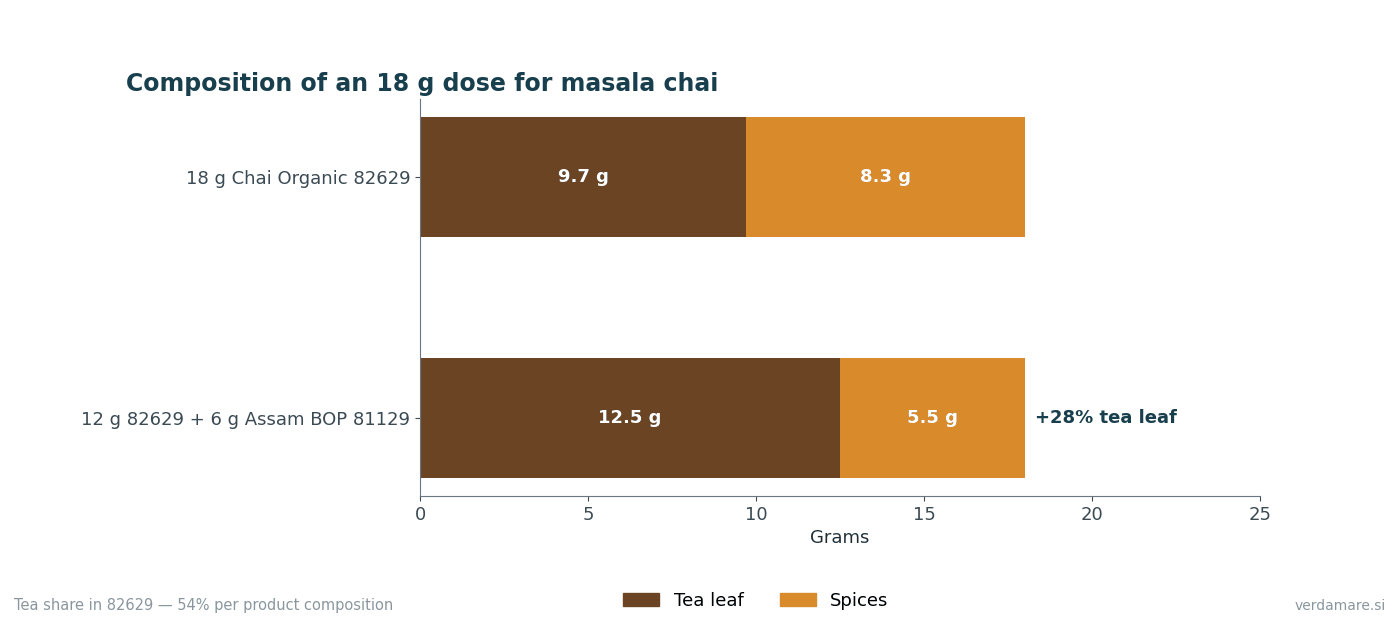
Chai Organic black tea (82629) is a blend in which Assam and South Indian black tea makes up 54%; the rest is cinnamon sticks, fennel, ginger, anise, cloves and ground cardamom. The catalogue dosage is 15–20 g/l. This means that 18 g of the blend contains only about 9.7 g of tea leaf, and 8.3 g of spices. When boiling with milk in a 1:1 ratio, this amount of tea is sometimes not enough: the spices come through brightly, while the tea base "falls through".
The solution is to fortify the blend with broken Assam. If you replace 6 g of the blend with Assam BOP (81129), i.e. take 12 g of 82629 + 6 g of 81129, the tea leaf rises to 12.5 g – 28% more at the same total weight – and the spices drop to 5.5 g instead of 8.3 g. The spiciness becomes slightly quieter, but the drink holds up to milk and sugar.
Recipe for 4 servings of 200 ml
| Step | Action | Time |
|---|---|---|
| 1 | Bring 500 ml of water to the boil in a heavy-bottomed saucepan | — |
| 2 | Add 18 g of blend (82629, or 12 g of 82629 + 6 g of 81129) and boil gently | 5 min |
| 3 | Pour in 500 ml of whole milk, add 40 g of sugar (according to the venue's recipe) | — |
| 4 | Bring to the boil without letting the foam rise, reduce the heat | 3 min |
| 5 | Strain through a fine sieve, press the leaf with a spoon | — |
| Yield | ≈ 850 ml: 4 servings of 200 ml + process residue | — |
Tea per serving is 4.5 g of blend; 100 g of blend gives about 22 servings. If the milk boils up and "runs over", reduce the heat at step 4 or stir: milk protein forms a foamy film that traps the steam.
Morning Tea (84002) as a masala base
In composition, Morning Tea (84002) is closer to Indian "street" masala chai: the base is Assam CTC, and the list of spices includes, besides cinnamon, ginger, cloves and cardamom, black and pink pepper and nutmeg. The manufacturer does not state the share of tea in the composition, so we do not convert it into grams of leaf. In practice: CTC extracts faster than broken leaf, and this blend usually does not need fortifying with Assam. The catalogue dosage is 12–15 g/l, time 7–10 minutes; when boiling according to the scheme above, use 15 g per litre of finished drink, and the boiling time in water can be reduced to 4 minutes: CTC granules release colour and body very quickly, and extra time only adds bitterness.
Comparison of the two blends at the counter:
| Parameter | Chai Organic 82629 | Morning Tea 84002 |
|---|---|---|
| Tea base | Assam and South India, 54% | Assam CTC (share not stated) |
| Spices | Cinnamon (sticks), fennel, ginger, anise, cloves, cardamom | Cinnamon (pieces), ginger, black and pink pepper, cloves, cardamom, nutmeg, natural flavouring |
| Catalogue: dosage / time | 15–20 g/l / 7–10 min | 12–15 g/l / 7–10 min |
| Character | Sweetish and aniseed, fennel, gentle spice | Peppery heat, cinnamon, dense tea base |
| Best use | Boiling with milk, seasonal drinks | Concentrate for lattes, masala chai at volume |
Concentrates and batches for volume
When chai lattes and masala chai sell by the dozen per shift, brewing "for each cup" stops working: service time grows and strength fluctuates. A concentrate solves both problems – the drink is assembled in the time it takes to froth the milk, and the flavour is the same for every barista.
How to prepare a concentrate for the shift
- Weigh the tea and the water rather than measuring "by eye": on a 2 l batch with 80 g of tea, an error of 10 g changes the strength by 12.5%.
- Use boiling water (100 °C) and a closed container – spice aromatics are volatile.
- Time: 8 minutes for CTC blends, 10 minutes for blends with cinnamon sticks and whole spices.
- Strain through a sieve, then press the leaf lightly. Pressing hard squeezes out bitter tannins and fine sediment, and the concentrate turns cloudy.
- Cool quickly: put the container of concentrate into an ice bath, then into the refrigerator. The aim is to pass through the 60–10 °C range, in which micro-organisms multiply actively, as fast as possible.
- Label it: name, time of preparation, "use by".
We recommend storing pure concentrate without milk or sugar in a closed container at 0–4 °C and using it within 48 hours. Mixtures with milk (finished masala chai, a pre-mixed "latte base") – only within one shift and under constant refrigeration. This is an internal standard worth anchoring in your HACCP-based procedures, which are required by Regulation (EC) No 852/2004 on the hygiene of foodstuffs.
Comparison: grams per serving and yield per 100 g
Below is a summary table of the recipes in this article. Prices for Alveus tea are not published in the catalogue; they are provided on request, so cost is calculated in grams. For illustration, a column with a notional price of 7.00 € per 100 g has been added – this is an example for calculation, not a catalogue price.
| Drink | Tea | G per serving | Servings per 100 g | Tea per serving at a notional 7 €/100 g |
|---|---|---|---|---|
| English-style tea with milk, 200 ml | 81129 | 3.0 | 33 | 0.21 € |
| Chai latte from concentrate, 250 ml | 84002 | 3.6 | 28 | 0.25 € |
| Stovetop masala chai, 200 ml | 82629 | 4.5 | 22 | 0.32 € |
| London Fog, 250 ml | 84063 | 4.0 | 25 | 0.28 € |
| Flash-chill iced tea, single serving ≈ 380 ml | any of the fruit teas | 5.0 | 20 | 0.35 € |
| Flash-chill iced tea, dispenser, 300 ml | any of the fruit teas | 3.9 | 26 | 0.27 € |
| Cold brew, 300 ml | any of the fruit teas | 3.7 | 27 | 0.26 € |
To recalculate for your own purchase price, multiply the grams per serving by the price of one gram (price per 100 g ÷ 100). Milk, syrup and cups are not included in this calculation – in milk drinks their cost is usually higher than the cost of the tea.

London Fog and the Earl Grey family
London Fog is Earl Grey with vanilla syrup and frothed milk. It is perhaps the tea latte guests understand most easily: the familiar bergamot aroma, the softness of vanilla, coffee-style service.
London Fog recipe, 250 ml
| Component | Quantity | Parameters |
|---|---|---|
| Earl Grey Organic (84063) | 4 g | Steep in 120 ml of water, 100 °C, 4 min |
| Infusion yield | ≈ 109 ml | Strain |
| Vanilla syrup | 15 ml | Into the cup with the infusion |
| Milk | 130 ml | Froth to 60–65 °C, pour into the infusion |
| Total | ≈ 254 ml | 300 ml cup with room for foam |
The infusion concentration here is about 33 g/l – noticeably higher than the catalogue's 12–15 g/l. This is deliberate: the infusion is diluted with more than its own volume of milk.
Why bergamot behaves differently with milk
The aroma of Earl Grey is created by volatile compounds in bergamot oil (mainly terpenes and esters). They are poorly soluble in water and readily soluble in fats. In milk, these substances partly "move" into the fat phase and bind to proteins: the top, bright citrus note is muted, leaving a rounder, "creamy" bergamot. In addition, volatile compounds evaporate easily when heated. Hence two practical rules:
- never froth milk together with Earl Grey (the "extraction in the pitcher" method is not suitable for London Fog – the steam drives out the bergamot);
- steep it strong and covered, and add the milk at the last moment.
Which Earl Grey for which drink
| Item | Base | Declared flavour | Catalogue | Best for |
|---|---|---|---|---|
| Earl Grey Organic (84063) | Assam and South India | bergamot | 12–15 g/l, 3–5 min | London Fog, tea with milk |
| Blue Earl Grey Organic (84064) | Assam and South India | bergamot | 12–15 g/l, 3–5 min | London Fog, served in a teapot |
| Russian Earl Grey (81008) | Assam and South India | grapefruit, lemon and bergamot | 12–15 g/l, 3–5 min | Iced tea, tea without milk |
| Earl Grey Darjeeling (84194) | Darjeeling (99%) | bergamot | 12–15 g/l, 3–4 min | Without milk, iced tea |
| Earl Grey Deluxe Lady Star (84343) | Ceylon | bergamot and lemon | 12 g/l, 2–4 min | Iced tea, served with lemon |
Earl Grey Darjeeling is built on Darjeeling – a tea with a light body and delicate aroma. Milk completely covers its character, so in a latte it loses out to the Assam-based version; in iced tea and served without additions, however, it is the most elegant. Lady Star on Ceylon with a lemon note calls for a slice of lemon – and here lies a trap: lemon and milk in the same cup are incompatible (see the section on milk). It makes sense to place the citrus Earl Greys in the "milk-free" part of the menu.
Dark sweet variations
A separate group of drinks that sells well in the cold season and with desserts is tea lattes with dark sugars and caramel notes. They share the same logic: a dense tea base (Assam, CTC or a spice blend), a sweetener with a pronounced flavour of its own, and milk.
| Drink | Base | Sweetener | Assembly for 250–300 ml |
|---|---|---|---|
| Dark sugar latte | 80 ml of 84002 concentrate | 10 g of dark cane sugar (muscovado) | Dissolve the sugar in the hot concentrate, then 170 ml of frothed milk |
| Honey cinnamon latte | 4 g of Autumn Dream (84176) in 100 ml of water, 100 °C, 5 min | 10 g of honey | Honey into the hot infusion, then 150 ml of milk |
| Orange spice latte | 4 g of Orange and Cinnamon (84170) or Black Christmas Tea Organic (84061) in 100 ml of water, 5 min | 10 ml of caramel syrup | 150 ml of milk, orange zest on top – no juice |
| Dirty chai | 80 ml of 84002 concentrate | 10 ml of sugar syrup | 1 espresso (≈ 30 ml) + 140 ml of milk |
A few technical details. Dissolve dark sugar and honey in the hot tea part before adding milk: in milk at 60 °C they dissolve more slowly and may settle at the bottom. Honey should not be boiled with milk on the stove – its aroma turns flat with prolonged heating. For fruit-and-spice lattes based on flavoured teas, keep the time at the upper limit of the catalogue range (5 minutes) and the dosage at about 40 g/l of water, because there is only 100 ml of infusion in the drink. Consumption per serving is 4 g, which is 25 servings per 100 g.
Dirty chai is a hybrid for coffee shops: spiced tea with espresso. The coffee plays the role of the "bitter body" here, so it is better not to sweeten the concentrate in advance but to add the syrup according to the recipe standard. The caffeine content of such a serving is noticeably higher than that of an ordinary tea latte – this is worth mentioning in the drink's menu description.
Iced tea: double-strength brewing, cold brew and terrace batches
Cafés make iced tea in two main ways. Both give a clear, aromatic drink if the arithmetic is respected.
Flash-chill: hot brewing straight onto ice
The principle: brew in half the volume of water at double the dosage and pour it over ice whose mass equals the mass of the water. The ice melts, diluting the infusion to normal strength, and at the same time chills it within seconds. Rapid cooling preserves the aroma and reduces clouding (so-called "tea cream" – a sediment of caffeine–polyphenol complexes that precipitates when a strong infusion cools slowly).
Single serving:
- 5 g of tea (double dose: ≈ 25 g/l of hot water);
- 200 ml of water, 100 °C, 4 minutes;
- after pressing, ≈ 186 ml of infusion at about 92 °C remains;
- pour it into a shaker or pitcher over 200 g of ice.
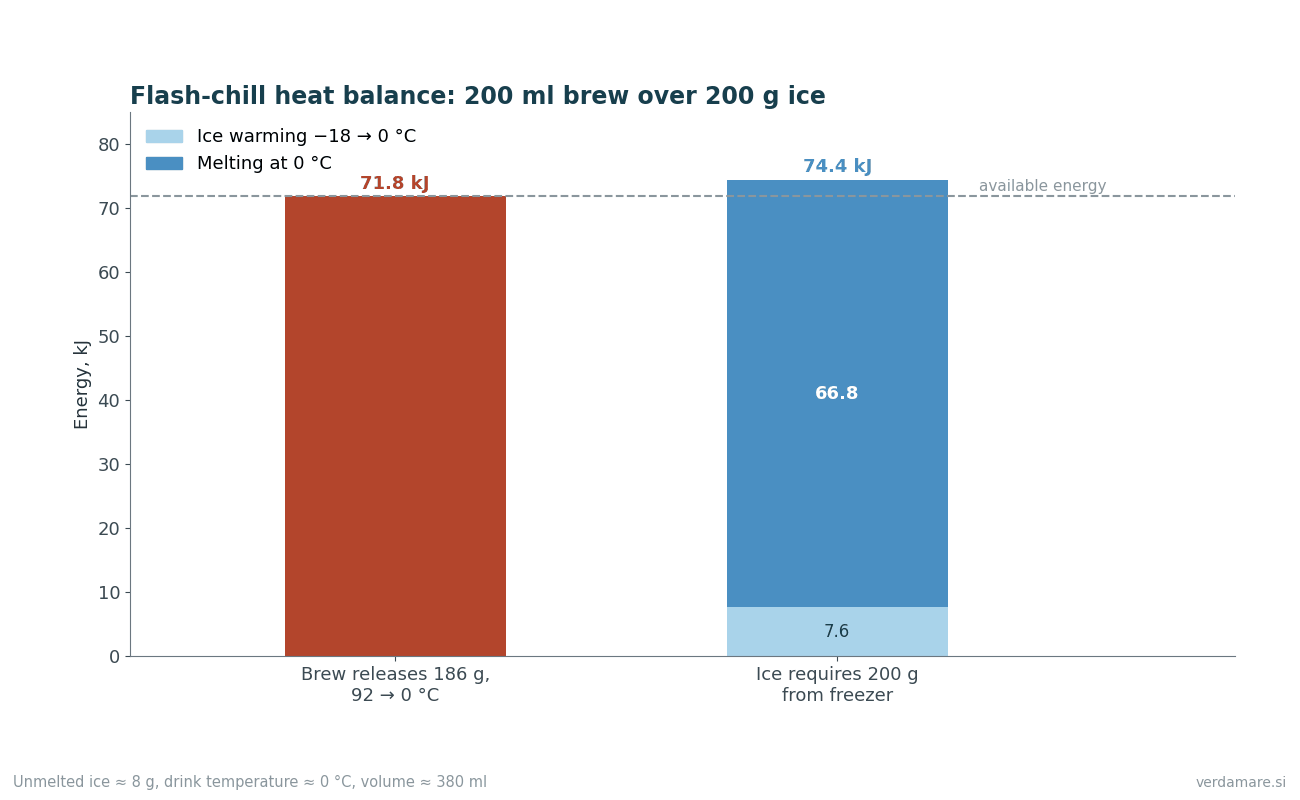
Let us check the heat balance. Cooling 186 g of infusion from 92 to 0 °C releases about 71.8 kJ. Melting 200 g of ice at 0 °C requires 66.8 kJ. If the ice comes from a freezer at −18 °C, another 7.6 kJ goes into warming it to 0 °C – 74.4 kJ in total. So almost all the ice melts (about 8 g remains), and the drink immediately reaches a temperature of about 0 °C. The volume is about 380 ml of slightly diluted tea; it is served in a 400–450 ml glass over fresh ice.
Terrace batch: 5-litre dispenser
| Stage | Value |
|---|---|
| Water | 2,500 ml, 100 °C |
| Tea | 62.5 g (25 g/l of hot water) |
| Time | 4 min, strain |
| Ice | 2.5 kg in the dispenser or a gastronorm container |
| Yield | ≈ 4.8 l |
| Serving | 300 ml of tea in a glass over ice |
| Servings | 16 |
| Tea per serving | ≈ 3.9 g |
Add sugar and syrups to the hot infusion before pouring it onto the ice – in cold tea, sugar dissolves slowly and settles. Put citrus slices in the glass, not in the dispenser: prolonged contact with the peel produces bitterness, and the flesh itself is a medium for micro-organisms.
Cold brew
The tea is covered with cold water and steeped in the refrigerator for 8–12 hours. There is no hot phase, so fewer tannins and less caffeine are extracted: the flavour is soft, sweetish, with almost no astringency, and there is no clouding on cooling. The method works well for fruit teas and Earl Greys, where aroma matters more than astringency.
| Parameter | Value |
|---|---|
| Water | 3,000 ml of cold drinking water |
| Tea | 36 g (12 g/l) |
| Time | 10 h at 0–4 °C, container closed |
| Yield | ≈ 2.9 l (cold leaf retains ≈ 3 ml per gram) |
| Servings of 300 ml | 9 |
| Tea per serving | ≈ 3.7 g |
Cold brew is made only in the refrigerator. Steeping at room temperature or "in the sun" (sun tea) is dangerous: several hours at 20–40 °C are ideal conditions for bacterial growth, and there is no boiling water to reduce the initial microbial load. For the same reason, we recommend using finished iced tea within 24 hours, or at most 48 hours at 0–4 °C. A dispenser on a sunny terrace should not stand there all day: keep in it the volume for 2–3 hours of sales, and the rest in the refrigerator.
Which black teas from the catalogue for iced tea
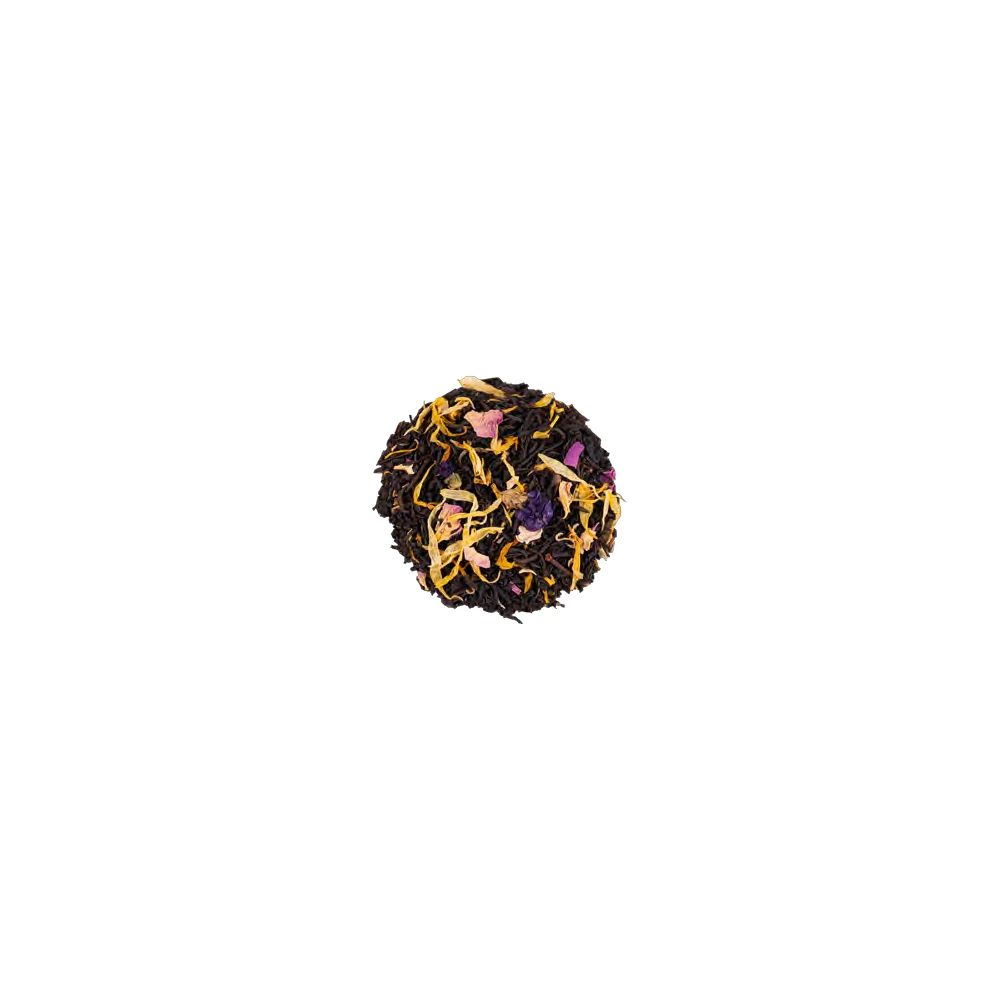
All the fruit black teas in the range share the same catalogue parameters – 12–15 g/l, 100 °C, 3–5 minutes – so the recipes above apply to any item without readjustment.
| Item | Base | Declared flavour | Use in iced tea |
|---|---|---|---|
| Andalusian Sun (84212) | Assam and South India | passion fruit and guava | Tropical iced tea, good with lime |
| Wild Cherry (84191) | Ceylon | wild cherry | Cold brew, berry tea lemonades |
| Forest Berries Organic (83395) | Assam and South India | forest berries | Terrace batch |
| Blackberry Tango (82454) | Assam and South India | red berries | Iced tea with sparkling water |
| Morning Light (84258) | Ceylon | mango and bergamot | A bridge between Earl Grey and fruit iced tea |
| Thousand Flowers (84987) | Ceylon | apricot and orange | Mellow iced tea without syrup |
Ceylon bases give a lighter, clearer iced tea; Assam and South Indian blends give a darker, denser one. The "warm" items – Orange and Cinnamon (84170), Autumn Dream (84176, baked apple and cinnamon) and Black Christmas Tea Organic (84061, cinnamon and orange) – are better used in the cold season as a base for sweet milk drinks: cinnamon pairs well with milk, and the orange note in the form of flavouring does not cause curdling, unlike fresh juice.
Lapsang Souchong: a smoky accent without alcohol
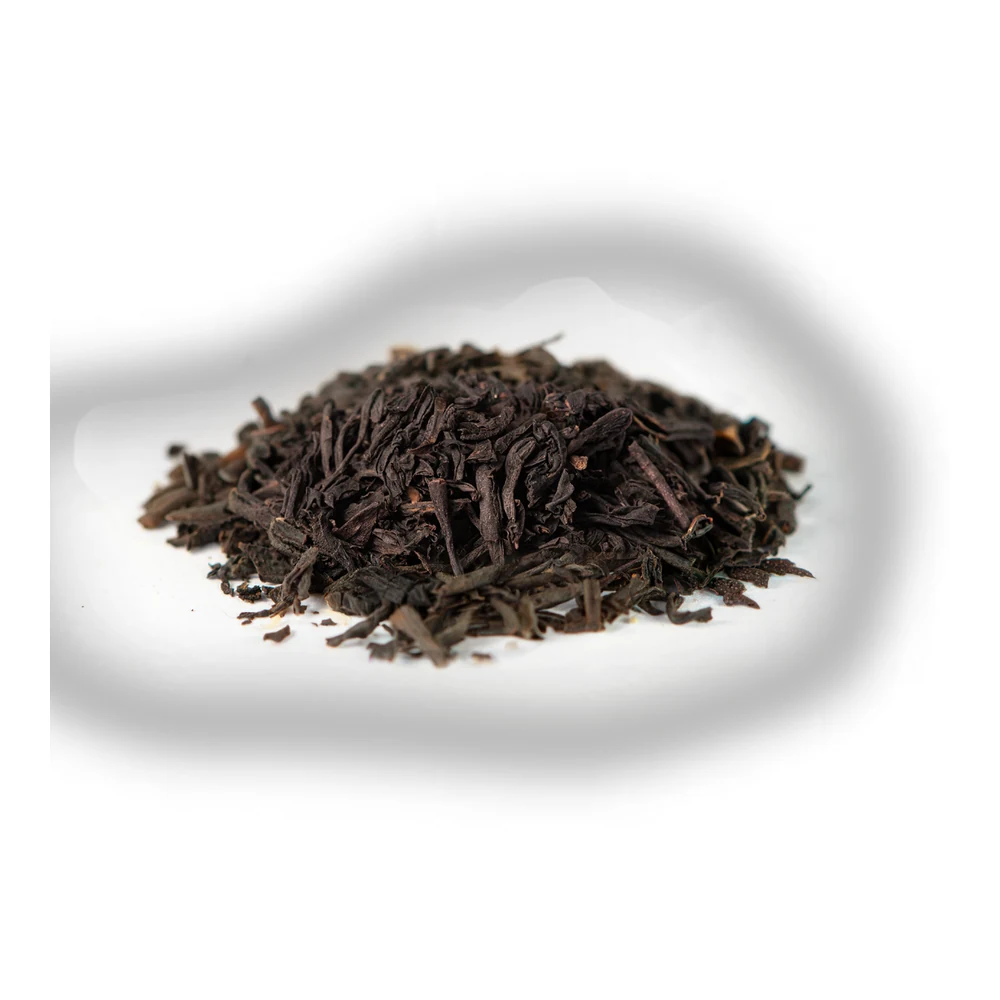
Lapsang Souchong Organic (82911) is a black tea dried over the smoke of softwood. Its strength lies in small doses: as a stand-alone drink it does not appeal to everyone, but as an accent it gives drinks a depth that bartenders usually get from whisky or mezcal.
Three ways to use it:
Smoked tea with milk. A 1:9 blend – 0.3 g of Lapsang to 2.7 g of Assam BOP (81129) per 200 ml serving. The smoke reads as a background reminiscent of caramel and smoked vanilla. Above 20%, with milk it already comes across as a "campfire".
Smoked syrup. Steep 10 g of Lapsang in 250 ml of boiling water for 5 minutes, strain (yield ≈ 223 ml) and dissolve 250 g of sugar in the hot infusion. The yield is about 380 ml of syrup, or 25 servings of 15 ml; tea per serving is about 0.4 g. Store the syrup in the refrigerator in a closed bottle; set its shelf life according to your HACCP system. Uses: smoked London Fog (replace half of the vanilla syrup), iced tea with orange, non-alcoholic tea-based "old fashioneds" with bitter orange notes.
Cold Lapsang. Cold brew at 8 g/l, 10 hours in the refrigerator: the smoke becomes softer and sweeter than with hot brewing. Mix 1:3 with cold Thousand Flowers tea (84987) to get an apricot-and-smoke iced tea.
Milk and plant-based alternatives
Half of the mistakes in tea lattes are mistakes in handling milk, not tea.
Temperature
Cow's milk is frothed to 55–65 °C. Above 70 °C, milk proteins denature more strongly, the foam becomes coarse and unstable, and the sweetness of lactose is no longer perceptible – a "boiled" taste appears. For tea drinks there is one more argument for a moderate temperature: the drink is assembled from a hot concentrate, so the overall temperature in the cup will be higher than that of the milk itself. The working target is 60–65 °C on the pitcher thermometer.
Stovetop masala chai is the exception: there the milk boils deliberately, as part of the drink's style.
Fat content and foam
Whole milk (about 3.5% fat) gives the most balanced texture and holds the aromatics of spices and bergamot best. Skimmed milk froths abundantly, but the foam is dry and the tea flavour seems harsher.
Plant-based alternatives
| Drink | Behaviour with black tea | Practice |
|---|---|---|
| Oat (barista version) | Stable, dense foam, sweetish flavour pairs well with spices | The best choice for chai lattes and masala chai |
| Soy | May curdle on contact with a hot, astringent and acidic infusion | Use the barista version, pour the tea into the milk rather than the other way round, do not overheat |
| Almond | Thin, the foam collapses quickly, the tea flavour comes through more strongly | Increase the concentrate by 10–20% |
| Coconut | Pronounced flavour of its own | Good with spiced and tropical teas |
Barista versions of plant-based drinks contain acidity regulators and stabilisers – these are what reduce the risk of curdling. With soy and almond drinks, "tempering" helps: first add a little cold drink to the hot concentrate, stir, then pour in the frothed drink.
Curdling and acidic additions
Milk proteins (casein) coagulate under the combination of acid and heat. In practice this means: lemon, fresh orange juice, acidic fruit purées and milk do not go together in the same hot cup. Flavourings in a tea's composition (bergamot, "orange", "cherry") do not add acid by themselves and do not curdle milk. Curdling is caused by a real acidic ingredient. If your menu has a "citrus latte", add the citrus as zest or as a zest-based syrup.
Equipment, serveware and portioning
Tea drinks do not require a separate equipment line, but some items make the work reproducible.
| Task | Equipment and serveware | Comment |
|---|---|---|
| Weighing | Scales with 0.1 g resolution | A 0.5 g difference per serving means 15–17% in strength |
| Boiling water | Water heater or kettle reaching 100 °C | For concentrates, it is boiling temperature that matters |
| Timer | Multi-channel timer on the counter | 3, 4, 8, 10 minutes – different drinks at the same time |
| Boiling masala chai | 2–3 l heavy-bottomed stainless steel saucepan | A thin bottom scorches the milk |
| Straining | Fine-mesh sieve, teapot with a mesh filter | Spices and CTC produce fine sediment |
| Frothing | 350 and 600 ml pitchers, thermometer | A separate pitcher for spiced tea drinks – so as not to "flavour" the cappuccino |
| Concentrate storage | 1–2 l bottles or gastronorm containers with lids, labelling | Volume for one shift, no more |
| Iced tea | 5 l dispenser with tap, ice machine, ice bath | Wash the dispenser daily, take the tap apart |
| Serving hot drinks | 250–300 ml cups | A latte needs extra volume for the foam |
| Serving cold drinks | 400–450 ml glasses | Ice + 300 ml of tea |
You will find serveware and teapots in the catalogue section "Tableware" → "For Tea and Coffee", and washing pitchers, dispensers and concentrate bottles is conveniently covered by equipment from the "Dishwashing Equipment" section.
For portioning dry tea at a busy counter, pre-weighed portions in small closed jars or bags for the shift are convenient: 3.0 g for tea with milk, 4.0 g for London Fog, 5.0 g for a single iced tea. The barista does not waste time on the scales, and consumption is easy to reconcile against the remaining stock at the end of the day.
Typical mistakes and their causes
Weak chai latte. Cause: the tea was brewed "as for a cup", while there is three times as much milk in the drink. Solution: a 40 g/l concentrate or a dedicated 4 g dose in 60 ml of water in the pitcher.
Bitter concentrate. Cause: steeping too long (more than 10 minutes) or pressing the leaf hard. Solution: a fixed time on a timer and light pressing.
Bland masala chai with a strong spice smell. Cause: not enough tea leaf in the spice blend. Solution: fortify it with broken Assam, as in the section on masala chai.
Masala chai "boiled over". Cause: strong heat after adding the milk. Solution: a gentle boil and stirring, a saucepan with spare volume (at least 2 l per 1 l of drink).
Cloudy iced tea. Cause: a strong infusion cooled slowly (on the counter, in a closed container). Solution: flash-chill onto ice or cold brew.
Watery iced tea. Cause: a normal-strength brew poured onto ice. Solution: double dosage in half the volume of water.
Flat London Fog. Cause: the Earl Grey was frothed together with the milk or steeped uncovered. Solution: a strong infusion steeped covered, milk at the end.
Curdled milk. Cause: lemon or fresh juice in a milk drink, an overheated soy drink. Solution: citrus only as zest, barista versions of plant milk, temperature up to 65 °C.
Spices in the cappuccino. Cause: a shared pitcher and an unpurged steam wand. Solution: a separate labelled pitcher and purging the wand after every tea drink.
Iced tea from the dispenser is "not right" by evening. Cause: the dispenser stood in the sun all day. Solution: fill it for 2–3 hours, keep the rest at 0–4 °C, use within 24 hours.
Shift launch checklist for drinks
| Time | Action |
|---|---|
| Opening | Brew the latte concentrate (2 l of water + 80 g of 84002), cool, label |
| Opening | Set up the cold brew for the next day (3 l + 36 g), put it in the refrigerator |
| An hour before the terrace rush | Flash-chill 2.5 l onto 2.5 kg of ice in the dispenser |
| Every 2–3 hours | Check the volume and temperature of the iced tea, top up from the refrigerator |
| During the shift | Masala chai – boil in batches of 4 servings |
| Closing | Discard expired concentrates, wash the dispenser, pitchers and sieve |
If you are planning to add chai lattes, masala chai or iced tea to your menu, the Verdamare team will help you select Alveus items for your drinks, calculate consumption for your volume and advise on serveware and equipment for the counter. Request availability and prices for tea through the catalogue – we will reply with the delivery time from our warehouse near Koper.
Latest articles
 Table Setting for Hotel Breakfast: Guest Place, Service and Table ResettingThe guest table at hotel breakfast: what is set in advance, what the server brings, how to reset a table quickly and how many pieces you need for a room…Read more →
 Pu-erh in hospitality: sheng and shu, brewing, cost per cup and working with the Alveus rangeWe follow pu-erh from Yunnan raw leaf to the cup in a hotel room: sheng and shu production, two brewing methods, rinsing, teaware and the exact cost per serving based…Read more →
 Porcel Porcelain for Restaurants and Hotels: How It Is Made, Why It Lasts and How to Choose a SeriesHow Porcel hard-paste porcelain is produced, what the collection ratings mean and how to put together a set for a restaurant or banquet hall from the HoReCa Collections catalogue.Read more →