


White Tea on Your Menu: Buds and Leaves, Re-Steeping, Cold Brew and Food Pairing
How to work with white tea in hospitality: why buds and leaves need different doses, how many infusions the tea can take, how to calculate servings per pack and how to make cold brew safely.
On a bar menu, white tea usually takes up a single line: "white, 75 °C, 3 minutes". In practice, that one word covers very different products. A pot of pure buds and a pot of a bud with two leaves behave differently in dosage, steeping time, number of infusions and even in the teaware they need. And some of the items sold under "White Tea" are actually built on a green tea base. If all of this is reduced to one brewing setting, guests get a cup that is sometimes watery, sometimes flat, sometimes astringent, and the venue gets an unpredictable cost per serving.
In this article we look at white tea as a working bar product: what actually happens to the leaf during production and why it matters for brewing, how to calculate servings per 100 g and per kilogram for a single steep and for re-steeping, how to organise cold brewing in summer without breaching hygiene requirements, how to position flavoured blends honestly and which dishes white tea works best with. The examples are based on Alveus products from the "Tea" → "White Tea" section at verdamare.si.
How white tea is made and what that means in the cup
Two steps instead of five
White tea has the shortest processing chain of all the classic tea types. The raw leaf is withered and then dried. The product description for China Pai Mu Tan ORGANIC (item 82536) puts it plainly: "minimal processing — withering and drying". By comparison, green tea undergoes fixation after picking — the leaf is heated in a pan, a drum or with steam to inactivate the enzymes and stop oxidation; it is then rolled and dried. Red (black) tea is rolled deliberately to break the cells and trigger full oxidation.
White tea has neither fixation nor rolling. This has three consequences that directly affect the bar.
First, the leaf and bud remain whole. The cell walls are only minimally damaged, so the extractable compounds come out more slowly than from rolled tea, let alone cut tea. Slow extraction means both a gentle first cup and enough reserve for several infusions.
Second, the enzymes are not harshly inactivated. During withering a light natural oxidation takes place, which is why white tea tastes different from green tea: fewer "grassy" and "roasted" notes, more sweetness, and more floral, honeyed and fruity nuances. For the same reason white tea continues to change during storage — we will come back to this in the section on ageing.
Third, the dry leaf is very bulky and light. An unrolled bud or an open leaf takes up several times more space than the same weight of tightly rolled green tea. This affects dosing: a measuring spoon that works reasonably well with granulated black tea gives results that vary several-fold with white tea. In a venue, white tea is dosed by weight only, on scales with 0.1 g resolution.
Down, cloudiness and a "pale" infusion
The buds are covered in fine white hairs — hence names such as "Silver Needle" and "White Peony". The description of the Nepalese Shangri-La under Himalayan Snow Mountain Organic (item 89008) says exactly that: "buds covered in white down". In the cup, the down gives a slight opalescence and tiny hairs on the surface. This is a normal sign of high-quality bud material, not a defect and not dust. It helps if staff know this in advance, so they do not strain the infusion through too fine a sieve or replace a "cloudy" tea.
The infusion of bud teas is light, straw-coloured and often almost colourless in the first steep. Judging its strength by eye is pointless: a guest used to the colour of black tea may think the tea "hasn't brewed". Presentation helps here — a glass teapot or glass in which the opened buds are visible, plus a short sentence from the server explaining that the pale colour is a characteristic of the tea.
Grades of raw material: buds, bud with leaves, Mao Feng
White teas are distinguished first of all by which part of the shoot was harvested. This determines the density of the dry tea, the extraction rate and, consequently, the dose and steeping time.
Buds only: Yin Zhen and Nepalese Shangri-La
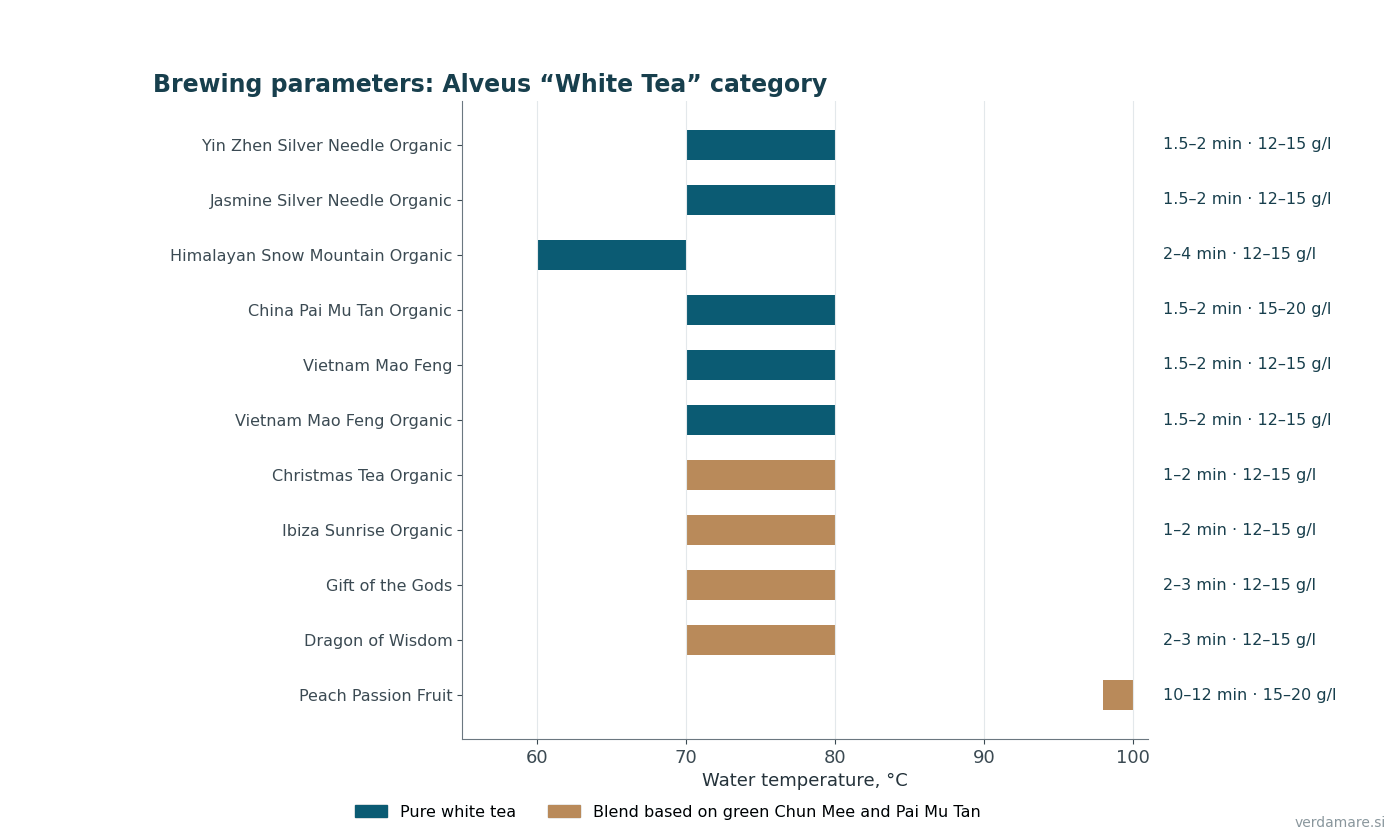
Yin Zhen "Silver Needle" Organic (item 82736) is a Chinese Dragon Silverneedle from the Fuding region, spring harvest, described as "only top-quality buds", with a sweetness reminiscent of cantaloupe melon. Brewing guide on the product page: 12–15 g per litre, 1.5–2 minutes, 70–80 °C, 250 g pack.
Himalayan Snow Mountain Organic (item 89008) is also a bud tea, but from Nepal: the Ilam valley, at an altitude of 1,600 m, with a mild, slightly sweet taste. Note the brewing guide: 12–15 g/l, but water at 60–70 °C and a time of 2–4 minutes. This is the "coolest" item in the category. The logic is clear: at a lower temperature extraction is slower, so the time is longer, and the tea's mild profile is not overpowered by astringency.
Buds are denser and heavier than open leaves, so a smaller dose is enough — 12–15 g/l compared with 15–20 g/l for Pai Mu Tan. At the same time, buds release their compounds slowly: the first infusion is light and delicate, while the second and third are often fuller than the first.
Jasmine Silver Needle Organic (item 82090) belongs to the same group in terms of raw material: Chinese buds scented with jasmine, 12–15 g/l, 1.5–2 min, 70–80 °C, 250 g pack. Jasmine noticeably changes where the tea can be used — more on this below, in the section on food pairing.
Bud and one or two leaves: Pai Mu Tan
China Pai Mu Tan ORGANIC (item 82536), also known as Bai Mu Dan or "White Peony", is harvested as a bud plus young leaves. The leaf adds more body, a light astringency, notes of dried fruit and flowers, and more volume in dry form. Brewing guide on the product page: 15–20 g/l, 1.5–2 minutes, 70–80 °C, 100 g pack.
The dose is higher than for buds because the leaf is light and bulky: for the same volume of water more grams are needed to reach a comparable intensity. The time, however, is the same — the leaf opens faster than the bud.
Vietnam Mao Feng
The category has two items of this type: Vietnam Mao Feng (item 89245) and Vietnam Mao Feng Organic (item 89246). The brewing guide is identical: 12–15 g/l, 1.5–2 min, 70–80 °C, 100 g pack. The name "Mao Feng" ("downy peak") indicates a harvest of a bud with a young leaf. The catalogue gives no flavour description for these items, so before adding them to your menu you should taste them using two or three brewing settings with your own water and record the result in the recipe card, rather than describing the taste to guests from general ideas about the tea type.
Brewing guide summary for the category
Below are the brewing guides for all 11 items in the category as stated on the product pages, plus the dose converted for a 400 ml teapot. The conversion is simple: dose in g/l × 0.4 l.
| Item (item no.) | Dose, g/l | Per 400 ml, g | Water, °C | Time, min | Pack |
|---|---|---|---|---|---|
| Yin Zhen "Silver Needle" Organic (82736) | 12–15 | 4.8–6.0 | 70–80 | 1.5–2 | 250 g |
| Jasmine Silver Needle Organic (82090) | 12–15 | 4.8–6.0 | 70–80 | 1.5–2 | 250 g |
| Himalayan Snow Mountain Organic (89008) | 12–15 | 4.8–6.0 | 60–70 | 2–4 | 250 g |
| China Pai Mu Tan ORGANIC (82536) | 15–20 | 6.0–8.0 | 70–80 | 1.5–2 | 100 g |
| Vietnam Mao Feng (89245) | 12–15 | 4.8–6.0 | 70–80 | 1.5–2 | 100 g |
| Vietnam Mao Feng Organic (89246) | 12–15 | 4.8–6.0 | 70–80 | 1.5–2 | 100 g |
| Christmas Tea Organic (82040) | 12–15 | 4.8–6.0 | 70–80 | 1–2 | 100 g |
| Ibiza Sunrise Organic (83156) | 12–15 | 4.8–6.0 | 70–80 | 1–2 | 100 g |
| Gift of the Gods (83322) | 12–15 | 4.8–6.0 | 70–80 | 2–3 | 100 g |
| Dragon of Wisdom (83416) | 12–15 | 4.8–6.0 | 70–80 | 2–3 | 100 g |
| Peach Passion Fruit (83233) | 15–20 | 6.0–8.0 | 100 | 10–12 | 100 g |
The physics of brewing: temperature, volume, infusions
Why 60–80 °C and not boiling water
During brewing, several groups of compounds pass from the leaf into the water at different rates and with different sensitivity to temperature. Amino acids and aroma compounds, which provide sweetness and floral notes, dissolve fairly quickly even at moderate temperatures. Polyphenols (catechins), responsible for astringency and bitterness, are extracted more intensively the hotter the water. Boiling water shifts the balance towards astringency and at the same time "knocks out" the delicate aromas faster. For large whole buds this shift is less noticeable than for cut green tea, but the flavour still becomes coarser and the reserve for subsequent infusions smaller.
In practice the main problem is not choosing a figure within the 70–80 °C range, but keeping it stable. If the bar has a single boiler at 95–98 °C for coffee and black tea, white tea will be brewed with "slightly cooled" water, and every bartender will interpret that differently. Working solutions:
- a separate water heater or kettle with temperature control for green and white tea;
- mixing: 3 parts water at 95 °C and 1 part water at room temperature (20 °C) give a calculated temperature of about 76 °C; allowing for heat absorbed by the teaware, it will be a few degrees lower in the cup — exactly what the 70–80 °C range needs;
- pouring into an intermediate jug: each pour into unheated vessels takes off a few degrees, but the accuracy of this method depends on the vessels and the volume — it needs to be calibrated once with a thermometer.
For Himalayan Snow Mountain with its 60–70 °C, mixing is the most convenient: 1 part water at 95 °C and 1 part at 20 °C give a calculated 57.5 °C, and a 3 to 2 ratio gives 65 °C.
Why large leaves need a roomy vessel
Verdamare's recommendation on the white tea product pages: wide teaware or a large infuser — large leaves and buds need room to open. This is not aesthetics but hydrodynamics. When water is poured over dry Pai Mu Tan, it absorbs water and expands several times in volume. If you put 6–8 g into a narrow tea "egg" or a small mesh basket, the leaf ends up compressed: the outer layers are in contact with water, the inner ones hardly at all. Extraction is uneven, the first infusion is weak, and if you try to compensate with time, it becomes astringent.
Practical guidelines for teaware:
- a 400–600 ml teapot with a wide base and a built-in strainer at the spout, without a removable infuser — the leaf floats freely;
- if an infuser insert is used, its diameter should be close to that of the teapot and its depth at least half the teapot's height;
- for serving Yin Zhen "in a glass" — a tall heat-resistant glass of 300–350 ml: the buds first float, then sink and stand upright; the guest drinks without removing the leaf and tops up with water;
- cups — thin-walled and light-coloured inside, so the colour of the infusion is visible.
Choosing such teaware is a task for the "Tableware" → "For tea and coffee" section; it is important that the volume of the teapots on your menu matches the volume for which the gram weight in the recipe card is calculated.
How many infusions white tea can take
A whole, unrolled leaf releases its compounds gradually, so pure white teas work well for re-steeping. Practical guidelines, with dose and temperature as per the product page:
| Raw material | Realistic number of infusions | How to adjust time |
|---|---|---|
| Buds (Yin Zhen, Snow Mountain, Jasmine Silver Needle) | 3–4 | 1st as per product page, each following one +30–60 s |
| Bud + leaves (Pai Mu Tan, Mao Feng) | 3 | 1st as per product page, 2nd +30 s, 3rd +60 s |
| Flavoured blends | 1–2 | second infusion only if the blend contains no large fruit pieces, +30–60 s |
| Peach Passion Fruit | 1 | the 10–12 min brewing time exhausts the blend in one go |
An essential condition for re-steeping is that after each infusion the liquid is completely drained off the leaf. If the leaf stays in the water on the guest's table, after 10–15 minutes the pot turns into an extract with pronounced astringency, and topping up will not fix it. That is why serving "with refills" requires either a teapot with a removable infuser or service in two vessels: the teapot with the leaf stays with the bartender, and the guest receives the infusion in a separate vessel.

Servings per 100 g and per kilogram
For white tea, yield should be calculated not "in cups" but by serving format. The same pack gives a different number of sales and a different volume of drink depending on whether you serve a cup, a teapot with a single steep or a teapot with re-steeping.
Let us take five typical formats. The gram weight is the dosage from the product pages multiplied by the volume; the yield is 100 g and 1,000 g divided by the gram weight. The "from–to" ranges correspond to the upper and lower limits of the dosage.
| Format | Grams per serving | Servings per 100 g | Servings per 1 kg | Litres of drink per 100 g |
|---|---|---|---|---|
| A. Yin Zhen, 250 ml cup, single steep (12–15 g/l) | 3.0–3.75 | 26.7–33.3 | 267–333 | 6.7–8.3 |
| B. Pai Mu Tan, 250 ml cup, single steep (15–20 g/l) | 3.75–5.0 | 20.0–26.7 | 200–267 | 5.0–6.7 |
| C. Pai Mu Tan, 400 ml teapot, single steep | 6.0–8.0 | 12.5–16.7 | 125–167 | 5.0–6.7 |
| D. Pai Mu Tan, 400 ml teapot, 3 infusions | 6.0–8.0 | 12.5–16.7 | 125–167 | 15.0–20.0 |
| E. Yin Zhen, 400 ml teapot, 3 infusions | 4.8–6.0 | 16.7–20.8 | 167–208 | 20.0–25.0 |
What the table shows. The number of servings sold per 100 g is the same in formats C and D — 12.5–16.7 teapots. But in format D the guest receives three times as much drink: 1.2 l instead of 0.4 l from the same amount of tea. The actual tea concentration per litre of drink served falls from 15–20 g/l to 5.0–6.7 g/l — and thanks to the whole leaf the flavour holds up. For the venue this means that the "teapot with refills" format hardly changes the raw material cost per sale, but noticeably raises the perceived value of the item. It makes sense to list it at a higher price and for a longer stay — for example, in a hotel lounge or as a tea pairing with dessert.
For 250 g packs (Yin Zhen, Jasmine Silver Needle, Himalayan Snow Mountain) the conversion is as follows: at 3.0–3.75 g per cup — 66–83 servings per pack; at 4.8–6.0 g per 400 ml teapot — 41–52 teapots. These figures are useful for planning rotation: if a bud tea sells 3–4 teapots a week, an opened 250 g pack lasts 10–17 weeks, which is a reason to think about storage (see below) or about a smaller serving within the menu.

Cost per serving: calculate in grams
The Alveus information catalogue does not publish prices — the product pages say "Request availability and price". It is therefore most accurate to put grams per serving into the recipe card and add the cost once you have received a quotation. The formula for the raw material part:
tea cost per serving = grams per serving × (pack price ÷ pack weight in grams)
To this you add water (and filtration), ice for cold drinks, consumables (filters, lids, straws for takeaway) and write-offs. For white tea, write-offs are a noticeable item: test brews during training, tea that has dried out in an open pack, leftover cold brew at the end of a shift.
To show the scale, here is a hypothetical example. At a purchase price of 8 €/100 g — a hypothetical example, not a catalogue price — one gram costs 0.08 €. Then:
| Serving | Grams | Raw material per serving at 8 €/100 g (hypothetical) |
|---|---|---|
| 250 ml cup, buds, 12 g/l | 3.0 | 0.24 € |
| 250 ml cup, buds, 15 g/l | 3.75 | 0.30 € |
| 250 ml cup, Pai Mu Tan, 20 g/l | 5.0 | 0.40 € |
| 400 ml teapot, buds, 15 g/l | 6.0 | 0.48 € |
| 400 ml teapot, Pai Mu Tan, 20 g/l | 8.0 | 0.64 € |
| 400 ml teapot, 6 g, 3 infusions — per 400 ml of drink served | 6.0 ÷ 3 | 0.16 € |
Insert your own price — the proportions will stay the same. The main conclusion holds at any price: with white tea, the cost difference between the "lower" and "upper" dosage on the product page is between a quarter and a third (3.0 vs 3.75 g, 6 vs 8 g), so the gram weight must be fixed in the recipe card and not left to the discretion of the shift.
Cold brew for the summer menu
Why white tea is good cold
In cold extraction, the polyphenols that cause astringency pass into the water slowly and in smaller amounts, while the sweet and fruity notes have time to develop over several hours. White tea, with its naturally mild profile, benefits from this more than other teas: the infusion is slightly sweet, clean, free of bitterness and holds up well when served over ice. For bud teas it is also a way of working with an expensive raw material in a format where the guest does not expect a ceremony.
Protocol
A working protocol for the bar based on the product page dosages:
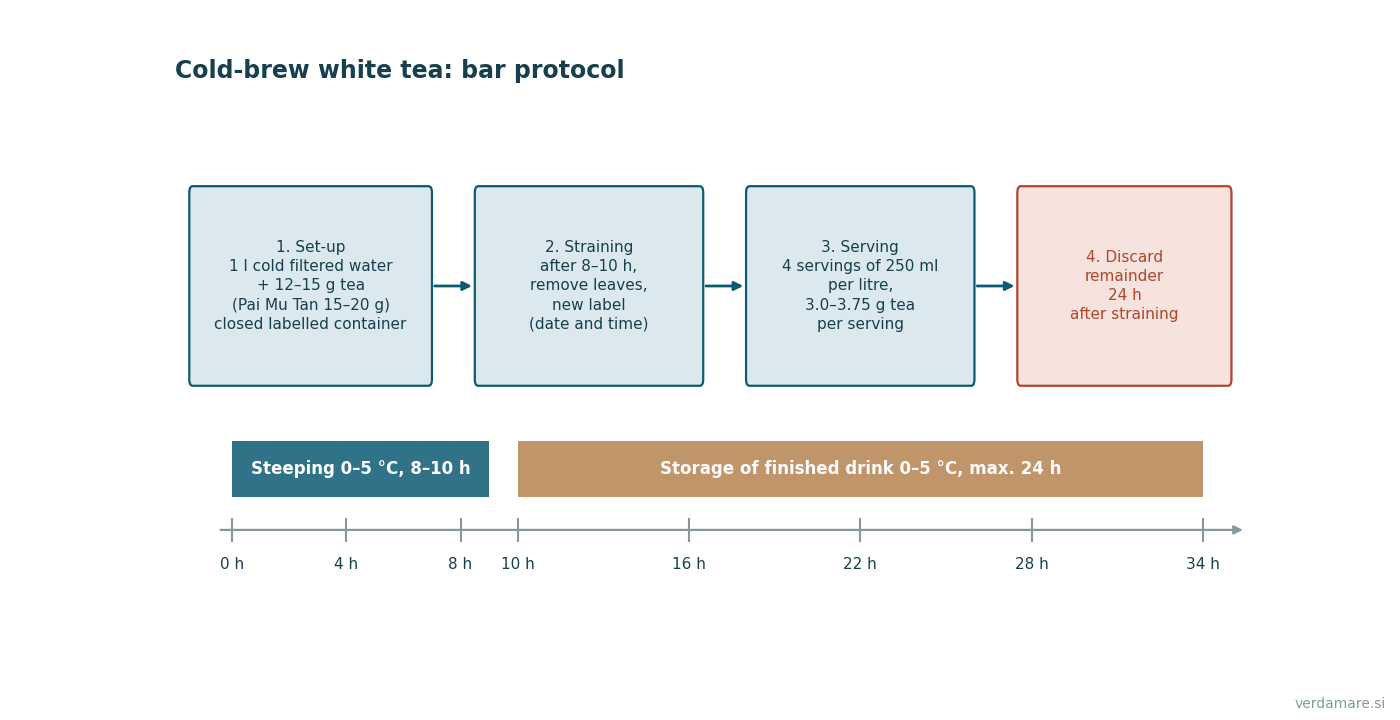
- Dose — the same as for hot brewing according to the product page: 12–15 g per litre for buds and most items, 15–20 g/l for Pai Mu Tan. Cold water extracts more slowly, so for a fuller flavour use the upper limit.
- Water — drinking water, filtered, cold. Container — a clean, closable glass or food-grade plastic jug or bottle, washed beforehand and rinsed with hot water.
- Add the tea loose, without a tea "egg" — the same principle as for hot brewing: the leaf needs room.
- Close, label (item, date and time of preparation, who prepared it) and put it in the refrigerator at 0–5 °C immediately. Do not steep at room temperature.
- Steeping time — 8–10 hours. It is convenient to set it up in the evening for the next day.
- Strain, remove all the leaves, pour into a clean labelled container with a new date and time.
- Store at 0–5 °C and use within 24 hours of straining. Anything left at the end of that period is written off.
One litre of cold brew gives 4 servings of 250 ml, with 3.0–3.75 g of tea per serving at 12–15 g/l. At the hypothetical price of 8 €/100 g, that is 0.24–0.30 € of raw material per glass plus ice.
Safety and shelf life of the drink
Cold tea is a low-acid drink prepared without heating. It lacks the "sterilising" step that boiling water provides, and the leaf is an agricultural raw material that has not been heat-treated. The shelf life of the finished drink is therefore determined not by taste but by the hygiene regime. Regulation (EC) No 852/2004 on the hygiene of foodstuffs requires food service businesses to work with procedures based on HACCP principles; cold brewing is exactly the kind of process for which critical points should be defined: storage temperature, steeping time, use-by period, labelling and cleanliness of containers. The 0–5 °C and 24 hours suggested above are a conservative internal rule; if your HACCP system sets different limits, follow it.
Typical violations: steeping on the counter "to make it faster"; topping up yesterday's unfinished jug with a fresh batch; storing the finished drink together with the leaf (extraction continues and astringency increases); unlabelled containers whose age nobody remembers.
Iced tea from hot brewing
If cold tea is needed "here and now", iced tea is made using the double-concentration method. The tea is brewed with hot water at the usual temperature and time, but in half the volume of water, and immediately poured over ice.
Example for a 400 ml serving: brew 6 g of tea (equivalent to 15 g/l for the final 400 ml) in 200 ml of water at 70–80 °C for 1.5–2 minutes and strain into a glass or shaker with 200 g of ice. The concentration of the brew is 30 g/l; once the ice melts, the drink reaches the target 15 g/l. Some of the ice will remain unmelted, so for serving in a glass with ice you can slightly reduce the proportion of ice in the brew and add fresh ice when serving. Important: do not extend the time — concentration comes from the dose, not from over-steeping — otherwise you will get an astringent cold tea.
Iced tea from hot brewing is brighter and slightly more astringent than cold brew, but does not require planning a day ahead. Many bars keep both formats: cold brew as the main summer drink and hot brewing over ice as a back-up for peak days.
Which items to use for cold service
- Ibiza Sunrise Organic (item 83156) — the website states outright that the blend is good served cold and belongs to the summer range. Flavour "grapefruit and lemon"; ingredients include lemongrass, lemon and orange peel, liquorice root, papaya, ginger, cranberry and pomegranate. Cold, the citrus part comes through brightly, and the liquorice gives a slightly sweet aftertaste without added sugar.
- Yin Zhen "Silver Needle" Organic (item 82736) — for a "pure" premium cold brew: the melon sweetness mentioned in the description is especially distinct in a cold infusion.
- Himalayan Snow Mountain Organic (item 89008) — a mild, slightly sweet profile; already designed for a low temperature in hot brewing, it turns out delicate when cold and is well suited to serving in a wine glass with light appetisers.
- China Pai Mu Tan ORGANIC (item 82536) — a fuller-bodied option that holds up well to ice and dilution; convenient as a base for signature non-alcoholic mixes.
- Jasmine Silver Needle Organic (item 82090) — an aromatic cold tea; jasmine tastes softer cold than hot.

Flavoured blends: what the base is and how to serve them
Being honest about ingredients
The "White Tea" category includes five flavoured blends, and their ingredient lists are worth reading carefully. Under EU labelling rules, ingredients are listed in descending order of weight. Looking at the first ingredients, the picture is as follows:
| Blend (item no.) | First ingredient | Tea base by ingredients | Ingredient notes |
|---|---|---|---|
| Christmas Tea Organic (82040) | green tea China Chun Mee | Chun Mee + Pai Mu Tan | apple, orange peel, cinnamon, ginger in cane sugar, cloves, cardamom, walnut — allergen |
| Ibiza Sunrise Organic (83156) | white tea Pai Mu Tan | Pai Mu Tan + Chun Mee | citrus, lemongrass, liquorice, cranberry, pomegranate |
| Gift of the Gods (83322) | green tea China Chun Mee | Chun Mee + Pai Mu Tan | lemongrass, lemon peel, fig, vanilla |
| Dragon of Wisdom (83416) | green tea China Chun Mee | Chun Mee + Pai Mu Tan + Mao Feng + Jasmine Dragon Pearls | candied pineapple, mango, papaya; berries |
| Peach Passion Fruit (83233) | green tea China Chun Mee | Chun Mee + Pai Mu Tan | candied pineapple and papaya, passion flower herb 4 %, peach 3 % (with rice flour) |
In other words, four of the five blends — Christmas Tea, Gift of the Gods, Dragon of Wisdom and Peach Passion Fruit — have a base of Chun Mee green tea with added Pai Mu Tan white tea. Only in Ibiza Sunrise is white tea listed first.
What this changes in brewing
Chun Mee is a rolled green tea that has undergone fixation. It extracts faster than a whole white leaf and reacts more sharply to over-steeping and high temperatures: if overheated or left an extra minute, a distinct astringency appears. For blends based on it, the product page brewing guide must therefore be followed more strictly than for pure white tea: 70–80 °C, and the time at the lower limit when you first try them (1 minute for Christmas Tea and Ibiza Sunrise, 2 minutes for Gift of the Gods and Dragon of Wisdom), then adjust to taste.
A separate note on Peach Passion Fruit: its product page states 100 °C and 10–12 minutes at a dose of 15–20 g/l. This is a brewing guide typical of fruit blends, where most of the flavour comes from the fruit, passion flower herb and flavouring, and the tea is the background. Follow the product page, but bear in mind that the drink will be rather fruity, full-bodied and with a noticeable tea astringency; a second infusion makes no sense here. This brewing guide also works for cold service: brew hot according to the product page, then cool and serve over ice — observing the same 24-hour storage limit if the drink is prepared in advance.
The pieces of candied fruit (pineapple, mango and papaya in Dragon of Wisdom, pineapple and papaya in Peach Passion Fruit) release their sugar into the first infusion, so the second infusion of a blend is noticeably "emptier" than the first. Hence the recommendation in the infusion table: blends — 1–2 infusions, no more.
How to position them on the menu
A guest who orders "white tea" expects a delicate, almost colourless drink. If they are brought an aromatic, golden infusion with cinnamon or passion fruit on a green base, it is not deception, but it is a disappointment. The solution is to split the menu into two groups:
- "White tea" — Yin Zhen, Snow Mountain, Pai Mu Tan, Mao Feng, Jasmine Silver Needle;
- "Flavoured teas" or "Fruit and spice blends" — with the base stated: "green and white tea, apple, cinnamon, orange" for Christmas Tea, and so on.
This way you do not mislead guests and at the same time sell the blends on their real merits — vivid flavour, seasonality, good compatibility with desserts. If your menu marks some drinks as "caffeine-free" or "low in caffeine", do not include either white teas or green-based blends in that group: both white and green tea contain caffeine.
Allergen: walnut
Christmas Tea Organic (item 82040) contains walnut, which is specifically marked as an allergen. Nuts are among the 14 allergens about which, under Regulation (EU) No 1169/2011, information must be available to guests also for dishes and drinks served without factory packaging. In practical terms this means:
- the item on the menu or in the venue's allergen matrix is marked "contains walnut";
- Christmas Tea is brewed in a separate teapot or infuser, or the teaware is washed after it before being used for another tea;
- a separate measuring container and a separate storage jar are assigned to this blend;
- staff know that the allergen is in the tea itself, not only in the dessert it is served with.

Food pairing and non-alcoholic pairing
Principles
White tea is a quiet drink. It is easily "drowned out" by spicy, smoked, fatty or very salty dishes. Good pairings are built on three principles:
- matching intensity — a delicate tea for a delicate dish;
- a shared aromatic bridge — melon, pear, honey, flowers, dried fruit, citrus;
- textural contrast — full, slightly astringent Pai Mu Tan "cleanses" creamy and buttery textures well.
Pairing table
| Tea | Profile by description / type | Works with | Avoid |
|---|---|---|---|
| Yin Zhen "Silver Needle" | sweetness reminiscent of cantaloupe melon | raw scallops, oysters, white fish crudo, fresh cheeses (ricotta, burrata), melon, pear, rice desserts | spicy, smoked, tomato-based dishes, lemon in the cup |
| Himalayan Snow Mountain | mild, slightly sweet | fruit salads, panna cotta, sponge cake, light cheese appetisers | spicy sauces, very bitter chocolate |
| Pai Mu Tan | bud + leaf: more body, light astringency | poultry, grilled white fish, risotto, pasta with butter, soft goat's cheese, almond pastries | red meat with demi-glace sauce |
| Mao Feng (89245, 89246) | profile — based on your own tasting | choose after tasting; as a guide — dishes that suit Pai Mu Tan | — |
| Jasmine Silver Needle | jasmine over a bud base | dim sum, prawns, steamed fish, pan-Asian dishes without strong heat, fruit desserts | dishes with their own strong floral note |
| Christmas Tea | orange, cinnamon, spices | strudel, gingerbread, pastries with nuts, pumpkin and apple desserts | do not offer to guests with nut allergies |
| Ibiza Sunrise | grapefruit, lemon | citrus salads, ceviche, light summer appetisers, sorbets | creamy desserts |
| Gift of the Gods | lemon, vanilla, lychee | cheesecake, vanilla desserts, fruit | savoury appetisers |
| Dragon of Wisdom | lychee, peach, tropical fruit | fruit tarts, macarons, mango desserts | — |
| Peach Passion Fruit | peach, passion fruit | children's and family menus, breakfasts, yoghurt desserts | refined bud-tea pairings in the same set |
Non-alcoholic pairing: a sample sequence
For a restaurant with a tasting menu, white tea is convenient because it offers both hot and cold formats from the same raw material. An example of a five-step tea pairing:
- Aperitif — Yin Zhen cold brew in a white wine glass, 100–120 ml.
- Cold seafood starter — Himalayan Snow Mountain cold brew, 100 ml.
- Fish or poultry — hot Pai Mu Tan, second infusion (it is fuller than the first), 100 ml in a tea bowl.
- Pre-dessert — Ibiza Sunrise cold, 80–100 ml.
- Dessert — Gift of the Gods or Dragon of Wisdom hot, 100 ml; in winter — Christmas Tea with an allergen warning.
Raw material for such a set per guest: with a pairing serving of 100 ml and a dose of 15 g/l — 1.5 g per course, about 7.5 g of tea per guest over five courses. When working with larger numbers of guests, cold brew is prepared in advance by the litre, and hot infusions are made from one teapot per table — so one 400 ml teapot with three infusions (1.2 l) covers the hot course for 12 guests at 100 ml each.
Service
For pairing, white tea is served in glass so the guest can see the colour and clarity. Cold — in a chilled stemmed glass, but without ice in the glass: ice dilutes the drink and mutes the aroma. Hot — in a thin tea bowl, at a serving temperature no higher than 70 °C, otherwise the guest will not taste the aroma and will burn themselves. Lemon, sugar and milk are not brought with pure white teas by default — only on request.
Storage in the venue
Four enemies: light, moisture, odours, air
White tea has not undergone fixation, and slow changes continue in its leaf. In addition, its loose structure with a large surface area quickly absorbs foreign odours. Hence the storage requirements:
- Light. Glass jars on an open shelf behind the bar look attractive, but light accelerates the loss of aroma and colour. For display, use a decorative jar with a small amount of tea and keep the working stock in opaque containers.
- Moisture. Downy buds are particularly sensitive to humidity. Do not store tea above the dishwasher or next to the combi oven, coffee machine or sink. A refrigerator is not needed for the working stock: every time it is opened, moisture condenses on the cold tea.
- Odours. Spices, coffee, flavoured blends (including Christmas Tea and Jasmine Silver Needle from the same category), cleaning agents. Keep pure white teas separate from flavoured ones, in airtight containers.
- Air. After opening, the pack is closed tightly, or better, transferred to an airtight opaque jar sized to the stock, so that there is as little air as possible above the tea.
A simple rule for the bar: a week's stock in the working area, the rest in a dry, dark storeroom at a stable room temperature. Shelf life — as stated on the pack; after opening, go by sensory assessment and FIFO rotation.
Aged white tea — without the myths
There are many legends around aged white tea, including medical promises. Without them, the picture is this. White tea does change during long storage: fresh floral and grassy notes fade, and honeyed, woody and dried-fruit notes appear. In Fuding and in the trade there is a separate category of aged white tea, often pressed, which is kept for years under controlled conditions. It is a specialised product with a known storage history.
A pack of Pai Mu Tan forgotten on a bar shelf for six months has nothing to do with this category. In a venue with fluctuating humidity and odours, tea does not "age" — it loses its aroma and may become damp. Therefore:
- the Alveus catalogue items in the "White Tea" category are not aged teas and must not be served as such;
- you should not "age" white tea yourself at the bar — such a product cannot be reproduced consistently or described honestly;
- if you want an aged white tea on your menu, that is a separate purchase of a separate product with a documented year of production.
Common mistakes and their causes
| Mistake | Result | Cause and solution |
|---|---|---|
| Boiling water from the coffee machine boiler | astringent, flat, "stewed" taste; fewer infusions | no separate water at 70–80 °C → kettle with temperature control or 3 : 1 mixing |
| Dosing with a spoon | strength varying several-fold between shifts | white tea is bulky and uneven in density → scales with 0.1 g resolution |
| Pai Mu Tan in a narrow tea "egg" | weak first infusion, then astringency | the leaf cannot open → wide teapot, leaf moving freely |
| One brewing guide for the whole category | Snow Mountain overheated, Chun Mee blends bitter, Peach Passion Fruit under-extracted | different guides on the product pages → brewing chart at the workstation |
| Leaf left in the teapot at the guest's table | bitterness by the 10th–15th minute | infusion not drained → infuser teapot or service in two vessels |
| Green-based blends under "White tea" without explanation | the guest expects one thing and gets another | ingredients not read → separate menu group and base stated |
| Christmas Tea without an allergen note | risk to the guest, breach of information requirements | walnut not flagged → allergen matrix, separate teaware |
| Cold brew steeped at room temperature | hygiene risk | "to make it faster" → refrigerator at 0–5 °C only |
| Yesterday's and today's cold brew in one jug | impossible to determine shelf life | no labelling → one batch — one container — one date |
| Iced tea: a normal brew poured over ice | watery drink | dilution by ice not accounted for → double concentration by dose, not by time |
| Bud tea in a clear display jar | fading, loss of aroma | light and air → opaque airtight containers |
| White tea next to coffee and spices | foreign odours in the cup | high absorbency → separate storage |
Implementation: a short one-week plan
To make white tea on your menu work consistently, a few steps are enough.
Days 1–2: taste all selected items using the product page brewing guides with your own water; for Mao Feng this is essential, as the catalogue has no flavour description. Record your adjustments: which end of the dose and time range gives the best result.
Day 3: recipe cards for each serving format — cup, teapot with a single steep, teapot with re-steeping, cold brew, iced tea. Each should include grams, volume, temperature, time, number of infusions and teaware.
Day 4: set up equipment — water at the right temperature, scales, teaware in the volumes from the recipe cards. A laminated brewing chart at the workstation.
Day 5: staff training — why the infusion is pale, what the down is, how pure white teas differ from blends, where the allergen is, how to label cold brew.
Days 6–7: trial sales, monitoring consumption in grams against sales; comparing actual yield with the planned yield from the servings table.
After a month, compare actual consumption with the calculated figure. If instead of 12.5–16.7 teapots you are selling 10 from 100 g of Pai Mu Tan, there is overconsumption somewhere — test brews, dosing "by eye" or cold brew write-offs. This check usually pays back the time spent on the recipe cards.
If you are putting together a summer tea programme or a pairing and would like to discuss a selection of Alveus items for your menu, teaware for specific volumes and gram weights, or simply request availability and prices for white tea, write to us. We will help you recalculate the recipe cards for your water, teaware and serving format, and delivery from our warehouse near Koper will cover both the tea and everything you need to serve it.
Latest articles
 Table Setting for Hotel Breakfast: Guest Place, Service and Table ResettingThe guest table at hotel breakfast: what is set in advance, what the server brings, how to reset a table quickly and how many pieces you need for a room…Read more →
 Pu-erh in hospitality: sheng and shu, brewing, cost per cup and working with the Alveus rangeWe follow pu-erh from Yunnan raw leaf to the cup in a hotel room: sheng and shu production, two brewing methods, rinsing, teaware and the exact cost per serving based…Read more →
 Porcel Porcelain for Restaurants and Hotels: How It Is Made, Why It Lasts and How to Choose a SeriesHow Porcel hard-paste porcelain is produced, what the collection ratings mean and how to put together a set for a restaurant or banquet hall from the HoReCa Collections catalogue.Read more →