


Commercial kitchen cooking equipment: how to plan the line
How to choose and arrange a restaurant cooking line: 700 and 900 series, gas, electric and induction equipment, ovens and cabinets, combi ovens, extraction, make-up air, connected load and layout.
Thermal line is one device assembled from several housings
The stove, frying pan, pasta cooker and neutral insert are not placed in a row for the sake of appearance. They are aligned in depth and height, covered with a common tabletop and work under one umbrella. An error in one module breaks the entire line - and is corrected not by replacing the device, but by remodeling the kitchen.
This is a text about how heating equipment is selected and placed: how the 700 series differs from the 900, when gas wins over induction, what is under the hob, how much air the hood needs and what questions the electrician will ask. Separately, there are modules that kitchens order last and then regret: neutral inserts and food warmers.
01Module, not a device
A professional kitchen is almost never assembled from free-standing appliances. It is assembled from modules of the same series - cases of the same depth and height, which are placed side by side, pulled together and covered either with their own tabletops or one common one.
The difference between “put a stove and a fryer next to it” and “assembled the line” is visible not on the first day, but on the second month. There are no gaps in the line between the bodies, which means there is nowhere for grease to flow and crumbs to fall in. The line has a common rear side, which means that splashes do not go behind the equipment, where no one can reach them. The line stands on one stand or on common legs, which means you can wash the floor under it, rather than raking it out once every six months.
Hence the first rule, which is the most expensive to break: a series is selected once and for the entire line. It is technically possible to mix a module with a depth of 700 and a module with a depth of 900 in one row - you will get a 200 mm step, against which everything will rest: the table top, the side, the umbrella above the line. On paper it looks like small change. In work, this is a place where something spills every day.

02Series 700 and 900: what is hidden behind the number
The number in the series name is the case depth in millimeters. Series 700 - modules with a depth of 700 mm, series 900 - 900 mm. The width is a multiple of the basic step: 400, 700, 800, 1050, 1200 mm and so on, depending on how many burners or how many baths are inside.
Two hundred millimeters of difference makes more than it seems.
| Parameter | 700 Series | 900 Series |
|---|---|---|
| Cabinet depth | 700 mm | 900 mm |
| Working surface area | less by a third | perceptibly larger, the baking tray fits across |
| Oven volume | for gastronorm container GN 1/1 or sheet 600 × 400 | under GN 2/1, full-size baking tray |
| Burner power | usually lower | usually higher with the same number of burners |
| Insulation and shell thickness | thinner | more dense, less heat loss to the outside |
| Module price | below | higher, the gap grows with width |
| Who is suitable | cafe, bar with kitchen, small restaurant, pre-cooking | full service restaurant, banquet kitchen, dining room, production |

The practical guideline is simple. If the kitchen prepares up to eighty to one hundred dishes per shift and does not work with large workpieces, the 700 series will solve the problem and save space, which is always lacking in a small kitchen. If there are banquets in the kitchen, if something is cooked in large volumes, if you need a whole baking sheet, take 900 and don’t return to this issue.
Separately about narrow modules. Both the 700 and 900 series have modules with a width of 400 mm and narrower: two-burner stoves, narrow neutral inserts. This is not a “half slab”, but a full-fledged way to get a line to the desired length without leaving holes.
 VD0014369700 series gas stove, 4 burners, with cabinet700 × 700 × (850 + 70) mm
 VD0014368Gas stove series 900, 4 burners, with cabinet800 × 900 × (850 + 70) mm
 VD0014375Gas stove series 700, 2 burners, with cabinet360 × 700 × (850 + 70) mm
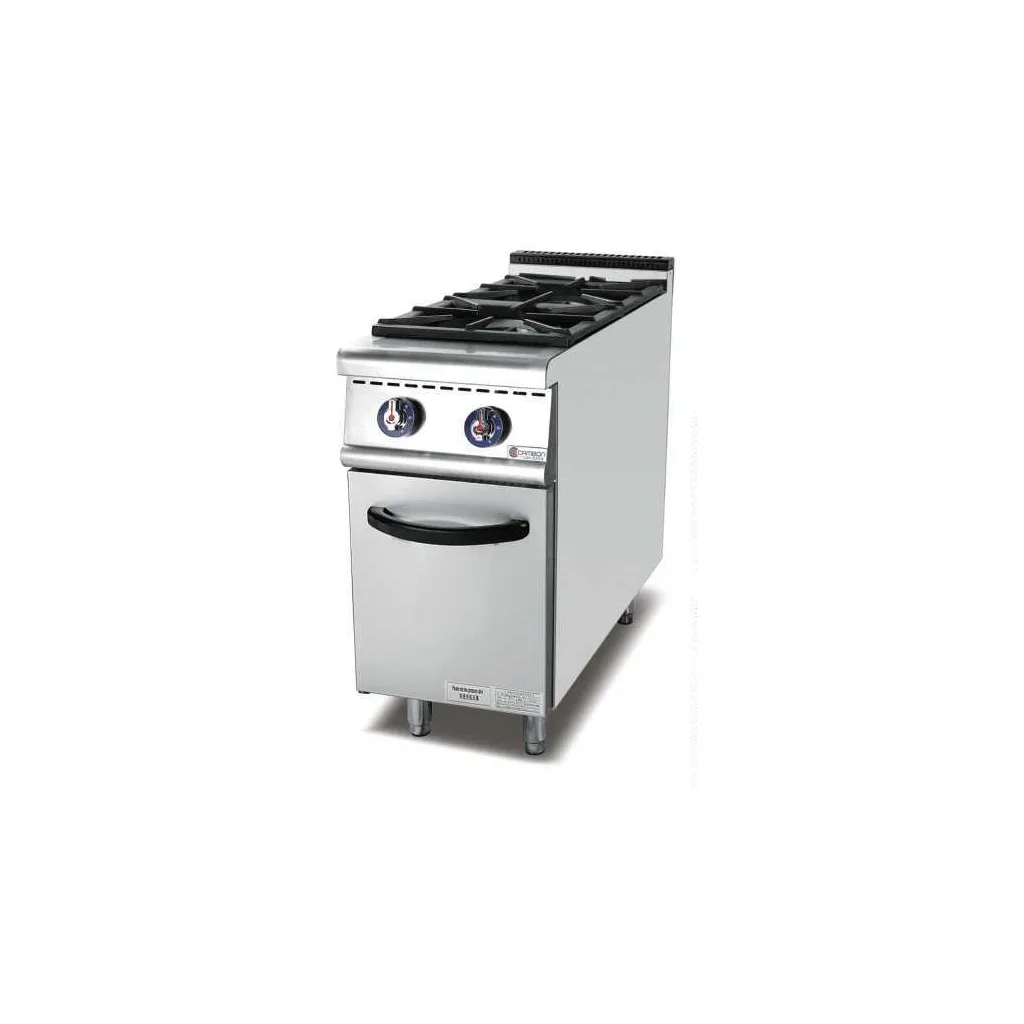 VD0014374Gas stove series 900, 2 burners, with cabinet400 × 900 × (850 + 70) mm
The example above is the same four-burner gas stove with a cabinet in two series, and a pair of two-burner narrow modules. Please note that the 900 series has a four-burner module width of 800 mm, not 700: its burners are larger and more freely spaced.
03Gas, electricity, induction
Three ways to heat the bottom of a pan. The choice between them is usually already made for you - by whether there is gas at the site and how many kilowatts are allocated. But if there is a choice, this is the difference.
Gas
The most familiar method to chefs. The flame is adjusted instantly and is visible to the eye - the cook evaluates the heating without looking at the appliances. Any cookware is suitable, including round-bottomed woks and copper. Heating occurs not only at the bottom, but also along the walls, which is important for some techniques.
The cons of gas live not in the stove, but around it. Every kilowatt of power that goes past the pan remains in the kitchen: the gas line heats the room more than the electric line for the same useful work. This means a more powerful hood, more supply air and a harsher climate in the workplace. Plus gas is the permitting part, design, acceptance and regular maintenance.
Electric burners
Cast iron pancakes - round or square. Simple, repairable and cheap to maintain equipment: the burner is replaced separately, there are almost no electronics.
Instead - inertia. The burner takes minutes to heat up and takes minutes to cool down. You won't be able to turn down the heat immediately under boiling milk: you'll have to remove the dishes. For a kitchen where they mainly cook and stew, this is not a problem. For a kitchen with quick sauces, this is a problem every day.
Square burners provide more usable space and allow you to place rectangular dishes; round ones are easier to compact and get less dirty around the edges. The difference in price is small, the difference in convenience depends on what exactly is on this stove more often.
Induction
It is not the burner that heats up, but the bottom of the pan. Hence all the properties at once: speed almost like gas, accuracy better than both alternatives, and dramatically less heat in the room - because the surface around the dishes remains almost cold.
Less heat in the kitchen means less stress on the hood and air conditioning. In large kitchens, this is often the main argument, and not the heating speed itself.
There are two restrictions. The first is ware: you need a ferromagnetic bottom, that is, steel and cast iron are suitable, aluminum and copper without a special bottom are not suitable. It can be checked with a magnet in two seconds, but it means that when switching to induction, some of the cookware will have to be replaced. The second is the price of the module and the cost of repairs: inside there are power electronics that cannot be repaired with a screwdriver.
VD0014368Gas stove series 900, 4 burners, with cabinet800 × 900 × (850 + 70) mm VD0014333Electric stove series 900, 4 burners, with cabinet800 × 900 × (850 + 70) mm
 VD0014382Induction cooker series 900 for 4 zones with a cabinet800 × 900 × (850 + 70) mm
 VD0014383Induction cooker series 900 for 2 zones with a cabinet400 × 900 × (850 + 70) mm
| Gas | Electric hotplates | Induction | |
|---|---|---|---|
| Response speed | instant | low | instant |
| Accuracy | by eye | steps | by number |
| Warmth into the room | maximum | high | minimum |
| Requirements for dishes | any | flat bottom | magnetic bottom |
| Module price | low | low | high |
| Ownership cost | gas and service | low | electricity and the risk of electronics repair |
| What is needed at the site | gas line and permits | power line | power line with reserve |
The mixed version works better than the pure version
The most common working scheme is not “all line on gas” and not “all on induction,” but a combination. Gas for woks and large pans, induction for sauces and quick cooking, electric oven underneath. It is more expensive to design and cheaper to operate, because each task is subject to suitable heating.
04What is under the hob
It takes a long time to choose the top of the slab, the bottom takes a minute, and in vain. There can be three different things under the same hob, and they solve three different problems.
Oven
The most obvious option and the most expensive. A stove and oven are two appliances in the size of one: the space savings are obvious. But the oven under the stove has a feature that you will learn about after installation: it heats up from above. Working burners add heat to the chamber, and the mode inside floats relative to what the knob shows.
For baking and finishing this is not critical. This is critical for baking, so the confectionery section almost always gets a separate cabinet rather than a sub-stove oven.
The second point is how the oven is heated. The cabinet for a gas stove can be either gas or electric. The electric one keeps the temperature more evenly and is easier to adjust; the gas one is cheaper to operate where gas is cheaper than electricity. The combination “gas burners on top, electrical cabinet below” is the most common and usually turns out to be correct.
Pedestal
A closed volume with doors and, as a rule, one shelf. Pots, gastronomy containers, stewpans go there - everything that should be at hand at the stove and should not be in plain sight.
The cabinet is cheaper than an oven, does not heat up and does not require a separate power line. For most kitchens, the “stove with cabinet” module is the correct choice by default, and ovens are taken separately, in the right quantity and of the right class.
Open stand
Frame with bottom shelf without doors. The cheapest option and the most convenient for washing: everything is visible under the module and everything is accessible. Used where the kitchen struggles with sanitation rather than storage space - and where nothing is stored under the stove anyway.
 VD0014330Gas stove 900 series, 4 burners, with oven800 × 900 × (850 + 70) mm
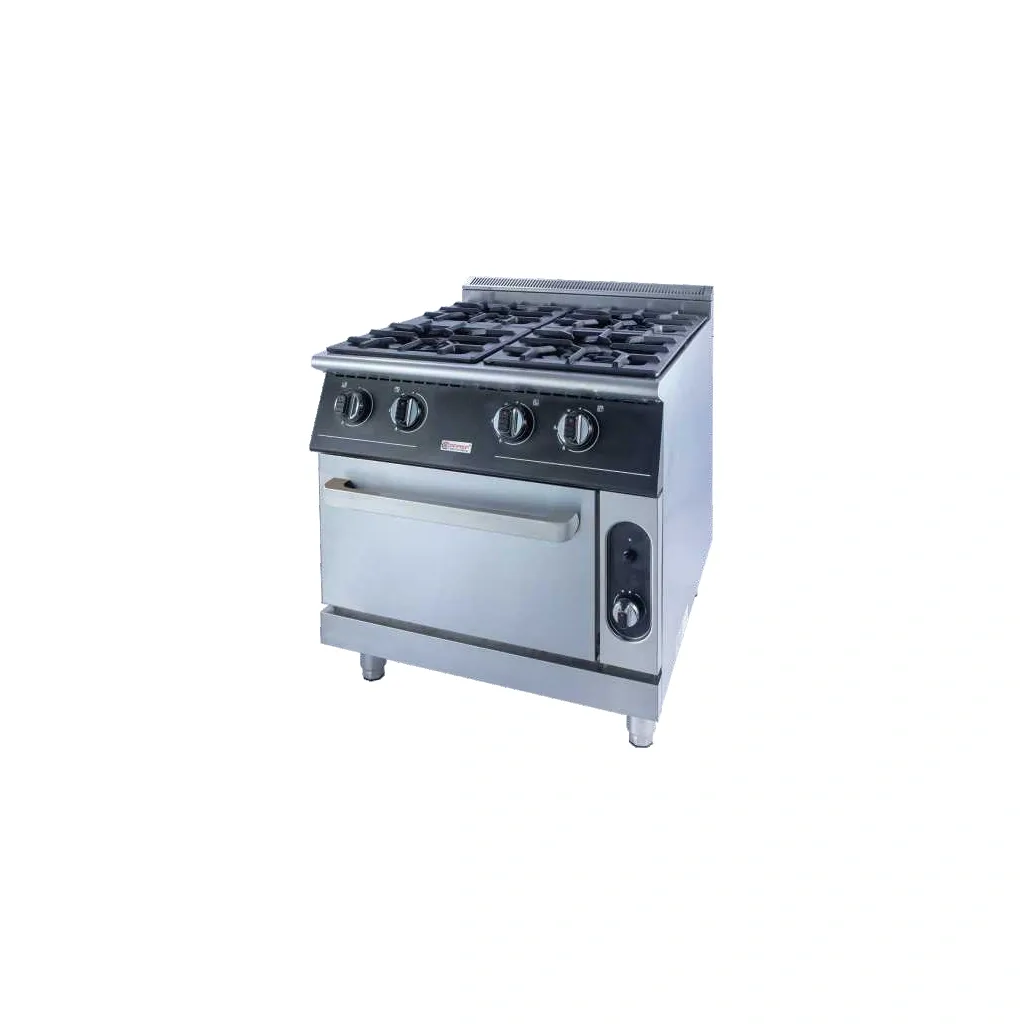 VD0014331Gas stove series 900, 4 burners, with cabinet800 × 900 × (850 + 70) mm
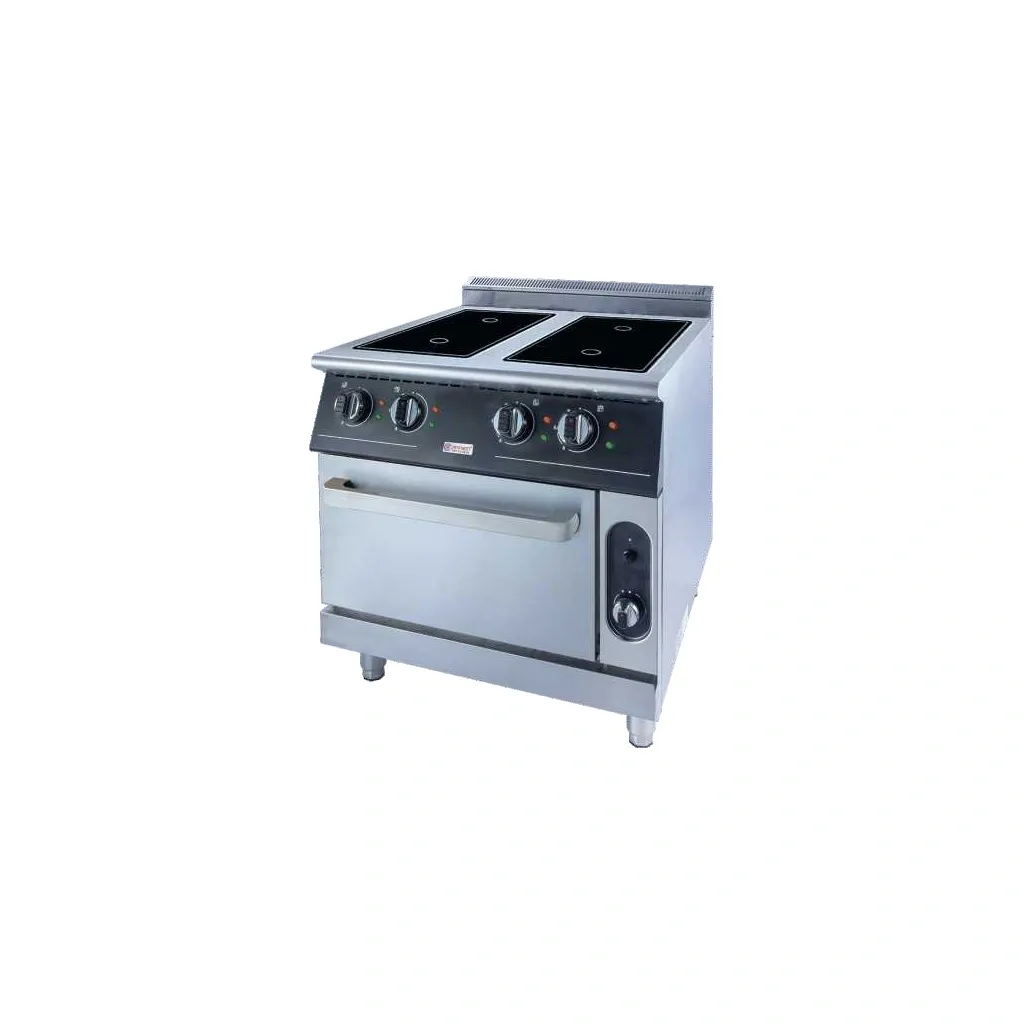 VD0014332Electric stove series 900, 4 burners, with oven800 × 900 × (850 + 70) mm
 VD0014360Gas stove 900 series, 4 burners, with electric oven800 × 900 × (850 + 70) mm
05Frying surface, grill and WOK
Three modules that expand the line beyond “cook and stew.”
Frying surface
A solid plate on which you cook directly: steak, burger, vegetables, eggs, panini. The main parameters are material and relief.
The smooth surface is versatile and easier to clean. The corrugated one gives stripes and partially drains fat, but is harder to clean and is not suitable for eggs and small slices. The combined option - half smooth, half corrugated - in practice almost always wins if there is enough width.
The second parameter is thickness and metal. A thick steel plate takes longer to heat up, but maintains the temperature when adding product: put in five steaks - the temperature dropped and returned. The thin one heats up faster and fails when loading, as can be seen from the result. Chrome surfaces are easier to clean and softer when heated, steel surfaces give a more pronounced crust.
Grill on lava stone
Under the grate lies a layer of volcanic stone, which is heated by burners or heating elements and gives off heat by radiation. The dripping fat falls on the stone, evaporates and returns to the product with smoke - hence the characteristic taste for which this module is taken.
In return - consumables and cleaning. Over time, the stone becomes greasy and changes, the grate is cleaned every shift, and the module itself produces a lot of greasy aerosol, which is sent into the umbrella. Placing a grill on a lava stone in line with a conventional hood is a sure way to get greasy filters along the entire length of the umbrella in six months.
WOK
A burner with a ring for a round-bottomed frying pan and high power. The peculiarity of the wok is not in the shape of the dish, but in the fact thatthe flame covers the walls: the product is fried not only with the bottom, but with the entire contact surface, in a matter of seconds.
Hence two requirements. The power is real, not nominal: a weak wok turns into an ordinary frying pan with an uncomfortable bottom. And the exhaust is local and strong, because the wok throws up a column of hot steam and aerosol.
 VD0014342Gas frying surface with cabinet, series 900800 × 900 × (850 + 70) mm
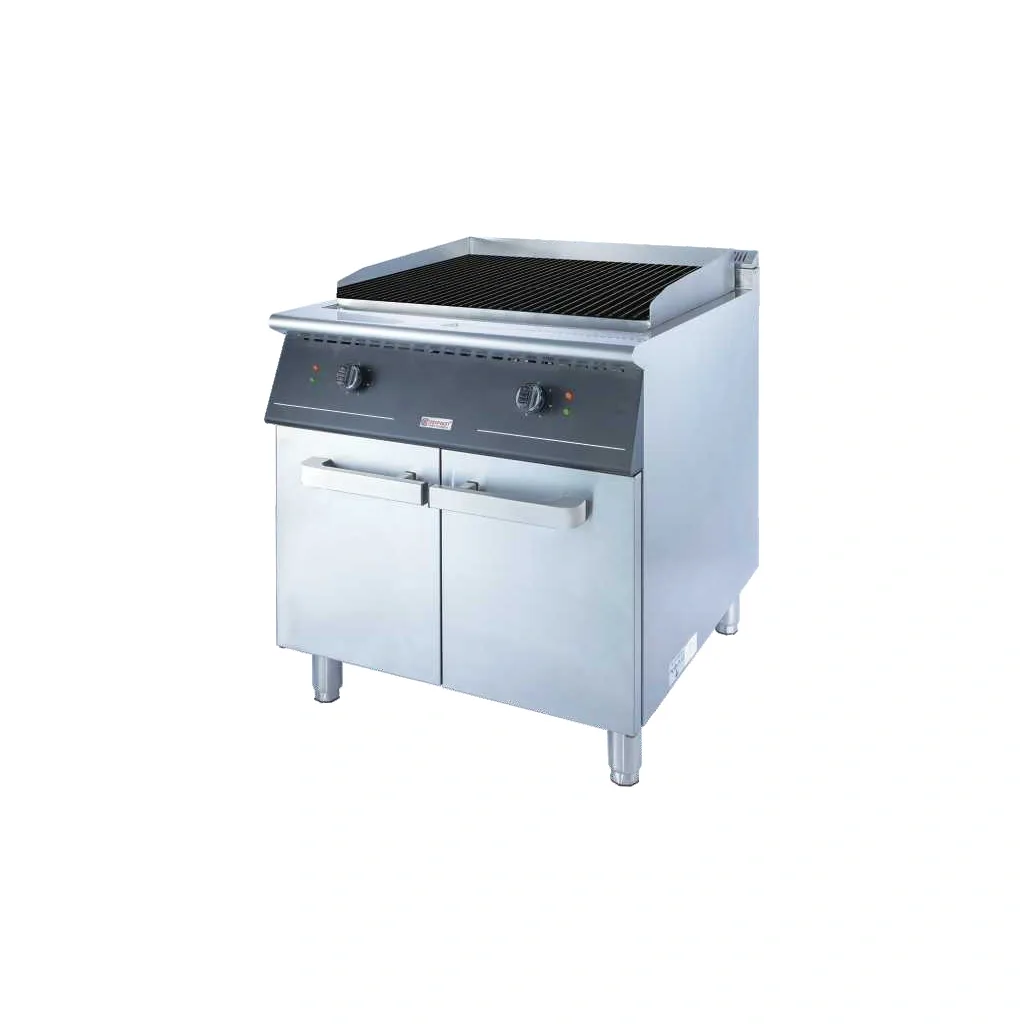 VD0014344Gas grill on lava stone with cabinet, series 900800 × 900 × (850 + 70) mm
 VD0014376Gas WOK-stove 900 series with cabinet800 × 900 × (850 + 70) mm
 VD0014354Gas stove 900 series, 4 burners, with WOK ring and oven1200 × 900 × (850 + 70) mm
06Kettle, frying pan, pasta cooker
Modules that appear when the kitchen is no longer small.
Food boiler
Stationary container with a lid for cooking large volumes: broth, soup, sauce, compote. The key difference is direct or indirect heating.
Direct heating heats up the bottom of the container. Quickly, cheaply and with the risk of burning anything that thickens: sauces, cereals, milk.
With indirect heating, there is a jacket with water or steam between the source and the product. The temperature on the wall does not exceed the temperature of the steam, and it is almost impossible to burn in such a boiler. It is more expensive and slower - and this is what is needed if more than just broth is cooked in the boiler.
Tilting frying pan
The most underrated module of the line. This is a wide bath with a lid and a tilting mechanism: they fry, stew, boil, simmer in it and add sauce in it. Essentially, one device replaces a large frying pan, saucepan and baking sheet.
The tilt is not needed for beauty: the finished product is poured out, not scooped out. The difference in the speed of impact and the number of burns in the kitchen is measurable. The mechanism can be manual or motorized - for volumes over fifty liters, the manual one ceases to be convenient.
Pasta cooker
Bath with constant boiling water, baskets and, in good models, automatic topping and overflow of starch foam. The module is highly specialized: if pasta is always on the menu, it pays for itself in terms of return; if pasta is served on Wednesdays, it will be cooked in a regular saucepan.
You need to look at the drain and top-up system. A bathtub that needs to be scooped by hand turns into a punishment for the one who closes the shift.
 VD0014338Gas cooking boiler with indirect heating800 × 900 × (850 + 70) mm
 VD0014339Indirectly heated electric digester boiler800 × 900 × (850 + 70) mm
 VD0014340Tilting frying pan, gas, 900 series800 × 900 × (850 + 70) mm
 VD0014341Tilting frying pan, electric, 900 series800 × 900 × (850 + 70) mm
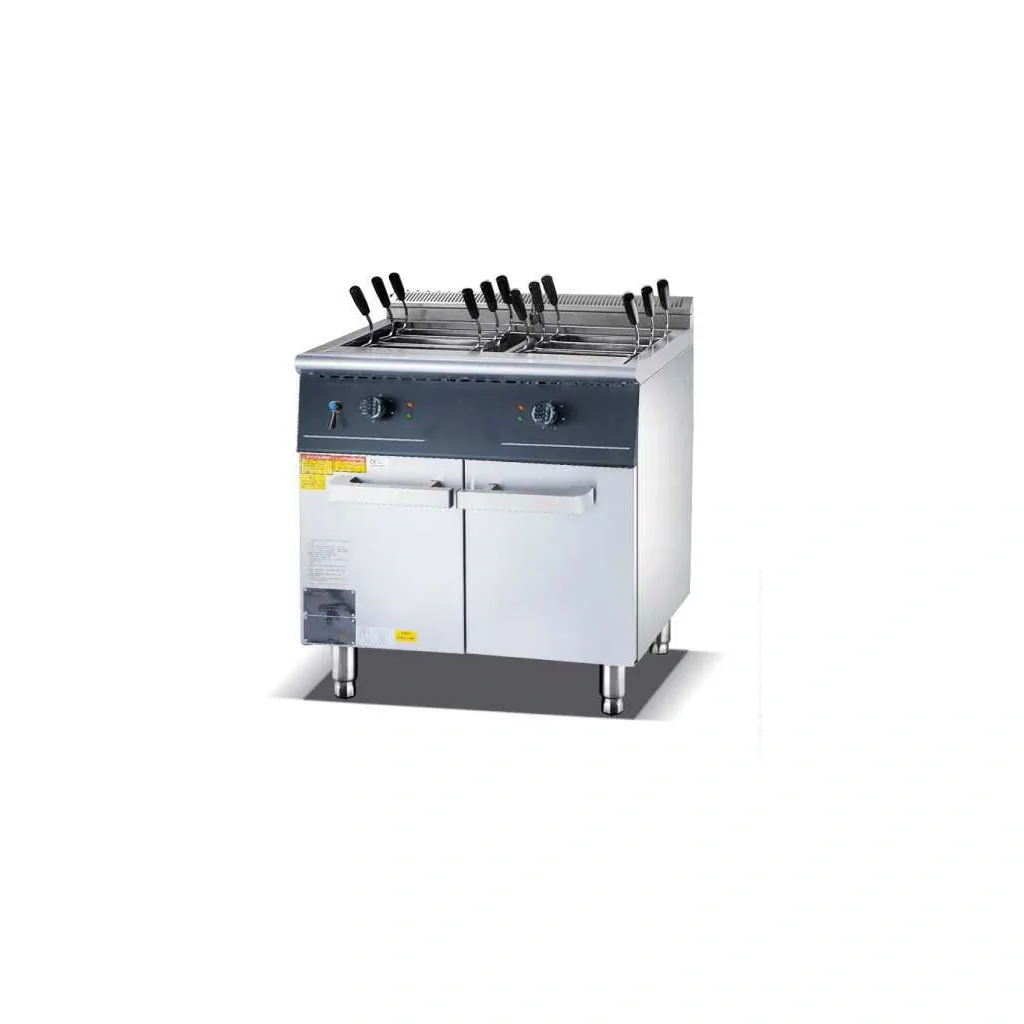 VD0014346Gas pasta cooker with cabinet, series 900800 × 900 × (850 + 70) mm
 VD0014347Electric pasta cooker with cabinet, series 900800 × 900 × (850 + 70) mm
 VD0014348Gas food warmer with cabinet, series 900800 × 900 × (850 + 70) mm
 VD0014349Electric food warmer with cabinet, series 900800 × 900 × (850 + 70) mm
07Fryer
The module that is most often purchased cheapest and most often replaced first.
A deep fryer is a tub of oil, a heater, and baskets. The whole difference between good and bad comes down to three things.
Cold zone The space under the heater where crumbs and breading settle. The oil does not boil there, so the sediment does not burn and spoil the taste of the entire bath. A fryer without a cold zone requires oil changes twice as often - and this, not the price of the housing, determines the cost of ownership.
Temperature restoration. When a frozen product is dipped into the oil, the temperature drops. The faster it returns, the less oil the product will absorb and the drier it will be when it comes out. A weak heater produces greasy potatoes, regardless of what is written on the package.
Drain. Tap at the bottom of the bathtub and a container for it. A deep fryer from which the oil is scooped out with a ladle will not be cleaned on time - this is checked in any kitchen.
The volume of the bath is calculated by the peak: for eight to ten liters there is approximately one serving of potatoes in one and a half minutes in a steady state. Two eight-liter baths are almost always better than one sixteen - you can fry fish and potatoes without mixing flavors, and you can clean one while continuing to work on the second.
08Combi steamer
A device that changes the kitchen more than any module in the line, and that is why it is worth a separate discussion.
The combi oven combines convection - hot air driven by a fan - and steam. Three basic modes, convection only, steam only and their mixture, plus humidity control inside the chamber. This means that in one device you can bake, steam, simmer, restore a cooled dish and proof the dough.
Practical consequence: the combi steamer takes away work from the oven, from the steamer, from part of the stove and from the water bath. In a small kitchen, it often reduces the line rather than enlarging it.
What to choose
Capacity is calculated in gastronomy container levels. Six levels are the typical size for a kitchen with 60–100 seats. Ten levels - restaurant or banquet. Twenty levels - production and catering; such devices are usually floor-standing and with a trolley.
Water supply - manual or automatic. A device with a boiler and automatic filling produces more stable steam and requires prepared water. Injection, with water injection onto the fan, is simpler and cheaper, the steam in it is less dense. For most kitchens, injection is sufficient.
Water is the topic that causes combi steamers to die most often. Hard water kills the steam generator within a season. Softening or reverse osmosis are included in the project along with the device, and not after the first breakdown.
Camera washing - automatic or manual. Automatic washing requires chemicals and costs money, but the camera is actually washed every day, and not when it comes to it.
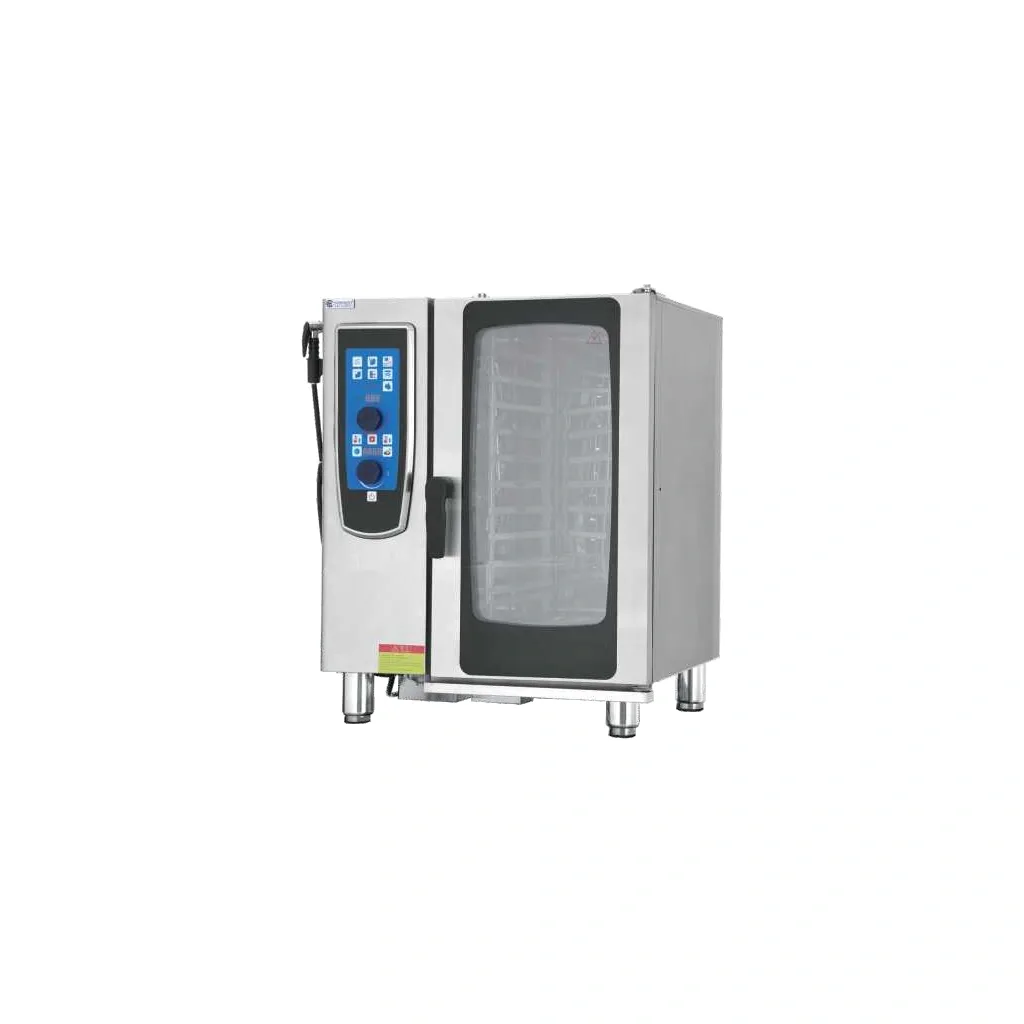 VD0014323Universal combi steamer with a manual water supply system850 × 770 × 785 mm
 VD0014325Universal combi steamer with automatic water supply system850 × 770 × 785 mm
 VD0014328Universal steam oven with six levels705 × 950 × 900 mm
 VD0014327Fast professional microwave oven405 × 710 × 610 mm
The stand for the combi oven is not an accessory
A tabletop device placed on a regular table almost always turns out to be too low or too high: the upper level is not visible, the lower one has to be reached from your squat. A special stand places the camera at working height and provides guides for the gastronorm containers below. It costs significantly less than the device and determines whether it will be used correctly.
09Marmit and distribution
The module that kitchens order last, and it determines how the dish will reach the guest.
A food warmer is a heated bathtub for gastronorm containers. Heating can be water or dry. Water is softer: heat flows through a layer of water, the temperature throughout the entire container is even, the product does not dry out at the edges. Dry is easier to maintain - there is nothing to pour in and nothing to drain - but it dries out and produces unevenness.
The key figure here is not power, but holding temperature. Everything that is being served must be kept above 63 °C - below that begins the zone in which bacteria readily multiply. A food warmer that does not reach this temperature when fully loaded is not equipment, but a risk.
The second thing to check on a bain-marie is lids and partitions. An open bath loses heat and moisture many times faster than a closed one, and half of the complaints about the second being dry are solved by a roller shutter cover.
10Neutral modules
The most common savings when ordering a line and the most common complaint after a month of operation.
A neutral module is a case of the same series and the same height, but without heating: just a tabletop, with a cabinet or shelf underneath. He doesn't cook. It gives a place to put.
A kitchen without neutral accents looks effective on the plan but does not work in reality. Once the pan has been removed from the fire, there is nowhere to put it - it is placed on the adjacent burner, which is occupied. The cutting board is held in hands. The baking sheet is carried from the oven across the entire kitchen, because there is no flat surface nearby.
The normal proportion is one neutral module for every two or three thermal modules, and always one at the edge of the line. Narrow inserts 400 mm wide exist for this purpose: they are cheap, fit into any gap and solve the problem entirely.
 VD0014350Neutral work surface 900 series with cabinet800 × 900 × (850 + 70) mm
 VD0014351Neutral work surface series 700 with cabinet700 × 700 × (850 + 70) mm
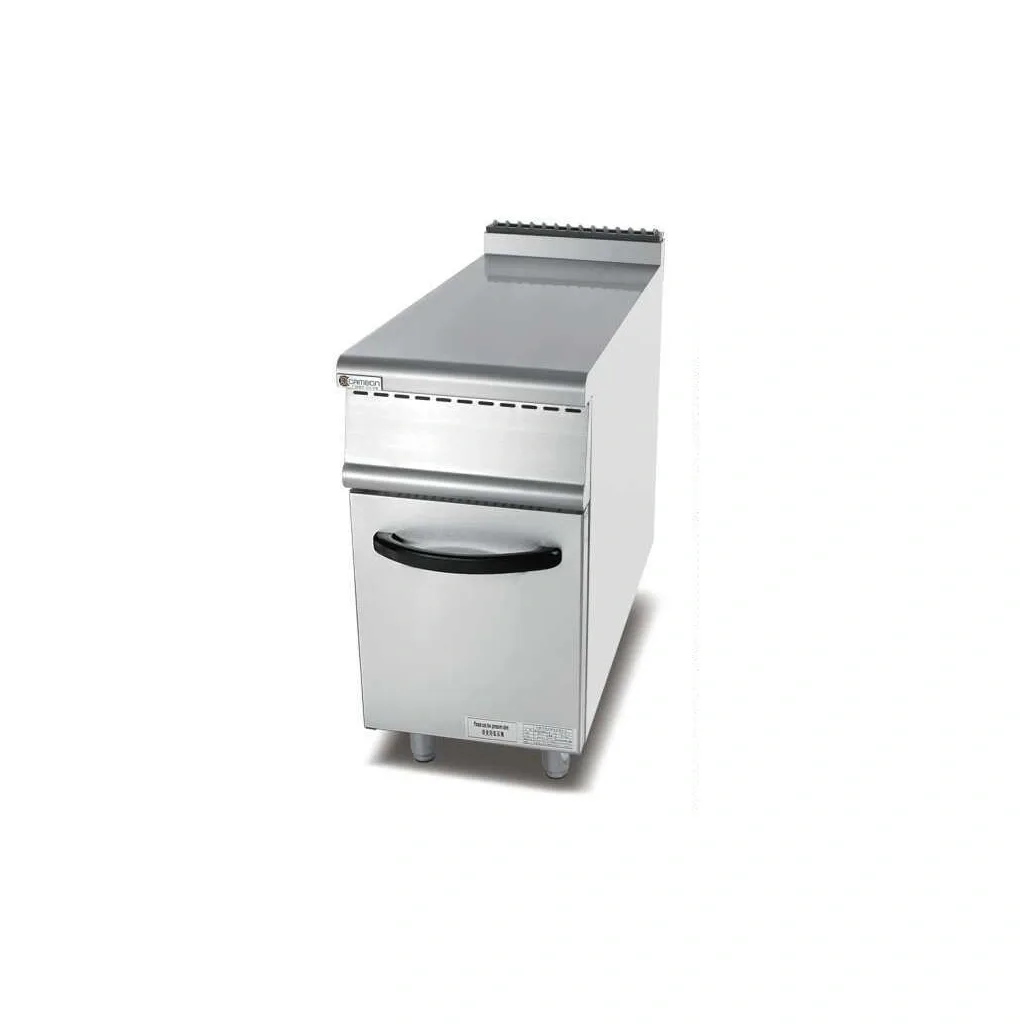 VD0014352Narrow neutral surface with cabinet, series 900400 × 900 × (850 + 70) mm
 VD0014353Narrow neutral surface with cabinet, 700 series360 × 700 × (850 + 70) mm
11Hood, heat and air
The part of the project in which savings are visible most quickly - by how the ceiling looks after six months.
Umbrella
The umbrella should overlap the line with a margin: 100-150 mm on each side, and more over modules with strong emissions - wok, grill, deep fryer. An umbrella cut to the size of the slab allows everything that rises along the edges to pass through.
Installation height is a compromise. A low umbrella catches better, but gets in the way of the cook and burns his head; high is convenient and loses effectiveness. Working range - 1900–2100 mm from the floor to the bottom edge, provided that this is not lower than the height of the personnel.
The shape can be wall or island. An island umbrella catches worse at the same air flow rate, because the suction comes from all sides - for an island they use a higher flow rate or make an umbrella with sides.
Filters
Labyrinth grease filters are not an option. They are removed, washed in the dishwasher and returned to their place; They, not the fan, determine whether grease gets into the duct. An air duct into which grease has entered is no longer a maintenance problem, but a fire problem.
For grill and fryer lines, add a grease trap to the labyrinth in the tract and plan access to the duct for cleaning in advance, rather than finding out that it is not there.
Inflow
The most underrated part. The hood removes air from the room, and it must be taken from somewhere. If the influx is not organized, the air comes through the hall, through doors, through cracks - and carries with it the smell of the kitchen into the hall, and in winter also the cold.
Normal scheme: inflow 80–90% from the exhaust, the rest is obtained by overflow. The kitchen should remain in a slight vacuum relative to the hall, so that the smell goes from the hall to the kitchen, and not vice versa.

 VD0014291Dismountable stainless steel exhaust hood3000 × 1200 × 530/380 mm
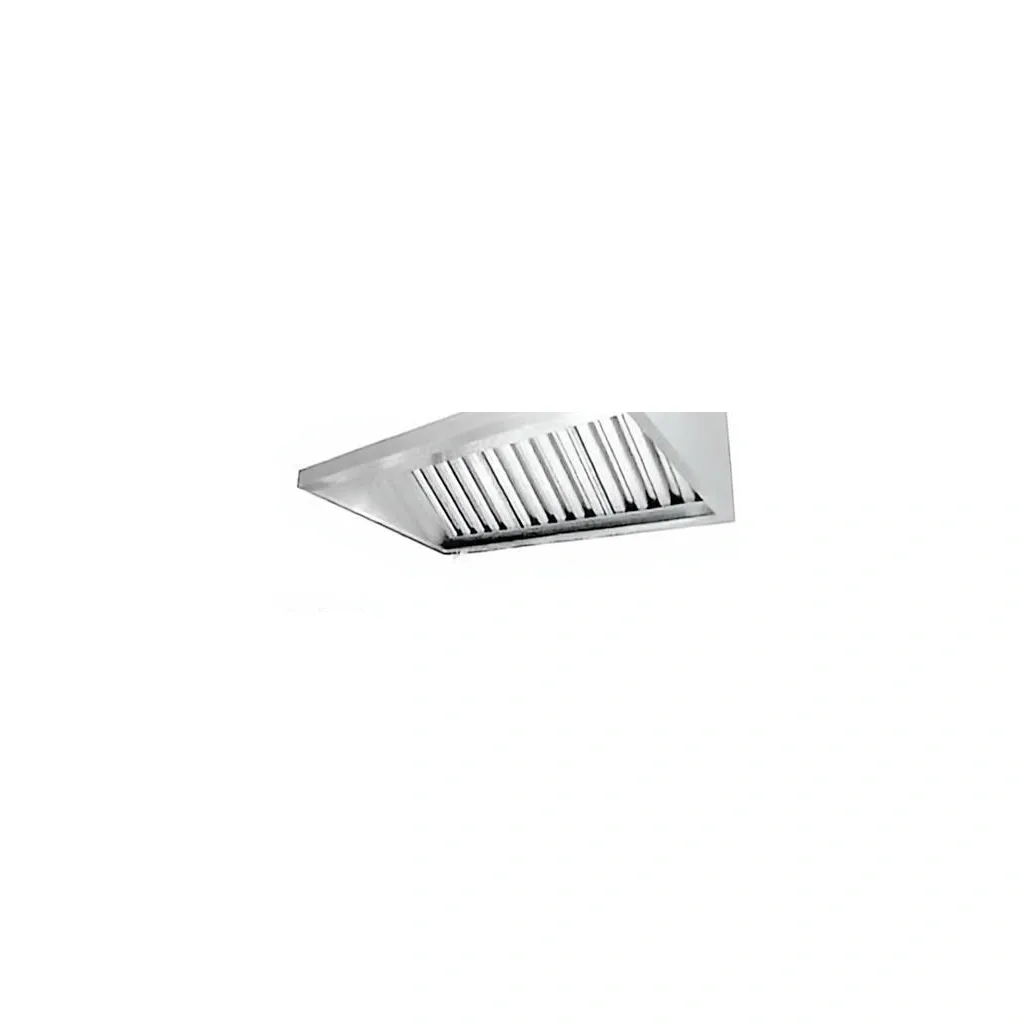 VD0014295Stainless steel exhaust hood1000 × 1000 × 500 mm
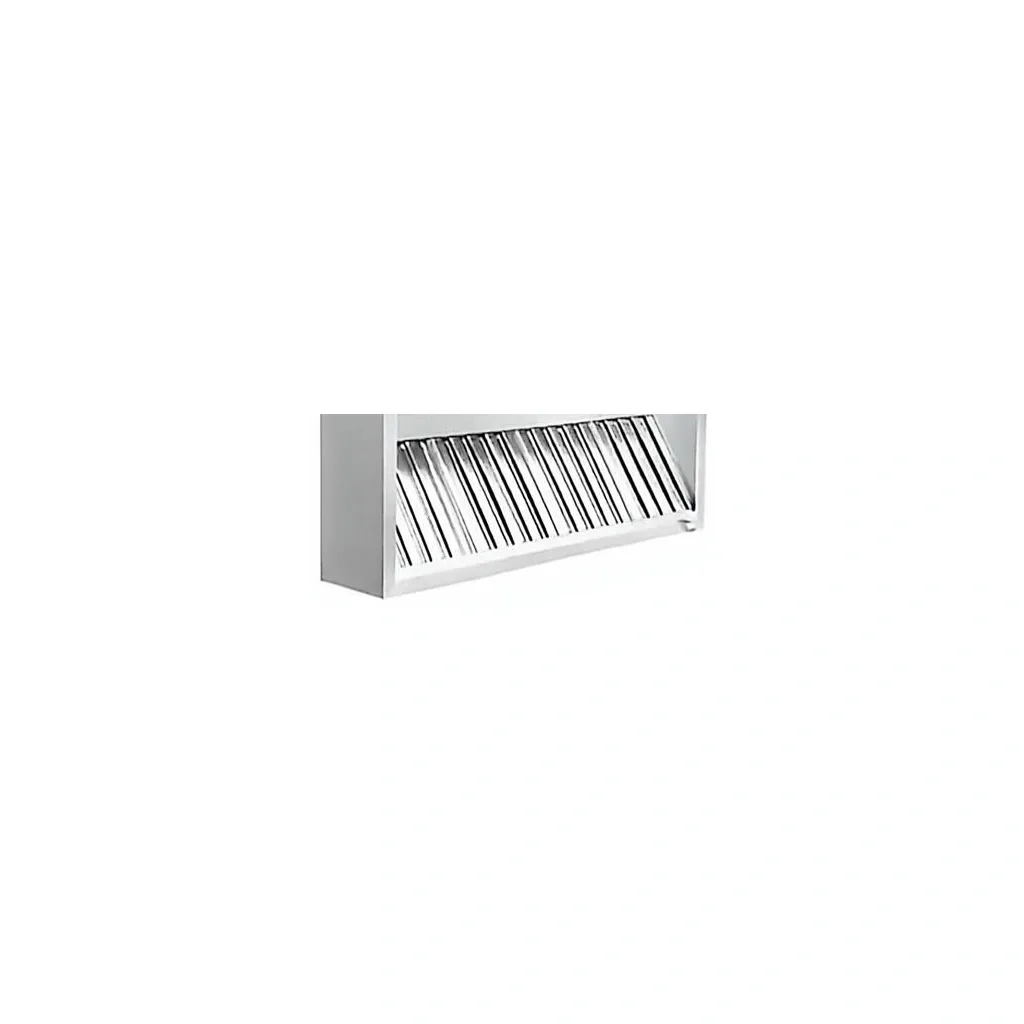 VD0014309Box-shaped stainless steel hood1000 × 1000 × 500 mm
 VD0014290Stainless steel grease trap500 × 400 × 350 mm
12Power, connection and electrician questions
The point at which the project most often stumbles: the equipment has been selected, but there is no allocated power for it.
The sum of the nameplate capacities of all thermal modules is not the number that needs to be ordered. Not everything works at the same time. But the simultaneity coefficient cannot be taken out of thin air: a kitchen with one peak at lunch has one, while a 24-hour canteen has another.
Practical guideline: for a kitchen with induction and a combi oven, set aside 0.7–0.8 of the amount; for a gas kitchen, the electrical part is small, but there is a separate calculation for gas.
| What the electrician will ask | What you need to know in advance |
|---|---|
| Total power of the thermal line | according to passports, broken down into constant and peak |
| Single-phase or three-phase consumers | most modules are three-phase; induction is almost always |
| Connection points | where exactly the cable goes out for each module |
| Protection | ratings of machines and RCDs for each line |
| Potential equalization | all line bodies communicate with each other and with the bus |
| Emergency shutdown | a button at the exit from the kitchen that turns off the entire line |
| Reserve | how many kilowatts are left for future equipment |
The questions about gas are fewer in number and more in consequences: design, approval, installation of a gas alarm with a shut-off valve, acceptance and service agreement. This is not the part that is done later.
The reserve is placed once
Add kilowatts after finishing - this is a new shield, a new highway and exposed walls. Adding hood performance after installation means a new fan and, most likely, a new duct. One and a half times the calculated value for both positions costs little when designing and saves the entire project at the very first menu expansion.
13How to read the equipment passport
A few lines behind which there is more than it seems.
| What is written | What does this mean in practice |
|---|---|
| Dimensions 800 × 900 × (850 + 70) | width, depth and working height plus tailgate. The edge is taken into account when calculating the umbrella, but not when calculating the tabletop |
| Power in kilowatts | maximum, on all burners simultaneously. Real consumption is lower, but the shield is calculated according to this |
| Three-phase connection with zero | a single-phase socket will not be enough under any circumstances |
| Gastronorm container format | determines what will physically fit inside the chamber or bathtub |
| Indirect heating | There is a shirt between the fire and the product. More expensive, slower, does not burn |
| Adjustment range | the lower limit is more important than the upper: it shows whether this device can be used for simmering |
| Housing protection class | will the equipment survive jet washing or just wiping |
The dimensions in the passport are not the dimensions in the kitchen
The gap to the wall is added to the width of the module, the space for the rear connections is added to the depth, and the side is added to the height. The open oven door protrudes forward by its own width. A plan drawn according to the passport dimensions without these additions is not assembled on site: the line does not fit into the allotted space by 100–200 mm, and this becomes clear on the day of installation.
14Arrangement
How equipment sits in relation to each other affects the speed of the kitchen more than the model of any individual appliance.
Streams do not intersect
There are four movements in the kitchen: food from the warehouse, preparation, delivery to the hall, dirty dishes back. There is only one rule: the dirty does not meet the clean. Washing dishes should not stand in the way from the stove to serving, and the receipt of raw materials should not pass through the area of ready dishes.
Wall line or island
The wall line is cheaper in terms of hood and simpler in terms of connections. The island version is more convenient for working on both sides and is required where two people work at the stove, but it costs more and requires a more powerful umbrella.
Distances
| Passage | Width |
|---|---|
| Working passage between the line and the table for one | from 900 mm |
| The same if someone is walking behind you | from 1200 mm |
| Main passage through the kitchen | from 1400 mm |
| In front of the hinged door of the oven or combi steamer | door width plus 600 mm |
| Between the heating line and refrigeration equipment | from 1000 mm, it is better to spread it completely |
The last line is about the fact that the refrigerator next to the stove operates in constant overload mode, breaks down more often and eats more. If it is impossible to separate them, a neutral module or at least a screen is placed between them.
What is next to what
Fryer and water are enemies. The deep fryer is not placed close to the sink and the pasta cooker: water getting into the hot oil causes emissions. There is always a neutral insert between them.
The grill and wok are under the strongest part of the umbrella, not at the edge.
Neutral module - at both ends of the line, so that there is somewhere to put what is removed from the outer burners.
15Care
Equipment only lasts as long as it is washed correctly.
Stainless steel is cleaned along the grinding. Circular movements with an abrasive sponge leave matte stains that are not removed later. Abrasive powders and steel wool are not used at all: they remove the passive layer, and a reddish mark appears at the stripping site, which is mistaken for bad steel.
Chlorine is not for stainless steel. Bleach and chlorine-containing products left on the surface cause pitting. If chlorine is used for disinfection, the surface is washed with water after it.
Hot food is not poured with cold water. The heated steel causes a sharp drop: after this, the frying surface ceases to be flat, and a puddle appears in the middle.
The burners and dividers are removed and washed. Clogged holes give a yellow flame, soot and a drop in power - usually this is the reason for the complaint that the stove has become worse at heating.
Umbrella filters - every week. Place in the dishwasher or in a degreaser bath. This is the only procedure on the list that should not be skipped: between “I wash it once a week” and “I wash it when we remember” there is a fire risk.
16Typical errors
| Error | What it turns out to be |
|---|---|
| 700 and 900 series mixed in one line | step, crack, puddle, reworking the tabletop |
| No neutral inserts | no place to put it, burns, slow recoil |
| Umbrella according to equipment size | grease on the ceiling and walls by the third month |
| Inflow not organized | kitchen smell in the room, drafts, hood doesn’t work |
| Power ordered without reserve | it is impossible to add equipment without reworking the shield |
| Combi steamer without water treatment | steam generator to be replaced per season |
| Fridge close to the stove | overconsumption, early compressor failure |
| Fryer next to the sink | oil release when water gets in |
| Equipment installed before finishing | dust in burners and fans, mechanical damage |
| No access to the air duct for cleaning | fat in the tract that cannot be removed |
17Checklist before ordering
A list that should be completed before the specification is sent to the supplier.
Technology
- The menu is divided into cooking methods, and there is a module for each
- Peak counted: how many dishes are served at the busiest hour
- It was decided what is prepared in advance and what from scratch on the return
- Series selected - one for the entire line
- There are neutral modules and there are at least a third of the line
Engineering
- Total power has been calculated, the simultaneity coefficient has been justified
- Reserve for electrical and exhaust hood
- Inflow is calculated and linked to exhaust
- Water treatment is available for both the combi oven and the dishwasher
- Connection points are marked on the plan, and are not connected locally
- Drains and floor slope are provided under the sink and under the tilting frying pan
Operation
- Aisles checked for width with doors open
- Each module has service access from the side or rear
- Umbrella filters can be removed without tools
- Under the line you can wash the floor
- There is an emergency shutdown button at the exit
18Frequently asked questions
Can I start with the 700 series and then move on to the 900?
To switch means to replace the entire line: the depth of the cases is different, the common tabletop and umbrella are designed for one. If there is a suspicion that the kitchen will grow, it is more honest to immediately take 900 in a shortened composition and add modules later than to take a full line of 700.
Does induction really save money?
On the meter - yes, because the efficiency is higher and the heat does not escape past the dishes. But the payback is not calculated in terms of electricity, but in terms of hood and air conditioning: in a kitchen where induction has replaced gas, the climate changes noticeably, and this often outweighs the difference in the price of the modules.
Do you need a combi oven if you have an oven?
These are different devices. The oven dries, the combi oven controls the humidity. If the menu includes large pieces of meat, fish, steamed vegetables or the restoration of preparations, the combi oven pays off not in convenience, but in the yield of the finished product: weight loss when baking with steam is noticeably lower.
How many burners do you really need?
It is calculated not by the kitchen area, but by simultaneous processes at their peak. Arrange the most dense hour by position: what is on fire at that moment. It usually turns out that you need fewer burners than you think, and more neutral surfaces.
Is it possible to install equipment during the finishing period?
Embeddings, eyeliners and routes - yes, this is the right moment. The modules themselves are not. Grinding dust clogs burners, fans and electronics, and the probability of mechanical damage during finishing work is close to one.
What to do if there is no gas at the site?
Build a line using electricity and induction. The only thing that is really lost is the classic wok; everything else closes without compromise, and in terms of hood and climate, the electric kitchen even wins.
19In short
If you reduce all the material to a few statements, they will be like this.
The difference between a kitchen that works and a kitchen that works for five years is not visible in the specification. It is visible in whether there is somewhere to put a pan, whether the floor under the line is washed and whether the umbrella filters can be removed without a screwdriver.
Verdamare - equipment and equipment for establishments
We supply kitchen equipment for restaurants, bars and canteens: heat line, neutral modules, hood, stainless furniture. If you are planning an opening or renovation and want the kitchen to be thought out before finishing, and not after it, write to us.
Latest articles
 Table Setting for Hotel Breakfast: Guest Place, Service and Table ResettingThe guest table at hotel breakfast: what is set in advance, what the server brings, how to reset a table quickly and how many pieces you need for a room…Read more →
 Pu-erh in hospitality: sheng and shu, brewing, cost per cup and working with the Alveus rangeWe follow pu-erh from Yunnan raw leaf to the cup in a hotel room: sheng and shu production, two brewing methods, rinsing, teaware and the exact cost per serving based…Read more →
 Porcel Porcelain for Restaurants and Hotels: How It Is Made, Why It Lasts and How to Choose a SeriesHow Porcel hard-paste porcelain is produced, what the collection ratings mean and how to put together a set for a restaurant or banquet hall from the HoReCa Collections catalogue.Read more →