


Tea Menu for Cafés, Restaurants and Hotels: How to Build It and What a Cup Costs
A practical guide to the tea menu: which teas to list for different venue formats, how to brew them, what water to use and how to calculate the cost of a cup, a pot and tea-based drinks.
Tea in a venue rarely fails because of the tea itself. It fails because it is made with boiling water from the espresso machine, measured out "by eye" with a spoon, stored in an open bag next to the coffee grinder and listed on the menu as "Tea, black/green – 2.50 €". The guest gets a bitter green and an over-steeped black and concludes that tea is not worth ordering here. A good tea menu is not a list of names but a system: a selection matched to the format, precise gram dosing, the right water, clear descriptions and an honest cost calculation. Below we break it down piece by piece using real products and prices from the Tea section of the Verdamare catalog (prices per 100 g, VAT included, at the time of writing).

Types of tea and what they mean for the bar
All "true" teas – green, white, oolong, black and pu-erh – are made from the same plant, Camellia sinensis. What sets them apart is how the leaf is processed, above all oxidation: when the leaf's enzymes come into contact with oxygen they convert catechins into theaflavins and thearubigins, the leaf darkens, and the flavor shifts from grassy towards honeyed, fruity and malty. For the bar this is not theory but a direct instruction on what water and how much time to give each item.
| Type | Processing | What it means in the cup | What it means for the bar |
|---|---|---|---|
| Green | oxidation stopped by heat right after picking | fresh, grassy, turns bitter easily | needs water at 70–80 °C and precise timing |
| White | leaf withered and dried, minimal processing | delicate, honeyed, floral | 80–85 °C, large, bulky leaf – scales only |
| Oolong | partial oxidation, very wide range | from green and floral to roasted | withstands several infusions, profitable in a gaiwan |
| Black | full oxidation | full-bodied infusion, tannins, good with milk | boiling water, strict timer, over-steeping makes it astringent |
| Pu-erh (shou) | post-fermentation involving microorganisms, not oxidation | earthy, deep, smooth | rinse, short infusions, many infusions |
| Herbs, fruit, rooibos | not tea in the botanical sense | caffeine-free (unless the blend contains tea or mate) | boiling water and long steeping only |
Caffeine: guidelines without myths
The most common evening question from guests is "which tea has less caffeine". The honest answer: the amount of caffeine depends more on the raw material (buds contain more than mature leaves), the dose, the temperature and the time than on the type of tea. The popular idea that "white tea has almost no caffeine" is wrong: bud-based white teas can be quite stimulating. Guideline values per 250 ml cup at a standard dose:
| Drink | Caffeine, approx. |
|---|---|
| Black tea | 40–70 mg |
| Oolong, pu-erh | 30–70 mg |
| Green tea | 20–50 mg |
| White tea | 15–55 mg, strongly dependent on the proportion of buds |
| Matcha, 2 g of powder | 40–70 mg |
| Decaffeinated tea | a few mg, but not zero |
| Herbal and fruit blends, rooibos | 0 |
For comparison: an espresso contains roughly 60–80 mg. The European Food Safety Authority (EFSA) considers single doses of up to 200 mg and daily intakes of up to 400 mg safe for a healthy adult. The practical takeaway for the menu: mark caffeine-free items with a symbol and keep at least one decaffeinated classic. The catalog includes, for example, Earl Grey decaffeinated (15.85 €), Ceylon OP decaffeinated (14.26 €), Darjeeling FOP decaffeinated (18.54 €) and the green China Sencha decaffeinated (13.31 €). Decaffeination costs money – in the catalog such teas are roughly 2–3 times more expensive than their regular counterparts, and this has to be reflected in the price.
Flavored and pure teas
Flavored blends sell themselves by name: guests choose Earl Grey Rose ORGANIC, Cinnamon Salsa or Amandine Cookie faster than Ceylon OP Nuwara Eliya. They are also forgiving of average-quality water and slight over-steeping. The downside is that aromatic oils migrate: in plastic containers, silicone lid seals and mesh filters, the scent of bergamot or cinnamon lingers for a long time. So keep separate measuring scoops and filters for heavily flavored teas at the bar, and never brew a white tea after Earl Grey in the same strainer without washing it thoroughly.
Pure teas – single-estate Darjeelings, Chinese greens, oolongs – are more demanding when it comes to water and temperature, but they are what the "grown-up" part of the menu and the tea room are built on. A good ratio for most venues is 50–60% pure teas and 40–50% blends; in a café the reverse is acceptable.
Organic items
Many catalog items come in pairs: regular and ORGANIC. The price difference can be symbolic (A Breeze of Lavender and A Breeze of Lavender ORGANIC – both 10.29 €), noticeable (8 Sensual Delights – 11.65 € versus 15.21 € for the ORGANIC version), and occasionally the organic version is even cheaper (China Pai Mu Tan – 14.26 €, China Pai Mu Tan ORGANIC – 8.70 €; these are different lots and different raw material, so compare them in a tasting, not by the label). Organic production in the EU is governed by Regulation (EU) 2018/848. If you write "organic" on the menu, keep the packaging or a supplier document confirming the status – it is a matter of guest trust and of inspections.
Menu structure for four formats
The length of the menu is determined not by ambition but by turnover: an opened pack of flavored tea loses a noticeable amount of its aroma within a few weeks. If an item sells less than two or three times a week, it does not belong on the core menu.
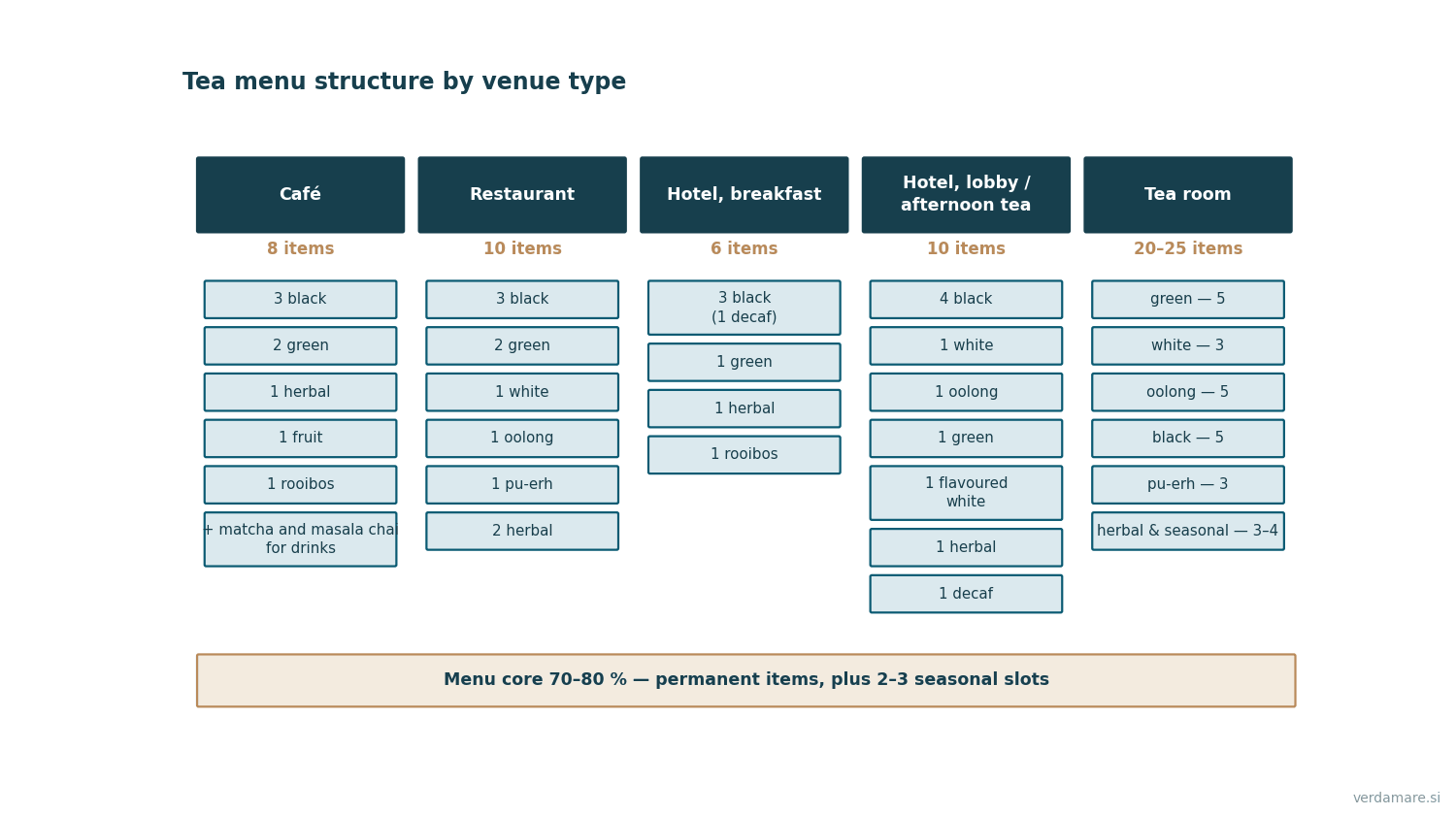
Café: 8 teas and two bases for drinks
A café needs a short, clear selection focused on speed and on drinks with milk.
| Item | Type | Price per 100 g |
|---|---|---|
| English Breakfast Broken | black | 5.94 € |
| Earl Grey | black with bergamot | 6.64 € |
| Assam BOP | black, strong, for milk | 6.32 € |
| China Sencha | green | 4.99 € |
| China Jasmine | green with jasmine | 7.59 € |
| Camomile Blossoms | herbal | 9.97 € |
| After Work | fruit, passion fruit and aronia | 8.38 € |
| Capetown | plain rooibos | 8.38 € |
In addition, two bases for drinks: Chai Black Tea (7.27 €) for chai lattes and China Ceremonial Matcha ORGANIC (12.26 €) for matcha lattes. In a café, tea is more often ordered by the cup than by the pot, so the basic format is 300–350 ml in a cup with an infuser insert, with a pot as an option.
Restaurant: 10 items, two of them "conversation pieces"
A restaurant menu has to cover the end of dinner and pairings with dessert, so it includes more pure teas and one or two items the server can tell a story about.
| Item | Type | Price per 100 g |
|---|---|---|
| Ceylon OP Nuwara Eliya | black | 7.59 € |
| Darjeeling TGFOP 1 Second Flush Margaret's Hope | black, second-flush Darjeeling | 10.92 € |
| Earl Grey Darjeeling | black with bergamot | 11.02 € |
| China Lung Ching | green | 17.43 € |
| China Jasmine High Grade ORGANIC | green with jasmine | 10.03 € |
| China Pai Mu Tan | white | 14.26 € |
| China Oolong Tie Guan Yin ORGANIC | oolong | 12.23 € |
| Pu Erh Special | pu-erh | 13.24 € |
| Melissa Lemon | herbal | 9.02 € |
| Mint Raspberry | herbal | 8.86 € |
Hotel: breakfast and lobby – two different menus
At breakfast, what matters is speed, familiarity and a decaf option. Six items are enough: English Breakfast leaf (5.62 €), Early Morning Tea (7.11 €), Earl Grey (6.64 €), the green China Chun Mee (5.62 €), Camomile Blossoms ORGANIC (7.06 €) and Ceylon OP decaffeinated (14.26 €). Breakfast tea is often brewed in batches into thermal dispensers; bear in mind that even in a thermal container black tea keeps changing and turns flat and astringent after 40–60 minutes, so batches should be small and the leaf removed immediately after brewing.
The lobby bar and afternoon tea are the hotel's showcase, and this is where premium items belong:
| Item | Type | Price per 100 g |
|---|---|---|
| Darjeeling FTGFOP 1 First Flush Singtom ORGANIC | black, first flush | 19.97 € |
| Assam FTGFOP 1 Mangalam | black | 14.89 € |
| Five O'Clock Tea | black blend | 6.64 € |
| Fleur Grey | black, flavored | 12.61 € |
| China White Peony Superior ORGANIC | white | 20.77 € |
| Elderflower Mint | white with elderflower and mint | 18.64 € |
| Milky Oolong | oolong | 10.13 € |
| China Jasmine special | green with jasmine | 10.92 € |
| Nice Dreams | herbal | 12.35 € |
| Earl Grey decaffeinated | black, caffeine-free | 15.85 € |
Tea room: 20–25 items by group
A tea room sells not a drink but time and knowledge, so the menu is grouped by type and origin, and within each group from light to full-bodied. An example of the backbone:
- Green: China Pi Lo Chun ORGANIC (16.64 €), China Lung Ching ORGANIC (21.56 €), China Gu Zhang Mao Jian (22.16 €), Anji Bai Cha 1st Grade ORGANIC (49.16 €), China Genmaicha ORGANIC (10.92 €).
- White: China Pai Mu Tan Special ORGANIC (19.66 €), Himalayan Snow Mountain ORGANIC (24.15 €).
- Oolong: China Oolong Shui Xian ORGANIC (14.89 €), China Oolong Muscatel Dragon ORGANIC (17.81 €), Halimun Jade Oolong ORGANIC (23.44 €), Deluxe Tie Guan Yin Premium ORGANIC (42.49 €), 1st Flush Jun Chiyabari ORGANIC (34.80 €), and as a collector's item, Japan Oolong ORGANIC (95.20 €).
- Black: China Keemun (6.64 €), Golden Yunnan GFOP ORGANIC (11.08 €), China Golden Needle ORGANIC (36.45 €), China Anji Black Baicha (41.15 €), Colombia Black Tea Leaf ORGANIC (32.64 €), Darjeeling FTGFOP1 Singell DJ3/2026 Airfreight BIO (31.44 €).
- Pu-erh: Pu Erh Mini Tuo Cha (7.06 €), Pu Erh Premium (19.91 €), Premium Pu Erh Menghai Five Years ORGANIC (38.04 €).
Expensive items are not a deterrent in a tea room: they are sold as a gaiwan session, where 5 g yields 4–6 infusions, and the price of a session is set differently from the price of a pot (see the calculation below).
How to write menu descriptions
A menu description has to answer the guest's three questions within 5 seconds: what is it, what does it taste like, and will it keep me awake. A formula that works: name – type and origin – 2–3 flavor words – caffeine note – serving format and volume – price. Anything beyond that, the server can explain in person.
Compare two versions for the same item. Poor: "China Pai Mu Tan – an exquisite white tea for true connoisseurs." Good: "China Pai Mu Tan – white tea from China, buds and the top two leaves. Honey, dried flowers, light sweetness. Moderate caffeine. 500 ml pot, 2 infusions." Two more examples using catalog items:
- "Capetown – rooibos from South Africa, no flavorings. Smooth, woody and honeyed, never bitter even with long steeping. Caffeine-free. 500 ml pot."
- "After Work – fruit blend: apple, pineapple, mango, papaya, lemongrass, aronia, cranberry. Sweet, tropical. Caffeine-free. 500 ml pot." Note: according to the ingredients on the product page, the pineapple, mango and papaya are sugared – if a guest asks about sugar, the server needs to know this.
A few practical rules. State the type of tea in words, not just the blend's brand name: "Angels Singing" tells the guest nothing, "green tea with fruity notes" does. Use symbols: caffeine-free, organic, goes well with milk. Under Regulation (EU) No 1169/2011, allergen information for food and drinks served in hospitality must be available to guests, so keep the ingredients of all blends in a folder at the bar: flavored blends may contain pieces of nuts, fruit, spices and sometimes dairy components – check the product page for each item. And do not turn the menu into a tasting sheet: guests do not read more than three flavor descriptors.
Brewing parameters by type
Every tea in the catalog has a recommended dose, temperature and time on its product page – that is the starting point for your recipe card. Below are general guidelines for "European-style" brewing in a pot and for a gaiwan.

| Type | Temperature | Time | Dose | Re-infusions |
|---|---|---|---|---|
| Green | 70–80 °C | 2–3 min | 12–15 g/L | 2–3, each 30–60 s longer |
| White | 80–85 °C | 2–4 min | 12–15 g/L | 2–3 |
| Oolong | 85–95 °C | 1–3 min | 10–12 g/L | 3–4 in a pot, 5–7 in a gaiwan |
| Black | 95–100 °C | 3–5 min | 12–15 g/L | usually none, 1 possible with whole-leaf tea |
| Pu-erh | 95–100 °C, rinse | 1–2 min | 12–15 g/L | 6–8 in a gaiwan |
| Herbs, fruit, rooibos | 100 °C | 5–12 min | 15–20 g/L | rooibos can take 1 |
In some cases the catalog pages give their own values, and these are worth taking into account: for China Sencha, 80 °C and 2–3 minutes; for China Pai Mu Tan, 80 °C and 2–3 minutes; for China Oolong, 80 °C and 1–3 minutes, with re-infusions possible; for Pu Erh Mini Tuo Cha, 100 °C, 1–2 minutes and a rinse; for After Work, 100 °C and 10–12 minutes; for Capetown, 100 °C and 5–8 minutes. Rolled oolongs such as Tie Guan Yin usually open up better in a gaiwan at 90–95 °C – try both options in a tasting and choose your own.
A separate note on herbal and fruit blends: they are brewed with boiling water only and are never cold-steeped in unboiled water. Plant material is not sterile, and boiling water is needed here not just for flavor but for safety. The good news is that they are almost impossible to over-steep: five extra minutes make a herbal infusion richer, not bitter.
Why grams, not spoons
The bulk density of tea varies by a factor of several: a teaspoon of broken-leaf tea weighs considerably more than a spoonful of rolled oolong, while white tea made from buds and leaves is so bulky that a "spoonful" gives half the dose. A measuring spoon turns your recipe card into a lottery. Scales with 0.1 g resolution solve the problem and pay for themselves quickly. Example: a bartender consistently puts 1 g more than the standard into a pot of white tea. At 14.26 € per 100 g, that is 0.14 € per pot; at 40 pots a day, 5.70 € a day, or about 171 € over 30 days. Not a disaster, but it is the price of a pack of premium tea every month, and the flavor drifts away from the standard as well.
Water: hardness, mineralization, filtration
An infusion is 98–99% water, so water determines the result as much as the leaf does. Four parameters matter for tea.
Hardness – the content of calcium and magnesium salts. It is expressed in mg/L CaCO₃, mmol/L or German degrees: 1 mmol/L = 100 mg/L CaCO₃ ≈ 5.6 °dH. Carbonate (temporary) hardness precipitates when heated: scale forms in the water heater, and in a cup of black tea an iridescent film of calcium carbonate and oxidized polyphenols appears. Hard water makes the infusion cloudy and dark and mutes the aroma, especially in green and white teas.
Total dissolved solids (TDS) – the total amount of dissolved substances, in mg/L. A range of roughly 50–150 mg/L works well for tea. For comparison, the SCA standard recommends about 150 mg/L for espresso, so if tea and coffee draw water from the same line, it is set closer to the lower half of the coffee range. Water that is too "empty" (after reverse osmosis without remineralization, TDS close to zero) produces a flat, slightly sour infusion and is aggressive towards the metal parts of equipment.
pH – around 7 as a guideline. Alkaline water makes black tea darker and duller; acidic water makes it lighter and sharper.
Chlorine and odors – removed by carbon filtration. Chlorine is immediately noticeable in a cup of green tea.
An important engineering detail: a handheld TDS meter measures electrical conductivity in µS/cm and converts it to mg/L using a factor (usually 0.5–0.7), so what it shows is an estimate. It also cannot tell which ions are in the water. After ion-exchange softening, calcium and magnesium are replaced by sodium: hardness drops but TDS barely changes – so check hardness separately, with a drop test or test strips.
A practical setup for the bar: a carbon filter plus softening or partial demineralization with a bypass to hit the target range; cartridges replaced according to their capacity in liters, not "whenever someone remembers". Your local water utility can provide data on tap water hardness, but measure the water yourself – it can change with the seasons. And never boil the same water repeatedly: reboiling drives off dissolved oxygen and concentrates the salts, and the infusion turns out flat.
Equipment at the bar
A tea station does not require expensive equipment, but it does require the right equipment.
A water heater with temperature control. The key tool. You need at least settings for 70, 80, 90 and 100 °C, or continuous adjustment with ±1–2 °C accuracy. Output is sized for peak demand. Heating 10 L of water per hour from 15 to 95 °C requires about 0.93 kW of net thermal output (10 kg × 4.186 kJ/(kg·K) × 80 K ÷ 3600 s), and 15 L per hour about 1.4 kW; allowing for losses and peaks, units of 3 kW and above with a storage tank make sense for a bar serving 50–60 pots an hour. It is best not to use hot water from the espresso machine's steam boiler for tea: it sits heated for a long time, comes out almost boiling and with steam, and is too hot for green and white tea.
If you do not yet have a temperature-controlled heater, mixing helps: to get 80 °C from boiling water and water at 20 °C, you need 3 parts boiling water to 1 part cold water (100 × 0.75 + 20 × 0.25 = 80). This is an emergency method, not a standard, but it is better than green tea made with boiling water.
Scales with 0.1 g resolution and a capacity of 500 g–2 kg – for dosing pots and for matcha.
Timers. A multi-channel kitchen timer or a timer for each pot. Tea that was forgotten for 4 minutes is the main reason for send-backs.
Teapots. For European-style brewing, porcelain or glass pots of 500 and 900 ml with a mesh infuser insert that lifts out together with the leaf. A French press works for black and herbal teas, but it has a catch: after the plunger is pressed, the leaf stays in contact with the infusion and extraction continues. So pour the infusion from a French press straight into a second pre-warmed pot, or serve it to the guest with a warning and a timer. A tea room needs gaiwans of 100–150 ml and fairness pitchers (chahai).
Other items: a probe thermometer for checks, separate measuring scoops for flavored teas, a whisk and bowl for matcha, strainers and a tray for spent leaves.
Serving ware – teapots, cups, milk jugs – is easy to choose in the Tableware section of the catalog, and Verdamare selects water heaters and designs barista workstations on a per-project basis.
Service: pre-warming and sequence
Pre-warming the ware is not a ritual but thermal engineering. A cold porcelain teapot takes heat from the water: if you pour 500 ml of water at 95 °C into a 500 g pot at 20 °C (the specific heat capacity of porcelain is about 0.85 kJ/(kg·K)), then, ignoring losses to the surroundings, the temperature evens out at about 82 °C. If you pour only 250 ml into a 400 g pot, the drop is even greater – to 76–77 °C. For black tea this means under-extraction and an empty taste; for green tea starting at 75 °C, it means water at around 60 °C and a "hay" flavor. Pre-warming with hot water for 20–30 seconds solves the problem.
Sequence for serving a pot: warm the pot and cup → pour out the water → weigh the leaf → add water at the right temperature → start the timer → at the signal, lift out the infuser with the leaf or decant the infusion → serve with a cup, saucer and, if the menu provides for it, a small jug of hot water for diluting. For teas with re-infusions, the leaf is not thrown away: the infuser with the leaf is served separately on a saucer, and the server tops up with water at the right temperature at the guest's request.
A gaiwan is served as a session: 4–6 g of oolong or pu-erh per 100–150 ml, first infusion 10–20 seconds (pu-erh is rinsed for 5–10 seconds beforehand), each subsequent one 5–10 seconds longer. The infusion is poured off completely into the fairness pitcher so the leaf does not "keep brewing". It is important that the server can show the guest how to hold a gaiwan without burning their fingers – or pours it themselves.
Cost per cup and per pot
Cost is calculated from the dose, and we take the dose from the catalog product pages. For black and green teas and oolongs, 12 g/L, i.e. 3 g per 250 ml cup and 6 g per 500 ml pot; for bulky white teas and pu-erh, 14 g/L (3.5 and 7 g); for herbs, fruit and rooibos, 16–18 g/L. The prices are the website's retail prices including VAT; for a VAT-registered business the actual cost will be lower by the amount of deductible input tax.
| Tea | Type | Price per 100 g | 250 ml cup | 500 ml pot |
|---|---|---|---|---|
| China Sencha | green | 4.99 € | 3 g – 0.15 € | 6 g – 0.30 € |
| English Breakfast Broken | black | 5.94 € | 3 g – 0.18 € | 6 g – 0.36 € |
| Earl Grey | black, flavored | 6.64 € | 3 g – 0.20 € | 6 g – 0.40 € |
| China Jasmine | green, flavored | 7.59 € | 3 g – 0.23 € | 6 g – 0.46 € |
| Pu Erh Mini Tuo Cha | pu-erh | 7.06 € | 3.5 g – 0.25 € | 7 g – 0.49 € |
| Capetown | rooibos | 8.38 € | 4 g – 0.34 € | 8 g – 0.67 € |
| China Oolong Tie Guan Yin ORGANIC | oolong | 12.23 € | 3 g – 0.37 € | 6 g – 0.73 € |
| After Work | fruit | 8.38 € | 4.5 g – 0.38 € | 9 g – 0.75 € |
| Camomile Blossoms | herbal | 9.97 € | 4 g – 0.40 € | 8 g – 0.80 € |
| China Pai Mu Tan | white | 14.26 € | 3.5 g – 0.50 € | 7 g – 1.00 € |
| Darjeeling FTGFOP 1 First Flush Singtom ORGANIC | black, first flush | 19.97 € | 3 g – 0.60 € | 6 g – 1.20 € |
Note the paradox: at a comparable price per 100 g, fruit and herbal blends cost more per cup than black tea, because their dose is one and a half times higher. Chamomile costs more per cup than Earl Grey – which is an argument against selling herbal teas for less than the classics, as is often done.

Full cost, food cost and price
The leaf is the main cost item, but not the only one. On top of it come losses (5% is a realistic estimate for a careful bar: test brews, spillage, stale leftovers at the bottom of packs), water and electricity (heating 0.5 L from 15 to 100 °C takes about 0.05 kWh, i.e. around 1 cent), and accompaniments: milk and sugar with black tea, lemon, biscuits. The accompaniments in the example below are indicative values; substitute your own purchase prices.
Food cost is calculated from the price excluding VAT. The example uses the standard rate of 22%; if your services are taxed differently, recalculate.
| 500 ml pot | Leaf incl. 5% losses | Water, energy, accompaniments | Full cost | Menu price | Price excl. VAT | Food cost | Gross margin |
|---|---|---|---|---|---|---|---|
| China Sencha | 0.32 € | 0.04 € | 0.35 € | 4.20 € | 3.44 € | 10% | 3.09 € |
| English Breakfast Broken | 0.38 € | 0.11 € | 0.49 € | 4.20 € | 3.44 € | 14% | 2.95 € |
| Earl Grey | 0.42 € | 0.11 € | 0.53 € | 4.20 € | 3.44 € | 15% | 2.91 € |
| China Jasmine | 0.48 € | 0.04 € | 0.52 € | 4.50 € | 3.69 € | 14% | 3.17 € |
| Capetown | 0.70 € | 0.06 € | 0.76 € | 4.50 € | 3.69 € | 21% | 2.93 € |
| Tie Guan Yin ORGANIC | 0.77 € | 0.04 € | 0.81 € | 5.50 € | 4.51 € | 18% | 3.70 € |
| China Pai Mu Tan | 1.05 € | 0.04 € | 1.09 € | 5.80 € | 4.75 € | 23% | 3.66 € |
| Darjeeling First Flush Singtom | 1.26 € | 0.06 € | 1.32 € | 6.50 € | 5.33 € | 25% | 4.01 € |
The main conclusion from the table: do not chase a single food cost percentage. If you priced the white tea and the first-flush Darjeeling at the same 10–14% food cost as the sencha, they would cost 9–11 € and stop selling. At a food cost of 23–25% they cost 5.80–6.50 € and still bring in more money per pot (3.66–4.01 € versus 2.91–3.09 €). Guests pay the margin in euros, not in percentages. The approach that works is a tiered markup: basic teas at a food cost of 10–15%, the mid-range at 15–20%, premium at 20–30%, and a few price tiers instead of ten different prices.
Re-infusions and session pricing
A re-infusion costs almost nothing – just water and energy, about 1 cent. So for green and white teas and oolongs, a free top-up of hot water is a cheap way to increase perceived value, not a loss. In a tea room the logic is different: the price is set per session. Example: a gaiwan of China Oolong Tie Guan Yin ORGANIC, 5 g of leaf – 0.61 € in cost; 5–6 infusions of 110 ml each give more than half a liter of tea for one or two guests. A session at 7.50 € gives a food cost of about 11% of the price excluding VAT at the 22% rate, while the guest spends an hour at the table and often orders sweets to go with the tea. For Deluxe Tie Guan Yin Premium ORGANIC (42.49 €), the same 5 g costs 2.12 €, and a session at 12–14 € stays within premium food cost.
Where the money really goes
Waste at a tea bar is rarely down to theft; more often it comes down to organization:
- opened packs of rarely ordered items that go stale before they are used up – solved by shortening the menu;
- over-steeped pots that are remade after a complaint – solved by timers;
- heaped-spoon dosing – solved by scales;
- "just in case" brewing into a large thermos at breakfast, half of which goes down the sink – solved by batches of 1–1.5 L.
Iced tea and tea-based drinks
In summer the tea menu earns its money on cold drinks, and their cost remains low.

Flash chilling (brewing over ice). The tea is brewed hot at double strength and immediately poured over ice, which chills and dilutes it at the same time. Example for 1 L of finished drink: steep 15 g of Cold Blueberry (10.92 € per 100 g) in 500 ml of boiling water for 4 minutes and strain over 500 g of ice. The aroma is preserved better than with slow cooling, and the tea does not turn cloudy. This method also works for herbal and fruit blends, because they are brewed with boiling water.
Cold brew. Pure tea (green, white, oolong, black) is covered with cold water at 10–12 g/L and left in the refrigerator for 8–12 hours. The result is smooth, slightly sweet, with almost no bitterness, and less caffeine is extracted. Herbal and fruit blends are not prepared this way – see above regarding boiling water.
Iced tea is a perishable product. Store it at no more than 5 °C in a closed container, label it with the time of preparation and use it within 24 hours.
Chai lattes and mixed drinks. Here the tea acts as a concentrate. Chai latte: steep 4 g of Chai Black Tea in 100 ml of boiling water for 4 minutes, strain and add 200 ml of steamed milk. Matcha latte: whisk 2 g of China Ceremonial Matcha ORGANIC in 50 ml of water at 80 °C and pour in 200 ml of milk. "London Fog": 4 g of Earl Grey in 120 ml of water, 150 ml of milk, 10 ml of vanilla syrup. Fruit mix: After Work, 20 g/L, 10–12 minutes in boiling water, then chilled; in a glass, 250 ml of the infusion, 50 ml of apple juice, orange slices and ice.
| Drink | Tea base | Other ingredients* | Cost | Menu price |
|---|---|---|---|---|
| Cold Blueberry iced tea, 400 ml | 3.75 g – 0.41 € | syrup 0.03 €, lemon 0.05 € | 0.49 € | 3.80 € |
| Cold brew China Sencha, 300 ml | 3 g – 0.15 € | mint or lemon 0.05 € | 0.20 € | 3.50 € |
| After Work fruit mix, 350 ml | 5 g – 0.42 € | juice 0.08 €, orange 0.07 € | 0.57 € | 4.20 € |
| Chai latte with Chai Black Tea, 300 ml | 4 g – 0.29 € | milk 200 ml 0.24 €, honey 0.05 € | 0.58 € | 4.20 € |
| Matcha latte, 250 ml | 2 g – 0.25 € | milk 200 ml 0.24 €, 0.03 € | 0.52 € | 4.50 € |
| "London Fog" with Earl Grey, 280 ml | 4 g – 0.27 € | milk 0.18 €, syrup 0.08 € | 0.53 € | 4.20 € |
*Milk is calculated at an indicative 1.20 € per liter, juice at 1.60 € per liter; substitute your own purchase prices.

For milk-based tea drinks, choose bases that milk does not "swallow": broken-leaf teas (Assam BOP, English Breakfast Broken), masala chai, Earl Grey. A delicate first-flush Darjeeling or a white tea in a latte is money down the drain: the milk completely masks its aroma. For sweet drinks use syrup rather than sugar – sugar does not dissolve in cold liquids.
Tea pairings with desserts and dishes
A pairing works when the intensity matches and there is one point of contrast. The tannins in black tea cut through fat, the roasted notes of oolongs support caramelization, the fresh bitterness of green tea balances sweetness, and earthy pu-erh stands up to fatty meat and aged cheese.
| Tea | Dish or dessert | Why it works |
|---|---|---|
| English Breakfast Broken, Assam FTGFOP 1 Mangalam | scones with cream, eggs Benedict, bacon | tannins and malt against fat and salt |
| Darjeeling First Flush | fruit tart, fresh goat's cheese | lightness and floral notes do not clash with acidity |
| Earl Grey, Fleur Grey | lemon tart, sponge cake, chocolate pralines | citrus supports citrus, bergamot sets off cocoa |
| China Lung Ching, China Sencha | steamed fish, asparagus, sushi | grassy notes echo green vegetables without overpowering the fish |
| China Jasmine High Grade ORGANIC | dim sum, white fish, panna cotta | floral aroma on a neutral base |
| China Oolong Tie Guan Yin ORGANIC | seafood, soft cheeses | creamy, floral texture |
| China Oolong Shui Xian ORGANIC | duck, grilled dishes, crème brûlée | roasted notes to match caramelization |
| China Pai Mu Tan | white peach, berries, almond biscuits | honey and delicacy, no competing with the dessert |
| Pu Erh Special, Premium Pu Erh Menghai Five Years ORGANIC | fatty meat, aged cheeses, dark chocolate | earthiness and smoothness after a heavy meal |
| Capetown | carrot cake, honey cake | honeyed, woody profile without caffeine – an evening pairing |
| Chai Black Tea | pumpkin pie, gingerbread | spice with spice |
Pairings sell better through the server than through the menu: one line on the dessert menu ("we recommend it with Pai Mu Tan") and one sentence at the table are enough.
Recipe cards and staff training
A recipe card makes the flavor independent of who is on shift. It should fit on one page and hang where the tea is brewed. Example:
| Field | Value |
|---|---|
| Item | China Pai Mu Tan, white tea |
| Catalog code | VD0011234 |
| Service | 500 ml pot with infuser, 200 ml cup, both pre-warmed |
| Dose | 7.0 g (scales, ±0.2 g) |
| Water | filtered, 80 °C |
| Time, 1st infusion | 2 min 30 s |
| 2nd infusion (on request) | 80 °C, 3 min 30 s |
| Cost | 1.00 € leaf, 1.09 € full |
| Menu price | 5.80 € |
| Guest description | "Honey, dried flowers, light sweetness. Moderate caffeine" |
| Pairings | white peach, panna cotta |
| Storage | opaque tin, opening date on the lid, separate from flavored teas |
| Common mistakes | boiling water → astringency; spoon instead of scales → under-dosing |
Training is built on tasting, not lectures. Three exercises teach more than any textbook. First: the same green tea brewed at 70, 80 and 95 °C – staff can taste for themselves where bitterness comes from. Second: the same black tea steeped for 3, 5 and 8 minutes. Third: the same tea brewed with filtered and unfiltered water. After that, for every item on the menu, each staff member should be able to name the type, three flavor words, whether it contains caffeine, and one dessert pairing. Introduce new items through a short tasting at the team briefing, and once a quarter run a "blind" check: a bartender brews a tea according to the card, and a senior colleague tastes it and compares it with the standard.
Typical problems and their causes:
| Symptom | Cause | Fix |
|---|---|---|
| Green tea is bitter | water too hot or over-steeped | heater set to 75–80 °C, timer |
| Black tea tastes "empty" | cold pot, too little leaf | pre-warming, scales |
| Film on the surface | hard water | softening, filter checks |
| Aroma "drifts" from week to week | pack left open next to the coffee grinder | airtight tin, opening date |
| Guest complains the pot turns bitter after 10 minutes | leaf not removed | infuser insert, fairness pitcher |
Storing tea at the venue
Tea's worst enemies are oxygen, moisture, light, heat and foreign odors. Hence a few simple rules for the bar area. Keep a working stock for one to two weeks at the bar in opaque airtight tins; the main stock belongs in a cool, dry room, not above the espresso machine or next to the dishwasher, which give off heat and steam. Each tin should carry the name, opening date and item code. Use tea on a "first opened, first used" basis. Store flavored blends on a separate shelf: aroma passes even through paper packaging. No spices, coffee or citrus nearby.
Once opened, keep matcha tightly closed in a cool place; if it is stored in the refrigerator, let the tin come up to room temperature before opening, otherwise moisture will condense on the powder. A separate problem is the "spoon from tin to tin": each tea must have its own scoop, otherwise you end up with Sencha with a hint of bergamot.
Seasonal menu rotation
The core of the menu, 70–80%, stays the same: guests come back for "their" tea. The remaining 2–3 items are seasonal slots that give you a reason for a new menu description, a post and a conversation with the guest.

Winter. Advent (7.84 €) – according to its product page, this is a classic fully oxidized black tea with no flavorings, so it suits guests who do not like sweet festive blends. For those who love spice: Christmas Tea (7.59 €), Christmas Candle (11.65 €), Chris-Mas (12.51 €), Gingerbread (8.38 €), the pu-erh Pu Erh Christmas Tea (13.24 €) and the white Christmas Tea ORGANIC (9.43 €). A non-alcoholic alternative to mulled wine is the fruit blend Caribbean Magic Mulled Wine (8.80 €), served hot with orange.
Spring. The time of first flushes: Darjeeling FTGFOP 1 First Flush Singell ORGANIC (26.64 €), Darjeeling FTGFOP1 Singell DJ3/2026 Airfreight BIO (31.44 €), Darjeeling FTGFOP1 Snowview DJ3/2026 Airfreight BIO (25.09 €), 1st Flush Jun Chiyabari ORGANIC (34.80 €). They are sold as "this year's tea" – as a limited line on the menu, with the server telling the story.
Summer. Cold items: Cold Blueberry (10.92 €), Caipirinha (9.49 €), Moscow Mule ORGANIC (10.61 €), Bamboo - Peach - Wild Strawberry (8.38 €), plus cold brew made with China Sencha and white tea.
Autumn. Autumn Dream (6.64 €), Autumn Feelings ORGANIC (7.91 €), Baked Apple (7.59 €), Apple Crumble (7.84 €), the rooibos Autumn Breeze (8.22 €) and chai lattes made with masala chai.
Plan the rotation in advance: introduce a seasonal item through a staff tasting two weeks before launch, and at the end of the season look at the sales – the best seasonal item sometimes earns a place on the permanent menu.
Where to start
Take your current menu and the number of tea orders per day, choose a format from this article and cut the list down to the items that will actually sell. Then order one pack of each finalist, hold a tasting with your team using your own water and record the parameters in recipe cards – after that, the menu is printed once and lasts a long time. The Verdamare team can help you select teas from the catalog for your menu, calculate costs based on your volumes and advise on tableware and equipment for your tea station while the menu is still on paper.
Latest articles
 Table Setting for Hotel Breakfast: Guest Place, Service and Table ResettingThe guest table at hotel breakfast: what is set in advance, what the server brings, how to reset a table quickly and how many pieces you need for a room…Read more →
 Pu-erh in hospitality: sheng and shu, brewing, cost per cup and working with the Alveus rangeWe follow pu-erh from Yunnan raw leaf to the cup in a hotel room: sheng and shu production, two brewing methods, rinsing, teaware and the exact cost per serving based…Read more →
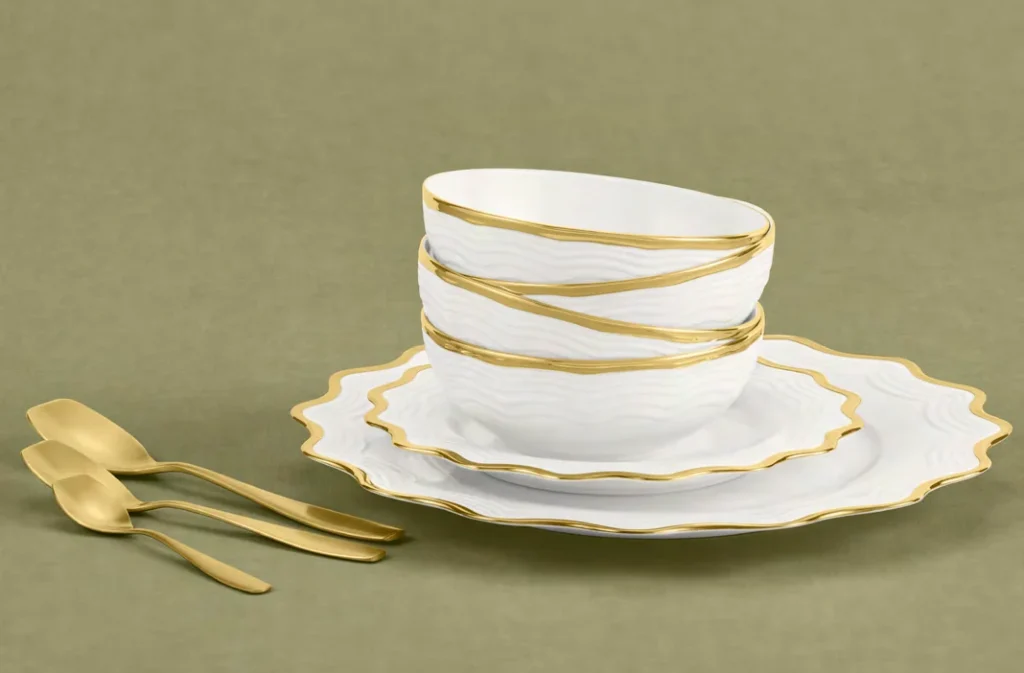 Porcel Porcelain for Restaurants and Hotels: How It Is Made, Why It Lasts and How to Choose a SeriesHow Porcel hard-paste porcelain is produced, what the collection ratings mean and how to put together a set for a restaurant or banquet hall from the HoReCa Collections catalogue.Read more →